

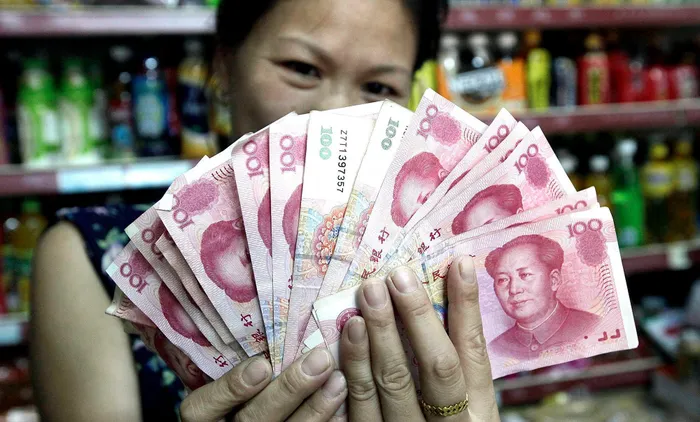
A bank that can hold RMB assets and liabilities has more ways to manage risk during global liquidity shocks, says the author.
Image: File.
Nomvula Zeldah Mabuza
On December 9. 2025, Standard Bank of South Africa became the first African bank to connect directly into China’s Cross-Border Interbank Payment System (CIPS). The ceremony photos and flags made for a compelling headline, but the real significance lies in the plumbing behind Africa’s largest trade relationship. The cameras captured the moment. The spreadsheets will capture the impact.
This is not ideology. It is arithmetic.
China has been Africa’s biggest bilateral trading partner for 15 consecutive years. In 2024, two-way trade approached $300 billion. South Africa alone traded more than $54 billion’ worth of goods with China in 2023 to 2024, yet roughly 60% of that was settled in US dollars through correspondent banks in London or New York.
Every one of those dollar legs carried an implicit cost of 1 to 3% plus settlement delays of one to three days. Across South Africa’s trade with China, this translates into $650 to $950 million a year in avoidable friction.
The inefficiency was not a flaw in the system. It was the system.
For decades, African corporates have worked within this architecture because there was no alternative. A South African importer would convert rand into dollars, route those dollars through offshore correspondent banks, and then have the receiving bank convert the dollars into renminbi. Every step added cost, delay and uncertainty. The complexity was tolerated as a cost of doing business.
Standard Bank’s direct participation in CIPS changes that reality. A payment that previously passed through several intermediaries can now move directly between Johannesburg and Shanghai through a single RMB settlement rail. The bank has already indicated that RMB settlements can be 30 to 70% cheaper than legacy routes and significantly faster. For a continent constrained by slow logistics and tight working-capital cycles, hours matter. Even a single day saved transforms competitiveness.
But the shift is not only operational. The deeper consequences emerge quietly, shaping the market before they reshape policy.
When African corporates begin paying Chinese suppliers directly in RMB, and when exporters receive RMB proceeds without forced conversion, onshore RMB balances will accumulate naturally. Standard Bank has already seeded liquidity, but trade will deepen it far more. Johannesburg could see five to ten billion RMB circulating within two years, providing African banks with new hedging tools, better pricing power and reduced currency mismatch. This is how a local RMB ecosystem is born.
Invoicing behaviour will follow. Today, only a small share of South Africa’s China trade is invoiced in RMB, largely due to the difficulty of settling it. Once settlement becomes simple and transparent, RMB invoicing becomes logical rather than ideological. Other emerging markets have already experienced this: Brazil and Russia now settle up to a third of their China trade in RMB after smoothing their payment rails. A shift from 7% to even 25% in South Africa would quietly reduce billions of dollars in annual FX demand. This is not de-dollarisation. It is cost optimisation.
The third consequence is balance-sheet resilience. A bank that can hold RMB assets and liabilities has more ways to manage risk during global liquidity shocks. Each Federal Reserve tightening cycle has historically squeezed Africa hardest because the continent relies heavily on offshore dollar liquidity. RMB deposits from trade flows provide banks with an alternative funding base and corporates with new pricing options for trade finance. Optionality becomes resilience.
Yet the significance of this moment goes beyond economics. It challenges the reflexive narrative that every shift in the global payments landscape is geopolitical theatre. The dollar remains dominant. The RMB remains modest in its global footprint. Standard Bank’s move is not ideological repositioning. It is simply the erosion of a forced monopoly. When treasurers finally have a choice, they choose the route that is cheaper, faster and more predictable.
CIPS itself is not a rival to SWIFT. It is a settlement infrastructure for RMB, growing from a regional experiment into a global network with more than a hundred direct participants and thousands of indirect institutions.
Afreximbank joined earlier in the year. Standard Bank’s step is a continuation of a practical evolution. Africa’s largest bank is aligning its pipes with the actual direction of Africa’s trade flows.
This shift also arrives at a moment when the global payments system is fragmenting into multiple rails. SWIFT, CIPS, India’s expanding UPI corridors, Europe’s instant-payment platforms and Africa’s own Pan-African Payment and Settlement System (PAPSS) are evolving in parallel. PAPSS already promises to save billions by routing intra-African payments in local currencies rather than through dollars in offshore accounts. When PAPSS and CIPS eventually speak to one another, the effect could be transformative. An RMB payment entering Africa through CIPS could convert seamlessly into a Ghanaian cedi or Kenyan shilling via PAPSS, reducing both settlement time and dollar dependence for SMEs.
This is the quiet architecture of financial resilience. Africa has long been exposed to risks triggered beyond its control, whether through de-risking by correspondent banks, sanctions spillovers or shifts in global regulatory sentiment. A diversified payment ecosystem cannot eliminate these risks, but it reduces their systemic impact.
It gives treasurers more than one door to walk through. It gives banks alternative liquidity routes. It gives policymakers room to manoeuvre.
The next 36 months will make this visible.
Payment revolutions rarely announce themselves. They unfold quietly in treasury offices, inside procurement decisions and across working-capital cycles. They reveal themselves not through speeches, but through narrower spreads, shorter delays and fewer unexplained bank charges. Eventually the old architecture becomes too expensive to justify.
Standard Bank did not make a geopolitical statement. It made a margin statement. Every basis point saved and every day of float removed compounds across an economy stretched by high borrowing costs and structural inefficiencies. The cameras have moved on from the signing ceremony. The spreadsheets have not.
And it is in those quiet cells of reduced cost and released liquidity that Africa’s financial sovereignty is beginning to take shape. Not as rhetoric. As arithmetic.

Nomvula Zeldah Mabuza is a Risk Governance and Compliance Specialist.
Image: Supplied
Nomvula Zeldah Mabuza is a Risk Governance and Compliance Specialist with extensive experience in strategic risk and industrial operations. She holds a Diploma in Business Management (Accounting) from Brunel University, UK, and is an MBA candidate at Henley Business School, South Africa.
*** The views expressed here do not necessarily represent those of Independent Media or IOL.
BUSINESS REPORT