

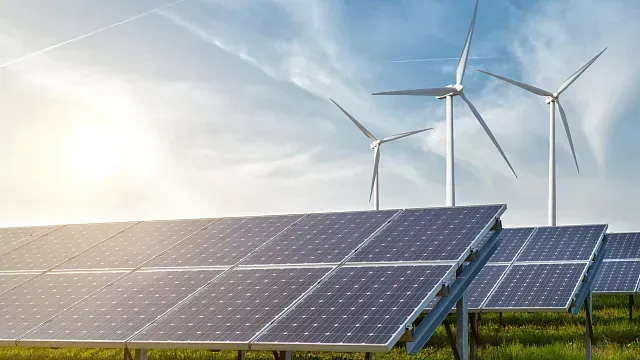
The country’s renewable energy sector is no longer a fledgling experiment, it is a maturing industry, meeting on Arab green hydrogen strategy and renewable energy cooperation, says the author.
Image: File
The global energy narrative has become increasingly complex. Shifting geopolitical alliances, economic pressures, and evolving social priorities have blurred the lines of cooperation that once defined the climate agenda. Yet, despite these global shifts, South Africa’s green energy transition continues to move forward with remarkable clarity and purpose.
The country’s renewable energy sector is no longer a fledgling experiment, it is a maturing industry, marked by innovation, resilience, and a growing appetite for clean power. South Africa’s energy landscape has evolved significantly over the past decade. What began with government-led procurement programmes has now expanded into a vibrant market driven by private sector investment and commercial demand.
The success of early initiatives laid the groundwork, but today’s momentum is being sustained by a new generation of developers, financiers, and energy users who are reimagining what is possible. Even in the face of grid constraints and regulatory delays, the sector is not slowing down. Instead, it is adapting, innovating, and accelerating.
One of the most profound shifts in the market is the move away from isolated, one-off projects toward scalable platforms. This evolution reflects a deeper maturity in the sector. Developers are no longer focused solely on building individual assets; they are aggregating portfolios, creating operational efficiencies, and unlocking economies of scale. These platforms are not just more bankable; they are more strategic.
They allow for long-term planning, better risk management, and the ability to replicate success across regions and technologies. This shift is enabling a new kind of partnership between developers and financiers, one that is built on shared vision and sustained collaboration.
Financing models have also undergone a transformation. Traditional project finance structures, while foundational, are no longer sufficient to meet the complexity and scale of modern renewable energy transactions. New instruments are being introduced to unlock capital, mitigate risk, and enhance liquidity. Payment guarantee facilities, for example, are helping to free up equity and strengthen the financial viability of projects.
The rise of private off-take models is itself a significant development. Businesses across sectors, from mining and manufacturing to real estate, are actively seeking clean energy solutions to decarbonise operations, hedge against rising energy costs, and meet sustainability commitments. These new models reflect a growing recognition that energy is also a source of competitive advantage.
Geography is playing an increasingly strategic role in South Africa’s energy transition. Regions like the Free State and Mpumalanga are emerging as renewable energy hubs, not only because of their solar and wind resources, but because of their proximity to grid infrastructure, industrial demand, and skilled labour.
In the Free State, utility-scale solar projects are being wheeled through off-takers in urban centres and industrial zones. This wheeling model allows clean energy to reach areas of high demand, even when generation is located remotely. Mpumalanga, long associated with coal, is now at the heart of the Just Energy Transition. Here, the repurposing of grid capacity and retraining of local labour are unlocking new opportunities in wind and solar development.
These projects are not only delivering clean energy, they are creating jobs, building skills, and empowering communities. They are helping to ensure that the transition is inclusive, that it delivers tangible benefits to local economies, and that it strengthens resilience in areas most affected by the shift away from fossil fuels. The emergence of energy traders and market makers is another important development.
Companies are reshaping how energy is bought, sold, and distributed, introducing new models of exchange that enable greater flexibility and responsiveness. These players are helping to match supply with demand, facilitate wheeling arrangements, and create new pathways for energy access. Their role is particularly important in where decentralised generation is becoming more prevalent.
This decentralisation is part of a broader trend toward the liberalisation of energy, where multiple actors contribute to a more resilient and responsive system. As South Africa’s renewable energy sector continues to evolve, it is clear that the future will be shaped by integration, innovation, and inclusion. Hybrid solutions that pair generation with storage are becoming more common, enabling load-shifting and grid optimisation.
Digital technologies are enhancing forecasting, monitoring, and control, improving efficiency and reliability. Cross-sector collaboration is driving integrated solutions, bringing together energy providers, industrial users, municipalities, and financiers to address shared challenges.
Regulatory reform remains essential, and continued policy evolution will be key to unlocking investment and streamlining development. Climate resilience is also becoming a central consideration. Projects are increasingly being designed with adaptation in mind, ensuring that infrastructure can withstand the impacts of a changing climate.
South Africa’s energy transition is not a linear journey. It is a dynamic process shaped by innovation, collaboration, and strategic vision. While global uncertainties may shift priorities, the momentum in SouthAfrica is unmistakable. The sector is moving forward, not just with ambition, but with action. The investments being made today are laying the foundation for a more sustainable, equitable, and prosperous energy future. They are creating new markets, empowering communities, and redefining what is possible.

Vincenzia Leitich, Executive Vice President, Energy and Infrastructure, Standard Bank.
Image: File
Vincenzia Leitich, Executive Vice President, Energy and Infrastructure, Standard Bank.
*** The views expressed here do not necessarily represent those of Independent Media or IOL.
BUSINESS REPORT