

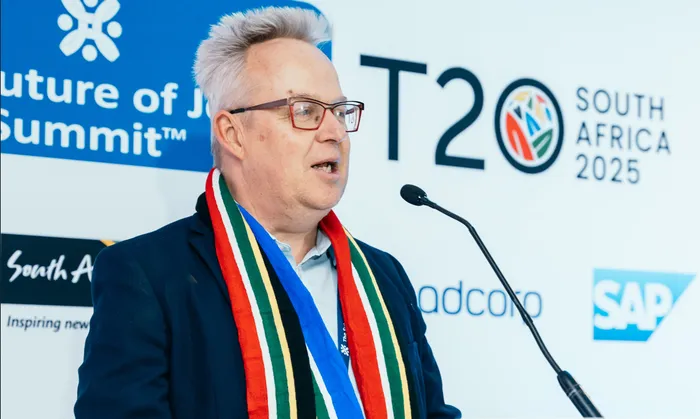
Dr Nik Eberl is the Founder & Executive Chair: The Future of Jobs Summit™ (Official T20 Side Event) .He will be writing a regular column in Business Report.
Image: Supplied
South Africa’s business confidence has reached a level not seen in more than a decade. According to the South African Chamber of Commerce and Industry (SACCI), the Business Confidence Index rose to 132.3 in November — its highest reading since 2011.
That is not a trivial milestone. Confidence indices are notoriously hard to move, particularly in economies that have endured prolonged periods of policy uncertainty, infrastructure constraints, and uneven growth. Yet here we are.
Tourism was a key driver. The so-called “G20 effect” is real. International visitors arrived in force, hotels filled up, airports functioned, service levels improved, and sentiment followed. For a brief but powerful moment, South Africa reminded itself — and the world — that it can host, deliver, and impress at scale.
But the real story is broader than tourism. Building confidence is at a 10-year high. Vehicle dealer confidence is at levels last seen in 2021. Retail and wholesale confidence are both climbing. Even consumer confidence, long mired in negative territory, has edged upward from -13 to -9.
Every major confidence indicator is pointing in the same direction at the same time. That rarely happens. When it does, it deserves attention — not celebration, but scrutiny.
Having coached and advised leaders through economic cycles across five continents, I have learned one thing with certainty: confidence is fuel. But fuel without an engine simply evaporates. And that is precisely the risk we face right now.
Sacci itself offered a sobering caution alongside the headline number: “It is essential that real economic activity matches up with financial expediency for business confidence to steady up and be sustainable.”
In plain terms, feeling good about the economy is not the same as building it. South Africa’s underlying growth numbers remain modest. GDP growth slowed to 0.5% in the third quarter. National Treasury forecasts just 1.2% growth for 2025. Structural constraints — energy reliability, logistics bottlenecks, skills mismatches, and policy execution gaps — have not magically disappeared.
This is why the current moment should be understood not as a turnaround, but as an inflection point. Confidence has lifted ahead of performance. That can be a gift or a trap. A gift, if it catalyses investment, hiring, and expansion. A trap, if it leads to complacency and a false sense of arrival.
Which brings us to the real question facing South Africa’s corporate leaders. Right now, boardrooms across the country are reviewing capital expenditure plans and finalising budgets for 2026. Many executives will look at the confidence data and feel reassured that their cautious stance has been justified. Others will look at the same data and see a signal to act.
There is a profound difference between optimism and investment. Between sentiment and commitment. Between believing in South Africa and betting on it. The G20 demonstrated that the country can coordinate complex systems when the stakes are high. Tourism data showed that global demand exists when the product and experience are right. The confidence indices confirm that momentum is building across sectors.
But momentum without deployment is just a good mood. History is instructive here. Economies do not grow because confidence improves; confidence improves because growth is anticipated — and that anticipation only becomes reality when capital moves. Investment decisions made during moments of tentative optimism often generate outsized returns, not just for shareholders, but for employment, supply chains, and long-term competitiveness.
This is particularly true in emerging markets, where private sector capital frequently moves ahead of the state, not behind it. South Africa does not need blind optimism. It needs deliberate, disciplined courage. Investment that is targeted, patient, and aligned with national priorities: infrastructure, skills development, industrial capacity, technology adoption, and export competitiveness.
The question, then, is not whether the data looks good. It does. The question is whether leaders are willing to convert that data into decisions. Confidence is a signal. Capital is a statement. Signals tell us what might happen. Statements shape what actually does.
At moments like this, leadership matters less in speeches and more in spreadsheets. Less in commentary and more in commitments. Less in waiting for certainty and more in creating it.
Fourteen years from now, we will look back at this period. The question will not be whether business leaders felt confident in late 2024. The data already answers that. The real question will be whether we acted like we did.
South Africa has been given a window — not a guarantee, not a bailout, not a miracle — but a window. The world is watching. The indices are pointing upward. The mood has shifted. Now capital must decide whether it will follow.
Dr Nik Eberl is the Founder & Executive Chair: The Future of Jobs Summit™ (Official T20 Side Event). He is Author: Nation of Champions: How South Africa won the World Cup of Destination Branding
*** The views expressed here do not necessarily represent those of Independent Media or IOL.
BUSINESS REPORT