

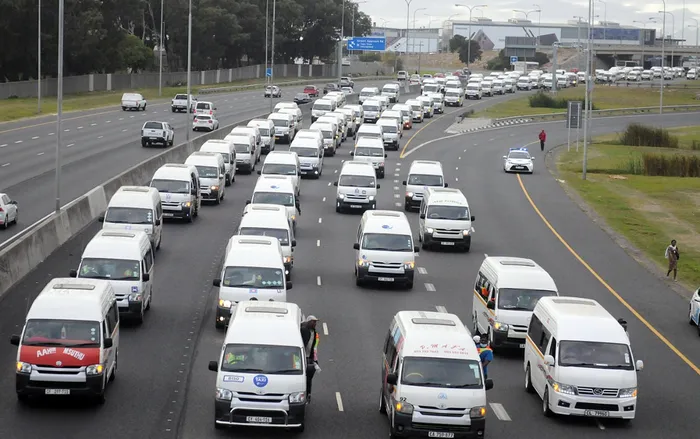
Millions of South Africans, workers, students, and small business owners, pay the price daily in longer commutes, higher costs, and personal insecurity.
Image: Ayanda Ndamane / Independent Newspapers
The country stands at a defining moment in its transportation story. The chaos playing out on our roads, rails, and ranks is not simply about vehicles, it’s about livelihoods, urban survival, and dignity in movement.
From violent clashes between minibus taxi operators and e-hailing drivers, to the vandalism and collapse of passenger rail, and the financial decline of bus services, our public transport system is fraying at the seams.
Millions of South Africans, workers, students, and small business owners, pay the price daily in longer commutes, higher costs, and personal insecurity.
Yet amid this crisis, there is a clear pathway forward. Around the world, nations facing similar challenges have turned to technology and inclusive innovation to transform their transport systems. South Africa can do the same, if we embrace digital tools not as threats to traditional livelihoods, but as bridges to shared prosperity.
South Africa’s passenger transport ecosystem is defined by fragmentation.
These crises are not isolated, they reinforce one another. Without rail, commuters turn to taxis. When taxis clash with e-hailing platforms, urban mobility becomes unsafe. When buses fail to compete, public confidence in all formal transport erodes.
It’s a vicious cycle that technology, if deployed inclusively, could help break.
Across the globe, countries have faced, and fixed, versions of South Africa’s transport challenges. Their lessons offer practical blueprints for local adaptation.
Bogotá’s TransMilenio Bus Rapid Transit (BRT) model turned conflict into collaboration by integrating informal minibus operators into a modern digital system. They became shareholders, received training support, and adopted smart-card ticketing and GPS monitoring. A key lesson for our market here is that inclusion beats confrontation. Empowering taxi associations as co-owners of digital systems can reduce violence and preserve livelihoods.
Kenya’s matatu industry faced chaos similar to ours until mobile-based innovations introduced cashless payments, GPS tracking, and safety ratings. Platforms like Little Cab formalised informal routes without displacing drivers. The lesson here is that technology can legitimise, not replace, informal transport, creating win-win outcomes.
If South Africa is to reverse its current decline, we need homegrown, technology-enabled systems that build trust, efficiency, and inclusion.
Create a unified app ecosystem where both minibus taxis and e-hailing services coexist, offering:
This model could bring traditional operators into the digital economy, while offering passengers choice, safety, and accountability.
Deploy IoT sensors, AI surveillance, drones, and blockchain asset management to prevent theft, predict failures, and ensure transparency.
A “community guardian” app could reward citizens for reporting vandalism, turning passengers into protectors.
Data-Driven Bus Modernisation
Use real-time demand data for dynamic route optimisation, integrate cashless payments, and link bus, rail, and taxi services through a mobility-as-a-service (MaaS) platform.
Cross-Cutting Innovation
A National Integrated Transport Platform could integrate all modes of transport, allowing:
Building Consensus, Not Conflict
Technology alone won’t solve South Africa’s transport crisis, it must be paired with inclusive policy and governance.
South Africa’s transport challenges are as much social as they are structural. But technology, if implemented collaboratively, can be the bridge between informal and formal, traditional and modern, exclusion and inclusion.
The global evidence is clear:Transformation succeeds where stakeholders are engaged, data drives decisions, and digital tools are designed for people, not against them.
As we reflect this Transport Month, we must move beyond crisis management toward co-created digital reform.
The future of South African mobility depends on our ability to harness innovation not just to move people, but to move society forward.
Lungi Sangqu, Renowned CIO and CEO of Africa Digital Success.

Lungi Sangqu, Renowned CIO and CEO of Africa Digital Success.
Image: Supplied.
BUSINESS REPORT