

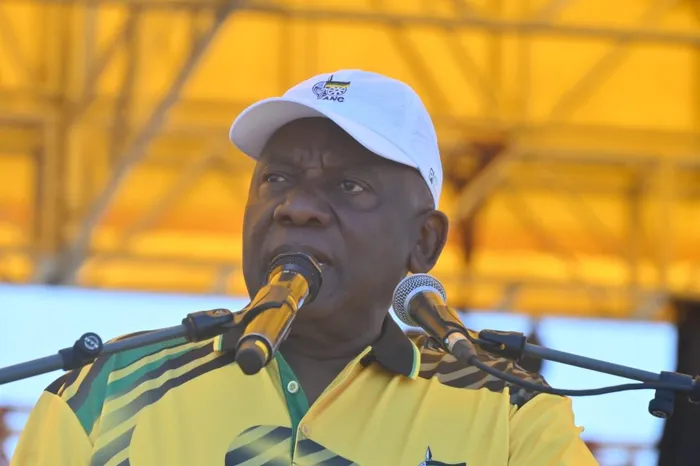
ANC president Cyril Ramaphosa.
Image: Ayanda Ndamane/ Independent Newspapers
President Cyril Ramaphosa presented the African National Congress’ January 8th Anniversary statement at Moruleng Stadium on 10 January.
The January 8th Statement provides a frank assessment of the many painful challenges we face, in particular the poor and the working class, and most critically it outlines critical areas of intervention for government to prioritise over 2026.
Whilst we face many dire socio-economic problems as a nation, we must always prioritise our staggering 42.4% unemployment and the 1% economic growth rate underpinning it. Fix these and many other issues will address themselves.
The January 8th Statement provides six focal points, namely fixing local government, stimulating inclusive economic growth and job creation, winning the war against crime and corruption, building a South Africa that belongs to all its people, renewing the ANC itself, and contributing towards a better Africa and world.
The economic commitments contain several important objectives, including a social compact between government, business and labour to speed up inclusive economic growth and job creation. Further priorities include supporting local businesses and locally produced goods and interventions to reindustrialise the economy. A welcome commitment to review and strength the SETAs can boost the skills of our workers. Emphasis was placed upon accelerating support for export industries, opening up new markets and rolling out of the African Continental Free Trade Area.
There are areas needing to be fleshed out. Reference is made to the important work done through the Presidential and Public Employment Programmes but none with regards to addressing their skills training and work conditions challenges or the need to drastically expand them to give a chance for the 12 million unemployed to earn a wage and gather skills, experience and confidence needed to enter the labour market.
The massive progress at Eskom must be applauded and the call to end loadshedding and ensure all consumers move to prepaid billing is fundamental. The need to provide short-term relief for industries struggling to cope with the high price of electricity needs to be expedited.
If our industrial sectors are to be revived, then we need to have a mass industrial financing programme mobilising much greater levels and access to capital from the fiscus, the developmental finance institutions, banks and investment funds. This necessitates providing the necessary incentives to unlock such investment, including reviewing Regulation 28, and far greater coordination between the state and key economic sectors. This must include the SMMEs and export sectors.
The Public Procurement Act’s Regulations and its roll out need to be finalised as a key tool to tackle state capture and corruption and support locally produced goods and South African companies.
The focus on winning the war against crime and corruption and the honest acknowledgment of the impact it is having on the lives of the working class and society are welcome. Particular emphasis on dealing with gangs, gender-based violence, rural and farm safety and cross-border crime are critical.
Whilst much detail must still be provided by government later, the war against crime and corruption will only succeed if the state shows the necessary political will and provides law enforcement and the judiciary with the tools they need, in particular skilled personnel, forensics and intelligence, working vehicles and communications capacity.
If we want to attract the investment needed to reach the 3% economic necessary to reduce unemployment, then fighting crime has to be elevated to the same national priority level as COVID-19 was.
Part of this war is at a public relations level where society needs to see senior politicians, business executives and other high-profile persons hauled before modern day Nuremberg trials and sent to the gulags.
The January 8th statement provides useful detail on priority areas for local government to focus on, in particular fixing the billing systems to ensure they collect the revenue necessary to fund municipal services, investing over R56 billion in water infrastructure, cleaning up our cities and towns, fixing potholes and street lights, investing in electricity and ensuring that indigent households receive their free basic services.
We must be deeply worried about the state of local government. A decade ago 10% of municipalities were in financial distress, today its over 70%. Previously municipal service collapse was confined to small rural municipalities. Today we see the rot in our cities. A dozen municipalities routinely fail to pay their workers with many more in arrears to their pension and medical aid funds plus their tax obligations.
Urgent interventions are needed with existing ones ramped up. This needs to include a new funding model and enabling Eskom, Sanral and the Department of Water and Sanitation to intervene and build capacity where needed.
Political accountability is fundamental. Mayors, Councillors and Municipal Managers who fail to fulfill their constitutional, legal and fiduciary duties must be fired and made a public example of. Molly cuddling financial delinquents is a recipe for disaster, something we cannot afford.
The ANC has done well to stare down the worst political vandals and to peg its flag firmly on the path of renewal. Whilst this must be applauded, given the number of public representatives (across all political parties) continuously caught with their grubby little hands on public funds and other forms of crass behaviour, much more must be done, including lifestyle audits conducted by SA Revenue Service (Sars) or the Special Investigating Unit.
There are many progressive commitments in the January 8th statement and if achieved would firmly set South Africa on the path of inclusive economic growth and a better life for all.
What is needed now is to ensure that these are fleshed out in the coming State of the Nation Address and the 2026 Budget.
There needs to be a firm sense of accountability and consequences for those who fail to deliver.
2025 has seen important green shoots from ending loadshedding to turning Transnet, Metro Rail and Sars around. 2026 needs to see the public and municipal services fixed, economic growth reaching 2% plus and unemployment falling below 40%, and real success in our war on crime and corruption.

Solly Phetoe is the general secretary of Cosatu.
Image: Doctor Ngcobo / Independent Newspapers.
Cosatu General Secretary Solly Phetoe
** The views expressed here do not necessarily represent those of Independent Media or IOL.
BUSINESS REPORT