

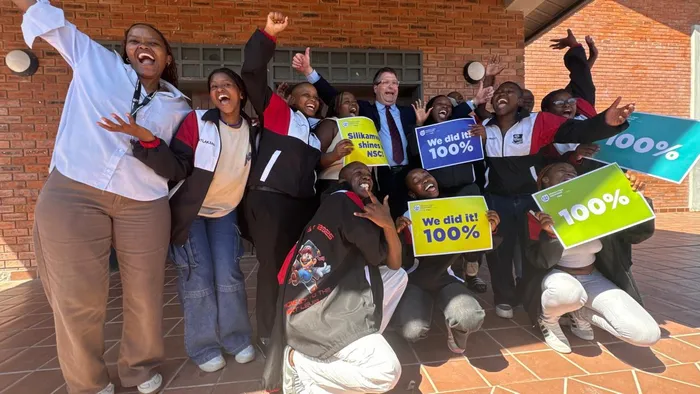
Silikamva High School’s matric class of 2025. Lehohla argues we must have a deeper look at the matric pass rate figures.
Image: Murray Swart / Cape Argus
The Lehohla Ledger a construction out of more than 3 000 weekly columns that focused on evidence to analyse and understand South Africa and the world has culminated into a ledger that invokes the heart – Mohlomi’s philosophy a veritable lens for interrogating the South Africa I know the home I understand. We turn the Lehohla Ledger on the 2025 matric results as an entry point.
Every January, South Africa engages in a familiar national ritual. We gather around television screens and newspaper supplements to witness the announcement of the National Senior Certificate (NSC) results. The Minister of Basic Education stands before the nation to announce a "pass rate"— a single percentage that is treated as the ultimate barometer of our progress. But as someone who has spent a lifetime interrogating the "Numerical Conscience" of this country, I must warn you: these percentages are a mirage. They mask a deepening crisis in the development of our productive forces and a betrayal of the mission of the 1994 generation.
To understand the peril, we must move beyond the "thumb-sucking" euphoria of a 80% or 85% pass rate. We must apply the lens of the Lehohla Ledger (LL) — a system that bridges the gap between the "Historic Truth" of our census data and the "current reality" of our economy. When we look at the matric results through this lens, the picture changes from a celebration of success to a diagnosis of a "Wicked Problem."
The Throughput Tragedy
The first deception is the denominator. We celebrate the success of those who sat for the exam, but we ignore the "lost generation" that never made it to the starting line. My analysis of the cohort that began Grade 1 12 years ago reveals a devastating "throughput" reality. Of the approximately 1.2 million children who enter our school system every year, only about half reach matric.
This is the "Shosholoza" path reversed. In the first 15 years of our democracy, we saw a gather in pace, but in the past 15, we have entered a state of "Gwara-Gwara"—disorder and decay. When half of your potential productive force is "weeded out" before they even reach the final assessment, you are not running a successful education system; you are managing a massive wastage of human capital.
The Quality Gap and the "Skills Trap"
Even for those who pass, the "Numerical Conscience" reveals a disturbing racialised and structural schism. We must ask the question: "Pass for what?"
Our data shows that while the aggregate pass rate may rise, the proportion of Black and Coloured youth who achieve a "Bachelor's Pass"—the gateway to higher education—remains stubbornly low compared to their White and Indian counterparts. As I noted in my recent comparative analysis between South Africa and Bolivia, while Whites and Indians show a steady increase in completing degrees, Black Africans and Coloureds are trapped in a "Low Voltage Skill Trap."
In 1975, for every Black African completing a degree, there were 1.2 Whites. By 2016, that ratio had deteriorated to one Black African for every six Whites. The matric results of 2025/2026 continue to reinforce this "neo-colonial" order. We are producing a surplus of matriculants who have "passed," but who possess neither the technical skills for the 21st-century economy nor the means to acquire them.
The Failure of Design Thinking
Why does this happen? It is a failure of Design Thinking and Systems Design. We have treated education as an isolated silo rather than the "ethical leaven" of our society. We ignore the structural barriers that the "Hadi Waseluhlangeni" (the Harp of the Nation) warned us about.
The Lehohla Ledger has integrated philosophy of Mohlomi with evidence and created longitudinal interrogative systems. Drilling deep into the bowels of evidence from Statistics South Africa Lehohla Ledger shows that "education" is ranked 15th in the priorities of many South Africans, behind water, electricity, and crime. This is not because our people do not value learning, but because the "material benefits" of education have become invisible. When 66% of youth poverty is driven by a lack of education and unemployment, the "matric certificate" starts to look less like a ladder and more like a participation trophy.
Furthermore, we have ignored the destruction of the family unit. With only 31% of mothers testifying to being married, and a "schizophrenic" gap in parental reporting, the support system required to turn a child into a "Master Weaver" of their own future has been systematically undermined by apartheid spatial design and our failure to densify and integrate our cities.
The Path to a "Second Liberation"
In his recent Maseru lecture, former president Thabo Mbeki called for a "Second Liberation"—a move from a "feeder relationship" with the developed world to a state of sovereign prosperity. This must start with our education system.
We must move away from the neoliberal "cookbook" that treats education as a compliance exercise. We need a "Sovereign Sprint" for our youth. This requires:
Conclusion: Beyond the Mirage
The matric results are a "videography" of our nation's health. If we continue to indulge in the "self-adulating perception" of high pass rates while ignoring the "Gwara-Gwara" reality of our skills trap, we are betraying the next generation.
We must "tell no lies and claim no easy victories." The first liberation gave us the right to a desk; the second liberation must give us the right to a future. We must use the "Technical Hammer" of evidence to forge a system where every child who enters Grade 1 has a statistically guaranteed path to becoming a productive, dignified, and sovereign citizen of the African Renaissance
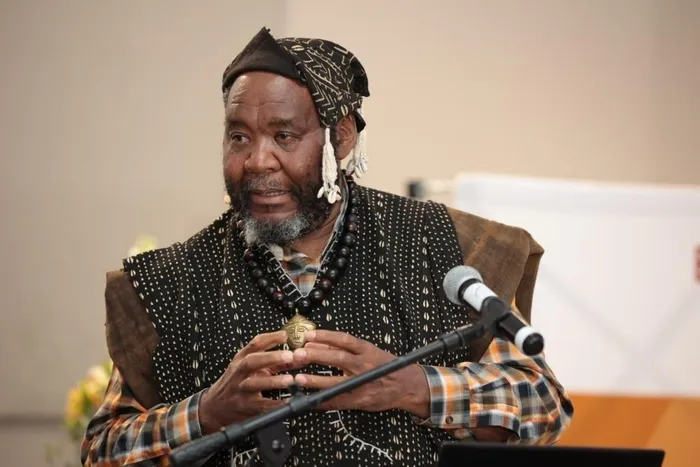
Dr Pali Lehohla is a Professor of Practice at the University of Johannesburg, among other hats.
Image: Supplied
Dr Pali Lehohla is a Professor of Practice at the University of Johannesburg, a Research Associate at Oxford University, a board member of Institute for Economic Justice at Wits and a distinguished Alumni of the University of Ghana. He is the former Statistician-General of South Africa.
*** The views expressed here do not necessarily represent those of Independent Media or IOL.
BUSINESS REPORT