

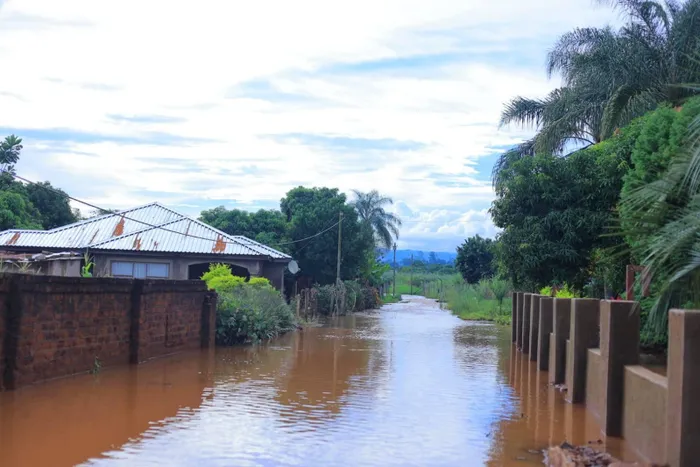
Devastating scenes in Limpopo after heavy rains led to widespread flooding, impacting communities and infrastructure.
Image: Office of the Premier: Limpopo Provincial Government/ Facebook
South Africa is once again experiencing the devastating human and economic consequences of extreme weather. Communities in many parts of the country, particularly in Mpumalanga and Limpopo are facing severe flooding, as repeated climate shocks reshape where people can live, how goods move across the country, and how public finances are stretched.
These events are more than a humanitarian crisis. They are also a systemic regional and national economic shock. Tourism in and around Kruger National Park has been affected as roads and access routes are damaged, reopening of schools has been disrupted, intensifying social impacts on households and learners. Agricultural production in affected districts has suffered losses to crops, livestock, and irrigation infrastructure, with implications for food security and rural livelihoods. These effects extend far beyond emergency services. They influence economic growth, employment prospects and investor confidence.
These events must be understood in the context of a broader changing climate. South Africa is experiencing more frequent and severe extreme weather events. Flooding is no longer an occasional anomaly but an increasingly a structural feature of our climate reality. This has direct implications for infrastructure planning, insurance markets, fiscal stability and development prospects.
As a national advisory body tasked with helping South Africa anticipate climate risks and strengthen long-term resilience, the Presidential Climate Commission (PCC) believes this moment calls for holist assessment and decisive forward-looking action.
The PCC recognises the declaration of a national disaster, the bold and quick response offers hope to all those affected and should be an instrument to support the efforts of emergency services, volunteers and first responders working under difficult conditions to protect lives and provide relief.
These actions are necessary and important in enabling the mobilisation of response mechanisms and coordination across spheres of government. Yet the growing scale, frequency and disruption caused by flooding demand more than emergency response alone. They require recognition of how climate change is no longer a distant environmental concern. It is now a central risk to South Africa’s development, economy and social stability.
Lessons from the last five years – A call for increased investments
Experience shows that response capacity alone is not enough. PCC research following the KwaZulu-Natal floods found that chronic under-resourcing of local government, fragmented coordination across spheres of government, underinvestment in prevention and preparedness, weak enforcement of land-use controls, settlement in high-risk areas, under-maintained stormwater systems, amongst other drivers significantly worsen disaster impacts. Municipal disaster management units are often understaffed and overstretched, making coordination difficult at precisely the moment when rapid action is most critical
South Africa must, therefore, respond to climate disasters with far greater agility. Disaster funding must be fast and flexible, ensuring that relief reaches communities quickly without undermining basic service delivery. Emergency allocations should not come at the expense of essential municipal functions. Past experience shows clearly that failing to invest in prevention and climate-resilient infrastructure is far more costly than rebuilding after destruction. Without reform, the country risks repeating the same cycle of loss and reconstruction.
Government coordination must also improve so that fiscal systems treat climate disasters as predictable risks rather than unexpected shocks. Climate impacts are no longer rare events. They are recurring pressures on public resources that must be planned for systematically.
The PCC, therefore, calls on business leaders, development partners, non-governmental organisations, donors and volunteer networks to work alongside the government. South Africa faces a substantial adaptation financing gap and remains overly reliant on emergency disaster relief. Stronger partnerships between the public, private and social sectors are essential to expanding resources for resilience-building, preparedness and recovery, particularly in vulnerable communities.
We need new solutions for a recurring problem
Drawing on its sectoral studies and adaptation readiness work, the PCC reiterates key recommendations to reduce the severity of future flood impacts, through:
Key Findings from our sector studies on (1) water, (2) agriculture, and (3) the built environment, demonstrate that climate-resilient development requires predictable, well-targeted financing that prioritises vulnerable communities and addresses systemic risk drivers, rather than reactive responses.
The PCC reiterates that the Climate Change Response Fund, currently at conceptual development can serves as a mechanism to support resilience-building efforts that are aligned with long-term adaptation objectives.
South Africa must, therefore, move decisively from reactive disaster management to proactive climate risk governance. This requires increased municipal disaster capacity, climate-proofed infrastructure, stricter land-use planning enforcement, and fully integrated early warning systems. Most importantly, it requires scaled and predictable investment in resilience, not only emergency relief. Systematic resilience financing is essential to safeguard communities, infrastructure and economic stability.

Dorah Modise, Executive Director of the Presidential Climate Commission.
Image: Supplied
Dorah Modise is Executive Director of the Presidential Climate Commission
*** The views expressed here do not necessarily represent those of Independent Media or IOL.
BUSINESS REPORT