

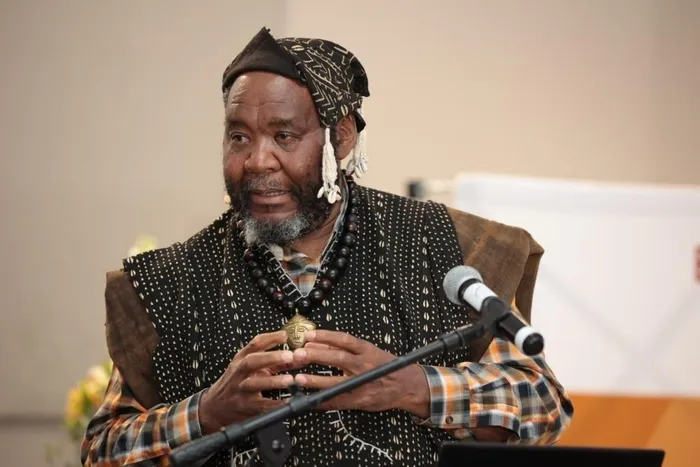
Dr Pali Lehohla is a Professor of Practice at the University of Johannesburg, among other hats.
Image: Supplied
A life uninspected is not worth living says Plato. Over a period of 24 years and counting, I have been a columnist in the Business Report, writing two articles a week interrogating South Africa through a lens of numbers. The interrogative narrative is undergirded by a trove of evidence. This has created a Lehohla Ledger of 2 745 instruments.
The Lehohla Ledger with its Ten Commandments that consist of Digital Codes of one-one (11), two-two (22), three-three (33), four-four (44), five-five (55), six-six (66), seven-seven (77), eight-eight (88), nine-nine (99) and zero-zero (00) is the Numerical Conscience through which the totality of South African life and life elsewhere will be inspected, the nation is inspired, the nation reclaims its freedom and in the final analysis life is worth living.
The Lehohla Ledger has 2745 instruments that are anchored on these Ten Commandments. This array of numbers represents the Numerical Truth and the Pulse of the nation. In this first column where I unleash the Lehohla Ledger into 2025 National Senior Certificate results in Gauteng staggering paradoxes that defines the current state of the Republic are microscopically analysed at the Ward Level (4 500), but the logic of the Lehohla Ledger riches at microscopic geographic entities of less than 200 dwellings. So what sayest Gauteng?
While Gauteng celebrates a robust provincial average of 89.06%, the Lehohla Ledger—our forensic audit of 2 745 evidence-based instruments—flashes a crimson warning over the Gauteng East District. Here, in the shadow of industrial giants, lies a "Cognitive Divide" that threatens the very fabric of our sovereign future.
The paradox is this: the East Rand (Ekurhuleni) is the cradle of the "Wisemen from the East"—a triad of academic and industrial titans who lead our most prestigious foundries. Yet, in the townships of Tsakane, KwaThema, and Nigel, the Class of 2025 has been subjected to a "Systemic Collapse" that no provincial average can mask.
The Wisemen and the Foundry
To understand the height of our potential, we must look at the Trinity. Professor Zeblon Vilakazi, the nuclear physicist at the helm of Wits; Professor Bonang Mohale, the guardian of ethical capital; and Professor Maurice Radebe, the architect of energy governance. All three are sons of the East. They emerged from Katlehong and the surrounding townships to claim the highest echelons of Commandment 55 (STEM Justice) and Commandment 88 (Wealth-Lock).
Their ascension proves that the East Rand is fertile ground. However, the Ledger reveals that the "Pipe" that produced these Wisemen is now leaking at an unsustainable rate. While Vilakazi leads a global top-tier university, Zikhethele Secondary School in Nigel—barely 30 kilometers from the industrial heartland—recorded a dismal 60.7% pass rate. This is not just a statistical outlier; it is a "Venting Artery" of human potential with a miserly 15% Bachelor’s Entry.
The Correlates of Deprivation
In the Lehohla Ledger, multidimensional poverty is the "Albatross" that weighs down the 2025 exam papers. The correlates of failure at Zikhethele and its neighbors are not found in a lack of learner ambition, but in the environment.
The Ledger identifies three specific "Vents":
The DDM: From Meetings to Mandates
The District Development Model (DDM) was intended to be the "One Plan" to fix these silos. But in Ekurhuleni, as everywhere else, the DDM is currently a victim of the "Silo Albatross." To bridge the divide between the Wisemen and the Wastelands, the DDM must transition from coordination to Sovereign Enforcement. For such to happen you need true tools and less hot air.
We propose three Ledger-led interventions:
Conclusion: The Choice for 2026
The paradox of the East is a mirror for the Republic. We have the Wisemen—the Radebes, the Mohales, the Vilakazis—who prove what is possible. But we also have the "Lost Weavers" of Zikhethele, who show us what happens when multidimensional poverty is allowed to act as a silent thief.
The Ledger classify the 60.7% pass rate at Zikhethele as a "Systemic Collapse," especially when the "Bachelor Yield" is below 15%. This leads to the Youth Unemployment Vortex. We cannot celebrate an 89% average while the foundry is crumbling.
The DDM has the blueprint, and the Lehohla Ledger has the instruments. The Renaissance of the Republic begins when the most vulnerable ward in Tsakane achieves the same "Numerical Truth" as the wealthiest suburb in Sandton. We must stop chasing children out of school to solve municipal problems and start building an Architecture of Excellence. The Wisemen have shown us the way out of the East; it is time to make sure the road is open for every child in Nigel after all the sage of Ngoliloe Morena Mohlomi four the foremost architect of governance nearly four centuries ago says “A responsible leader guarantees intergenerational value through integrated reporting” – These are two nutrients that South Africa does not possess despite the oft hallucinated about District Development Model. Without a Numerical Truth based Blockchain Ledger – the DDM becomes a sewer pipe.
Dr Pali Lehohla is the former Statistician-General of South Africa, a Professor of Practice at the University of Johannesburg, a Research Associate at Oxford University, and a distinguished Alumni of the University of Ghana. He is the former Statistician-General of South Africa.
*** The views expressed here do not necessarily represent those of Independent Media or IOL.
BUSINESS REPORT