

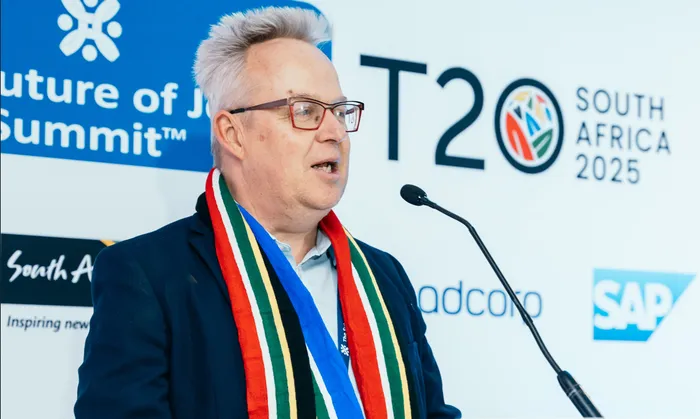
Dr Nik Eberl is the Founder & Executive Chair: The Future of Jobs Summit™ (Official T20 Side Event).
Image: Supplied
Something fundamental has shifted in how the world sees South Africa in 2026. It did not happen because all our problems disappeared, nor because a single policy suddenly fixed decades of structural challenges. It happened because momentum — economic, cultural and psychological — finally began moving in the same direction. And when momentum turns, perception follows fast.
One of the most unlikely catalysts for this shift did not come from government, business or a glossy tourism campaign. It came from an American YouTuber. IShowSpeed landed in South Africa. He ate kota. He lost his mind over KFC. He sprinted alongside a cheetah. He barked at sharks. Millions watched him get overwhelmed by township energy in real time — unfiltered, unscripted and deeply human.
And something shifted. Not because South Africa suddenly changed, but because the world finally saw what had long been missing from the picture.
The two-extremes problem
Having coached leaders across five continents, I have watched South Africa get packaged for global consumption in painfully narrow ways. We are either a postcard: Table Mountain at golden hour, wine farms, safaris, sunsets. Or we are a warning label: crime statistics, corruption headlines, load shedding, poverty. Beauty or breakdown. Paradise or peril.
What consistently gets left out is the middle — the rhythm of everyday life. The warmth. The humour. The chaotic normality. The moments between the extremes that define this country. For decades, our story has been told about us, rarely with us, and hardly ever by us. That absence has consequences. When a country is reduced to extremes, it becomes easy to misunderstand, oversimplify and misjudge.
A narrative disruption
IShowSpeed’s livestreams were not polished tourism reels. There were no scripts, no edits, no carefully framed messaging. They were raw, messy and real. That is precisely why they worked. Millions of viewers — many encountering South Africa meaningfully for the first time — saw the country as it breathes. Chaotic streets. Excited kids. Spontaneous dancing. Laughter that needed no translation.
They did not see a concept. They saw a place. A people. A culture that refuses to be boxed into neat categories. This was not reputation management. It was narrative disruption. And it forced a reconsideration of assumptions that had gone largely unchallenged for years.
The confidence multiplier
This cultural moment coincides with a deeper economic reality that global markets have already begun to recognise. Discovery CEO Adrian Gore captured this dynamic succinctly: “Confidence is the multiplier. It creates a self-fulfilling cycle. It’s the quickest way to stimulate an economy without expending significant resources.”
Confidence does not politely follow data. It amplifies it. And right now, the data is unambiguous. The rand has posted its strongest sustained run in nearly 20 years. South Africa has secured a sovereign credit rating upgrade, exited the FATF grey list, seen debt-to-GDP peak, eased electricity constraints and begun restoring logistics capacity. Capital is flowing back into local bonds and property. Foreign investors are reallocating — not sentimentally, but rationally. Global markets are forward-looking. They price direction, not perfection. And they are signalling that South Africa’s trajectory has changed.
A power shift in storytelling
Young South Africans instinctively understand something many institutions are still catching up to. Culture travels faster than policy. A phone and a data connection can rival a broadcast studio. Visibility precedes legitimacy. Being seen — truly seen — is a form of power. Stories no longer need permission. They simply need someone bold enough to capture them.
For decades, global storytelling power sat with legacy media and foreign correspondents. Their reporting was not always wrong, but it was often incomplete — stripped of cultural nuance and lived experience. That era is ending.
Narrative power has decentralised. It has moved from studios to streets, from press releases to lived moments. And South Africa, with all its contradictions and creativity, is uniquely positioned to benefit — if it chooses to.
Representation and reality
A viral clip cannot fix inequality. A YouTube livestream cannot replace policy. Representation is not a substitute for reform. But representation and reality are not opposites. They are intertwined.
The danger is not that the world sees South Africans laughing. The danger is that it only ever sees us suffering. When viewers watched kids confidently approach a global star, heard local slang without subtitles, saw spontaneous joy erupt in township streets, they were forced to reconsider what they thought they knew.
That is the quiet undoing of assumptions. And assumptions shape how risk is priced, how opportunity is assessed, and how a country is engaged. In an era where perception influences everything from tourism to trade to talent flows, this shift is not trivial. It is strategic.
A leadership moment
This is not merely a cultural moment or a macroeconomic moment. It is a leadership moment. What expansion are you delaying because you are still waiting for “certainty”? What hiring decisions are frozen because yesterday’s headlines still dominate your thinking? What investments remain on hold because confidence feels unfamiliar after a decade of defence?
The data has shifted. The economists are aligned. The world is leaning in. In confidence cycles, the leaders who act first do not merely benefit from momentum — they become part of it. South Africa in 2026 remains complex, contested and imperfect. But it is also investable, credible and increasingly compelling. The world is already looking differently. The only remaining question is whether South African leaders are ready to act like they have noticed.
Dr Nik Eberl is the founder and executive chair: The Future of Jobs Summit™ (Official T20 Side Event). He is also the author of Nation of Champions: How South Africa won the World Cup of Destination Branding.
*** The views expressed here do not necessarily represent those of Independent Media or IOL.
BUSINESS REPORT