

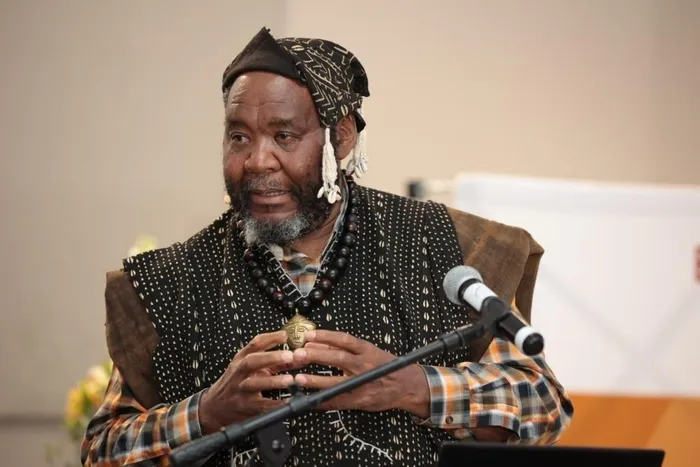
Dr Pali Lehohla is a Professor of Practice at the University of Johannesburg, among other hats.
Image: Supplied
This year South Africa experienced and celebrated the 114 years of Africa’s oldest liberation movement in Pella ea Matlhako, the birthplace and eternal resting place of the ANC Isithalandwe, Moses Kotane.
Pella has a special place in my heart, because it was one of the villages I paid attention to through the successive censuses I had the privilege of holding in this our beautiful South Africa. It was the village I drove past in my maiden entry into Bophuthatswana on the 1st of October 1983. Dusty, hot and bushy with no life in sight, anxiety kept leaping in all my faculties as I had an unknown destiny and destination. Not until the sign Tampostadt appeared.
At 114, the liberation movement would be a deservingly proud institution given the pedigree of the leadership that directed the Mangaung 1912 vision. Former president Mbeki discusses the century long cross sectional African leadership at his delivery of the Inaugural Memorial Lecture of King Moshoeshoe the II held on the 14 of January this year in Lesotho. Here is the Lehohla Ledger that Moses Kotane reads in January 2026. The verdict of the Lehohla Ledger through the lens of the eminent leadership Mbeki spoke of, however, leaves me with a deadly anxiety for Pella. Here is why.
In the quiet corridors of the National Planning Commission, success is often measured in aggregate percentages and national averages. But for those of us who dwell in the "placename," the truth is found in the geometry of the ground. As we count down the final six years to 2030, the National Development Plan (NDP) is not merely failing on its promises; it is failing because it has allowed failure to cluster.
To demystify this "Quiet Crisis," the Lehohla Ledger has undertaken a forensic spatial audit of Pella ea Matlhako (Tampostadt) and its ten distinct nodes: Kgosing, Monneng, Tshwaedi, Ledig, Ramasoko, Rasetlang, Motlhabeng, Ramolokwane, Ramomene, Maphusumaneng, Lengeneng, Lekubung and Bashabaerata. By applying an asernal of tools amongst them, the Moran’s I statistic, we are not just observing poverty; we are measuring its spatial contagion.
The Math of Neglect
The Moran’s I is a powerful instrument of statistical finality. It measures whether a variable—such as unemployment or service delivery failure—is spatially random or if it clusters.
When we apply this to the data across Pella, we do not find the random, diverse development that a successful NDP would produce. Instead, we find a high positive Moran’s I, (I right-facing arrow +1). This is the mathematical signature of a structural geographic trap. This Moran’s I Scatterplot for the "Pella 13" is the definitive statistical verdict on the failure of the National Development Plan (NDP) at the placename level and the scatterplot says it all.
Forensic Analysis of the "Pella 13" Mesh
The clustering of Lekubung, Lengeneng, Maphusumaneng, Ramomene, and Motlhabeng in the top-right quadrant represents the epicenter of the NDP’s failure.
Kgosing (the traditional seat) and Bashabaerata (the heritage anchor) sit near the center-right. They represent the "suspended abode." While their deficits are slightly lower than the water-stressed nodes, their spatial lag remains high. The Mohlomi Lens would argue this is the "Ethical Void"—the historical soul of Pella is being pulled down by the surrounding structural decay.
Ledig is the only node that sits significantly lower in the "Low-Low" quadrant. Being on the fringe of the mining activity, it shows a lower relative deficit, yet its position on the regression line proves it is still part of the same dysfunctional system. It is the Extraction Point that fuels the "National Treasury" while the rest of the 13 placenames remain in a state of forensic suspension.
Looking through the lens of responsible leadership, Isithalanwe Moses Kotane has placed the Lehohla lens before us and seeks a verdict of Pella ea Matlhako.
The Lehohla Ledger Verdict for Redress
This scatter plot demystifies the NDP’s failure by proving that the state’s "average-based" planning is mathematically blind to the Spatial Trap of Pella.
In the Lehohla Ledger, a "Leader" is not just a historical figure, but a lens of finality. By applying these lenses to the thirteen placenames of Pella, we can see exactly where the governing instinct has failed to "settle" the democratic project.
Dr Pali Lehohla is a Professor of Practice at the University of Johannesburg, a Research Associate at Oxford University, a board member of Institute for Economic Justice at Wits and a distinguished Alumni of the University of Ghana. He is the former Statistician-General of South Africa.
*** The views expressed here do not necessarily represent those of Independent Media or IOL.
BUSINESS REPORT