

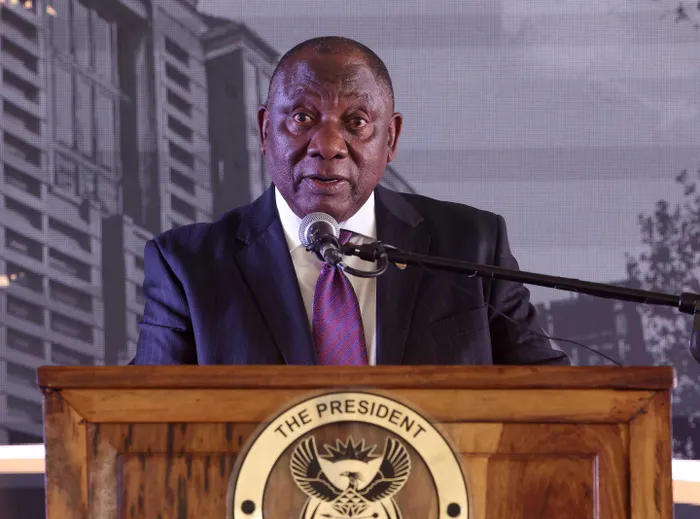
President Cyril Ramaphosa will deliver the State of the Nation Address (Sona) to Parliament on 12 February.
Image: Jairus Mmutle/GCIS
President Cyril Ramaphosa will deliver the State of the Nation Address (Sona) to Parliament on 12 February. There’s a natural tendency in life, in particular in government, to treat such events as business-as-usual occasions. This would be a strategic mistake.
Society, and in particular the working class, are exhausted by weak economic growth, high levels of unemployment, entrenched poverty and inequality, and endemic crime and corruption. Sona needs not focus on a laundry list of nice to haves but rather the key high impact interventions that will rapidly spur economic growth reaching the 3% growth needed to slash our untenable unemployment rate of 42.4%.
It is easy to get distracted by the daily headlines. Yet there are real green shoots being put in place. We must applaud the tireless efforts of the workers of Eskom and municipalities, and the African National Congress led government which have seen the dark chapter of loadshedding end, giving relief to the economy.
Engagements on a 12-month relief package for struggling industries unable to sustain operations due to the increasingly unaffordable price of electricity must be expedited. Plans need to be finalised on a more affordable electricity tariff regime beyond that if the economy is to grow and jobs are to be saved. This must include plugging Eskom’s many financial holes and moving all consumers to prepaid billing, enabling Eskom to enter the renewable energy space and fast tracking the rollout of the 14 000 kms of new transmission lines.
Welcome progress has been made to rebuilding Transnet and Metro Rail, which were heading towards the precipice not long ago. Whilst applauding this, more must be done to return them to full capacity. An efficient Transnet unlocks thousands of mining, manufacturing and agricultural jobs and generates badly needed taxes for public services. A safe and reliable Metro Rail provides 10 million workers and urban commuters a fast and cheap means to get to work and their destinations in the cities. More support is needed to reduce Transnet’s debt burden, boost infrastructure investments and ensure the safety of commuters and freight.
More must be done to turnaround other embattled State-Owned Enterprises, in particular Denel, the South African Broadcasting Corporation, the Post Office and Postbank. The remarkable resuscitation of the South African Airways has proven that our SOEs can indeed be fixed and once again play their role in unlocking economic growth.
The South African Revenue Service (SARS)’ impressive turnaround has shown that with competent management, filling frontline vacancies and recruiting skilled staff, removing corrupt and criminal elements, and investing in the institution’s capacity; that not only will it deliver upon its constitutional and developmental mandates but also generate the economic growth necessary to fund public services.
This approach must be adopted for public services across the state. Reckless austerity budget cuts and a naïve belief that neo-liberal policies will deliver results have proven a fallacy. Fixing and investing in public services from our schools to universities, from police stations to the National Defence Force, from hospitals to clinics; is key to economic growth.
There can be no sugarcoating our unacceptably high levels of crime and corruption. They have made the lives of the working class, especially women, a living nightmare where rampant and often violent crime has been normalised. It has robbed the state of scarce resources needed to uplift the poor, stimulate growth and create jobs.
A bold and decisive Marshall Plan led by President Ramaphosa is needed to win this existential war against crime and corruption. We must lead with the same determination and focus, the mobilisation of resources and society, and action consequences for those who break the law. The South African Police Service, the National Prosecuting Authority and the Judiciary must be given the leadership and resources needed to win this war and be held accountable where they fail. This is how we collectively defeated Covid-19 and the only way we can again defeat the pandemic of crime threatening the nation.
The state of local government is extremely worrying and similarly requires decisive action, including the removal of incompetent and corrupt Councillors and managers and the deployment of Treasury, Eskom, Sanral and the Department of Water and Sanitation to ensure that basic services are delivered and the capacity of municipalities rebuild. This is not a matter that can be left to PowerPoints presentations.
Whilst the obstacles to growing the economy and creating decent jobs are being removed, we must ramp up efforts to stimulate economic growth. This must include finalising the roll out of the new mining rights application system to revive this strategic industrial backbone of the economy and a bold stimulus package coordinated between the Fiscus, the Developmental Financial Institutions and private banks and investments funds. Finance must be geared towards the industrial and export sectors, SMMEs and localisation.
Relief must be put in place for struggling workers, businesses and sectors, through tax rebates and by fixing the Unemployment Insurance Fund’s Temporary Employment Relief Scheme. The SRD Grant needs to be raised to the Food Poverty Line and the Presidential Employment Stimulus expanded to 1 million participants by April and 2 million by November 2026.
The government must work with social partners to overhaul the UIF and the Compensation of Occupational Injuries and Diseases Funds and ensure that the CCMA is properly resourced as these institutions play a key role in protecting vulnerable workers.
SA Revenue Service must be provided with the resources and support it requires to raise tax compliance from 67% to 75% by 2029, thus generating R200 billion in owed taxes to the state enabling it to reduce the debt burden whilst providing the public and municipal services that the working class and the economy depend upon.
President Ramaphosa must seize the moment of Sona to give hope to workers and society that things are and will get better. This is not a moment for business as usual but rather the occasion for decisive leadership to get South Africa working.
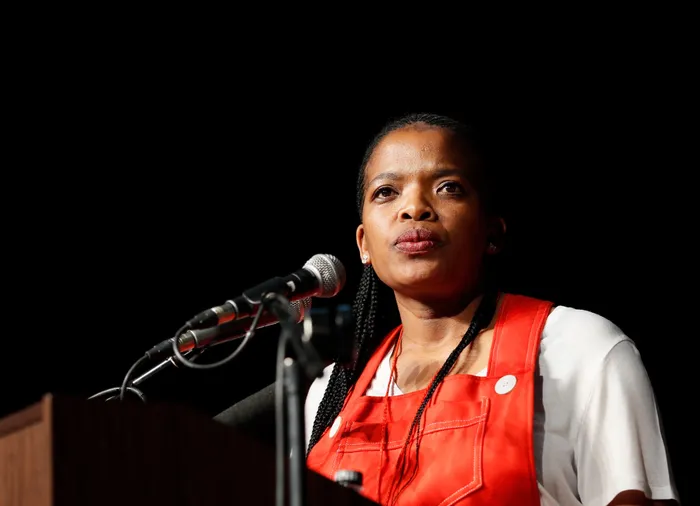
Zingiswa Losi is the president of Cosatu.
Image: Independent Newspapers
Cosatu President Zingiswa Losi
*** The views expressed here do not necessarily represent those of Independent Media or IOL.
BUSINESS REPORT