

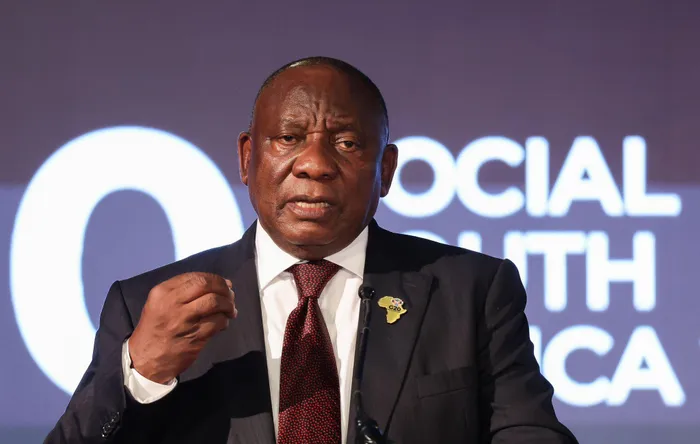
President Cyril Ramaphosa will deliver his State of the Nation Address this week.
Image: Presidency
When President Cyril Ramaphosa delivers his State of the Nation Address tomorrow, he will no doubt have to navigate a complexity of factors, both domestically and in the geo-political environment. As the global financial and trade architecture ruptures, and the once-unanimous global consensus frays, South Africa must align and integrate all its domestic policies to firmly establish a national development path to address our socio-economic challenges in a fragile international environment.
The established multilateral system has experienced its most intense challenge in recent history, resulting in potentially existential crises for the United Nations (UN) and its agencies including the UN Framework Convention on Climate Change which remains the platform for global cooperation in addressing climate change.
South Africans know all too well what climate impacts mean for our people and economy. Recent extreme weather events - including the devastating floods in KwaZulu-Natal, persistent drought conditions in the Eastern Cape, and the escalating wildfires in the Western Cape and recent floods in Mpumalanga and Limpopo —serve as critical signals of a shifting climate baseline, reminding us that inaction is not an option.
The undeniable truth of our century is that human suffering and loss, fiscal strain and economic costs are direct consequences of these occurrences. Climate change is not merely an environmental concern but a social, economic, and developmental challenge. We must re-evaluate and strengthen the country’s social and economic strategy.The critical challenge for all countries is to recalibrate their transitional strategies without losing the impetus for climate action.
We need an industrial strategy that embraces the need for rapidly transitioning high emissions sectors, whilst developing new sectors that will respond to the green economy opportunities. The concept of a "just" transition is not an after-thought, nor is it a paternalistic response to our most vulnerable workers and communities, it is central to the national development strategy's success, in this regard, the Presidential Climate Commission (PCC) plays a critical role in aligning and convening diverse stakeholders and social partners.
South Africa’s current economic model, heavily dependent on fossil fuels, exposes the country to compounding and complex transition risks. With trade and capital markets deeply integrated into a global economy that is actively pricing and penalising carbon, the risk to carbon-intensive exports constitutes a growing risk.
Although developed countries seem to be reviewing their ambition for climate action, the adoption of carbon border adjustment mechanisms (CBAM) is a trend that is likely to continue and impact countries such as South Africa. The pathway to remain competitive is further complicated by the “political weaponisation” of trade and tariff regimes.
This necessitates both strategic intent and flexibility in our export-dependent sectors. Our response must be initiative-taking, strategic and growth-oriented.The commission developed the Just Transition Framework (JTF), which was adopted by Cabinet in 2022, and it provides an organising logic: decarbonisation aligned with growth, inclusion, and stability.
The PCC acts as the monitor and an enabler of action of the three principles contained in the framework – Restorative, Procedural and Distributive Justice. South Africa’s recently updated Nationally Determined Contributions (NDC), whilst recalibrating ambition, commits us to a pathway of reduced emissions and establishes the urgent need for adaptation and resilience programmes, and effective financing of the just transition and our climate goals.
In realising the NDC our country has developed amongst others, (1) the Integrated Resource Plan (IRP) as a clear signal to the market on what is needed for production of renewable and carbon-free sources of electricity, (2) the National Green Finance Taxonomy, which authoritatively categorises green finance, (3) the South African Renewable Energy Master Plan recognising the imperative for industrial and technology capabilities in the renewable energy value chain, and (4) the carbon tax system which provides an incentive mechanism for corporates to reduce emissions.
These initiatives are critical enablers, establishing a common basis for "green investment" to unlock liquidity in the domestic market and restructure balance sheets in the private sector.The capital required for the energy transition alone - encompassing the decommissioning and repurposing of the coal value chain and the construction of a new renewable-enabled national grid - is estimated in the hundreds of billions ofrands, hence the Minister of Electricity and Energy has made innovative capital raising his over-riding priority.
The impediments to private investment and capital provision must be removed, with an appropriate sharing of risks in large capital projects and through innovative private sector participation (PSP) models, which are essential to de-risk investments and crowd in the necessary scale of private capital as a multiplier factor to public finance.The challenge is one of unity in strategic purpose, effective implementation, and appropriate speed and scale of the transition.
Climate impacts do not adhere to political whims or budgetary cycles, and the economic cost of inaction is already being realised through disaster relief expenditure, lost productivity, and human displacement. We have to find pathways for a “just future” through meaningful engagement and empowerment opportunities for affected workers and communities particularly in regions that will be most impacted by a transition to a less-carbon intensive future.The just transition cannot be viewed as a separate or optional policy; it is the central economic strategy for achieving a resilient, competitive, and an equitable South African economy in a decarbonising world.

Dipak Patel is Deputy Chairperson of the Presidential Climate Commission.
Image: Supplied
Dipak Patel is Deputy Chairperson of the Presidential Climate Commission.
*** The views expressed here do not necessarily represent those of Independent Media or IOL.
BUSINESS REPORT