

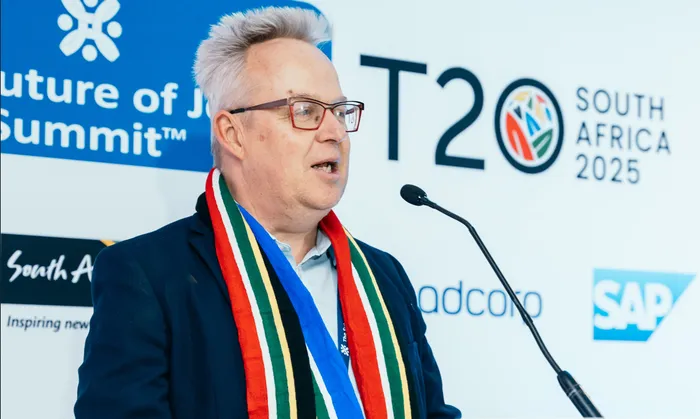
Dr Nik Eberl is the Founder & Executive Chair: The Future of Jobs Summit™ (Official T20 Side Event).
Image: Supplied
South Africa does not need to guess what economic success looks like. We have already done it. Over the past decade, the country has quietly built one of the world’s most competitive Global Business Services (GBS) sectors — attracting multinational investment, exporting high-value services, and creating hundreds of thousands of jobs for young South Africans. What began as a call-centre industry has evolved into a sophisticated ecosystem spanning customer experience, fintech support, analytics, and digital back-office operations.
GBS offers more than a success story; it provides a blueprint for how South Africa can lead the industries of the future. At a time when youth unemployment remains one of our greatest national risks — and responsibilities — the question is no longer whether South Africa can compete globally. The real question is whether we can replicate this success across multiple future-defining sectors.
At the upcoming Future of Jobs Summit, we will explore what I call the Next10 — ten industries with the potential to transform our economic trajectory while creating jobs at scale. But before looking forward, it is worth recognising a powerful truth: South Africa is already globally competitive in several sectors.
Where South Africa Already Leads
Our banking sector is consistently ranked among the most sophisticated in emerging markets, combining regulatory strength with digital innovation.
Our digital and fintech capabilities continue to attract global attention, supported by a deep pool of technical talent.
In horticulture and viniculture, South African products reach premium international markets, demonstrating our ability to compete on quality, not just cost.
Tourism and hospitality remain global assets, underpinned by natural beauty, cultural richness, and world-class service standards.
And then there is GBS — arguably one of the most underappreciated economic victories of the democratic era. The sector succeeded because it aligned five critical forces: policy support, private-sector investment, targeted skills development, global competitiveness, and a compelling national value proposition. This is precisely the formula we must now apply to the Next10.
The Next10 Industries South Africa Must Lead
The GBS Blueprint: Five Lessons for National Growth
If GBS taught us anything, it is that job creation at scale is never accidental. First, clarity of ambition. GBS succeeded because South Africa decided to compete globally — not regionally. Second, skills at speed. Training pipelines were aligned directly to industry demand. Third, public-private collaboration. Government enabled; business executed. Fourth, a compelling global proposition. We positioned ourselves as high quality, cost competitive, and culturally aligned with major markets. Fifth, confidence. Investors back countries that believe in their capabilities. Imagine applying this blueprint simultaneously to green energy, AI, advanced manufacturing, and healthtech. The multiplier effect would be profound.
From Potential to Leadership
South Africa stands at an inflection point similar to the years preceding the 2010 FIFA World Cup — a period when the nation united around a bold ambition and delivered infrastructure, investment, and global credibility. Today, we need a comparable national mission — not around a sporting event, but around economic renewal.
The global economy is reorganising itself around technology, sustainability, and skills. Countries that move early will shape markets; those that hesitate will import the future rather than build it.
Encouragingly, South Africa already possesses many of the ingredients required for leadership: strong institutions, entrepreneurial depth, financial sophistication, and a resilient private sector.
What we need now is coordinated execution. The Future of Jobs Summit is designed to accelerate precisely this conversation — bringing together business leaders, policymakers, investors, and educators to move from insight to implementation.
Because high unemployment is not merely a crisis; it is dormant capacity waiting to be activated. If we scale what works, replicate the GBS playbook, and mobilise around the Next10, South Africa can transition from a consumption-driven economy to a globally competitive producer of talent, technology, and innovation.
History rarely signals when a generational opportunity arrives. But when it does, nations must decide whether they will observe — or lead. South Africa has already shown it can lead. Now we must do it again.
Dr Nik Eberl is the founder and executive chair: The Future of Jobs Summit™ (Official T20 Side Event). He is also the author of Nation of Champions: How South Africa won the World Cup of Destination Branding.
*** The views expressed here do not necessarily represent those of Independent Media or IOL.
BUSINESS REPORT