

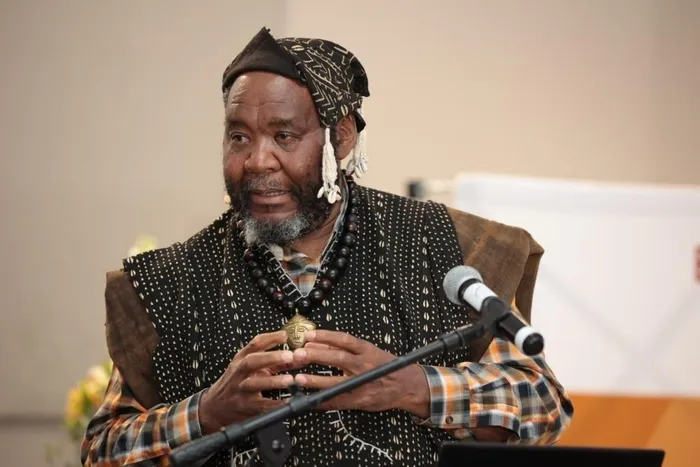
Dr Pali Lehohla is a Professor of Practice at the University of Johannesburg, among other hats.
Image: Supplied
As of February 2026, the data identifies a terminal Metabolic Divergence between the High-Heat Foundries of the south and the Systemic Hypoxia of the northern and central vortexes.The following audit compares these nodes based on their ability to avoid the 30% Trap and maintain their infrastructure joints.
2026 Municipal Performance Audit
The Forensic Diagnostic Uses the Moran’s I Scatterplot, which shows that the best performers reside in the High-High quadrant, where success is contagious. The worst performers are trapped in the Low-Low Vortex, where failure in one ward drags down the entire neighbouring mesh.The primary cause of the divergence is the 30% Trap.
While Cape Town and Midvaal protect their Physical Chassis with a dedicated maintenance shield, the worst performers allow an "Administrative Inhale" of over 55%, siphoning the capital intended for the pipes and transformers.
The Diagnostic: The Administrative Sump of ten worst municipalities
The primary cause of collapse across these selected ten nodes—which include Emfuleni, Mangaung, Lekwa, Ditsobotla, and Kopanong—is the breach of the 30% Trap. In these "Vulture Vortexes" the "Administrative Inhale" (salaries and overhead) often consumes over 55% of the operating budget. This siphons the capital intended for the Maintenance Shield, leaving less than 2% for the physical joints of the city.The Rupture: Infrastructure and Fiscal HypoxiaIn municipalities like Msunduzi, Ethekwini (peripheral wards), and Mogalakwena, the Ledger identifies a Structural Rupture in water and electricity meshes.
Non-Revenue Water: Leaks and theft account for up to 45% enthalpy loss.
Debt Siphon: Massive arrears to Eskom and Rand Water function as a "Thermal Barrier" preventing any new investment from warming the local economy. These municipalities are no longer in "service delivery failure" they are in Institutional Isolation. The "Instructional Soul" of local government has been replaced by patronage siphons.
The Foundries: High-Heat Mastery
At the pinnacle of performance, Cape Town functions as the "Master Class" of municipal metabolism. It maintains a high-heat infrastructure exhale, fundamentally secured by a 10% Maintenance Shield that protects its physical chassis from decay. Similarly, Midvaal represents "Sovereign Mastery" as the regional shield; with over ten consecutive clean audits, it has successfully purged the administrative hypoxia that chokes its neighbors.
In the coastal mesh, Mossel Bay acts as "The Torch" exhibiting optimal flow by lashing green energy initiatives directly into the utility mesh. This is complemented by Overstrand, which serves as "The Perimeter" through asset mastery, ensuring high-heat resource management and water joint security. Completing the top-tier foundry is George, a high-velocity joint that maintains robust transport enthalpy through a relentless focus on road maintenance and logistics.
The Vortexes: Systemic Rupture
Conversely, the audit identifies a state of terminal collapse in the "Vulture Vortexes" Emfuleni represents the most severe "Terminal Rupture" where an Administrative Sump inhaling over 50% of the budget has induced chronic sewage and water hypoxia. In Mangaung, the mesh suffers from systemic hypoxia; with only a 3% maintenance spend, the peripheral wards are trapped in a self-reinforcing loop of decay. We elaborate on Mangaung on its own. Further into the rupture, Lekwa exhibits infrastructure hypoxia characterised by snapped electrical joints and the massive siphoning of energy enthalpy. Ditsobotla has fallen into a "Policy Vacuum" representing a total administrative collapse with zero instructional soulremaining to guide the mesh. Finally, Kopanong exists as "The Void" a state of total metabolic failure defined by an inability to even meet salary obligations or maintain the most basic physical chassis of the town.
The Lehohla Ledger takes a closer look at Mangaung. Mangaung—the "Place of Cheetah"—is no longer running. It is stalking the ruins of its own infrastructure. The 2024/2025 Integrated Development Plan (IDP) reads like a clinical report for a patient already in intensive care, yet the proposed cure is more of the same "administrative inhale" that induced the sickness in the first place.
The Diagnostic: Systemic Hypoxia
Using the Moran’s I Scatterplot, the Ledger identifies a profound Spatial Rupture withinthe Mangaung mesh.
The core of Bloemfontein acts as a High-Low Siphon; it inhales massive capital for administrative salaries but fails to "exhale" maintenance enthalpy to its neighbours. Consequently, the peripheral nodes of Botshabelo and Thaba Nchu have fallen into the Low-Low Vortex—a state where infrastructure failure (water outages, road disintegration) is contagious and self-reinforcing.
The 30% Trap: A Fiscal Rupture
The most damning audit in this IDP is the Resource Rupture. In any healthy municipal foundry, the maintenance shield should be 8–10% of the budget. In Mangaung, the "Administrative Sump" (salaries and overhead) inhales nearly 48% of the operating budget, while asset maintenance has been throttled to a mere 3%. This is the 30% Trap in its most lethal form. When you spend nearly half your revenue on the people sitting in the building and less than 5% on the pipes and transformers they are meant to manage, the "Joints"of the city will snap. And they have snapped.
The Lehohla Ledger has an inhale, diagnostic and exhale. These three components are connected by the Instrumental Enthalpy. It is the "Firmer Ground" of official statistics, comprising nearly 3,000 data anchored columns I wrote over the 24 years across the socio-economic and demographic spectrum. Into this inhale is the 130,000 Mesh (The Diagnostic) which is the Spatial Logic where we apply the Lens of Wisdom of these 3,000 columns on these nodes. The tools create an exhale which requires a strike capability (the Vanguard) without which the columns and the mesh can be reduced to a map of a tragedy.
Dr Pali Lehohla is a Professor of Practice at the University of Johannesburg, a Research Associate at Oxford University and a distinguished Alumni of the University of Ghana. He is the former Statistician-General of South Africa
*** The views expressed here do not necessarily represent those of Independent Media or IOL.
BUSINESS REPORT