

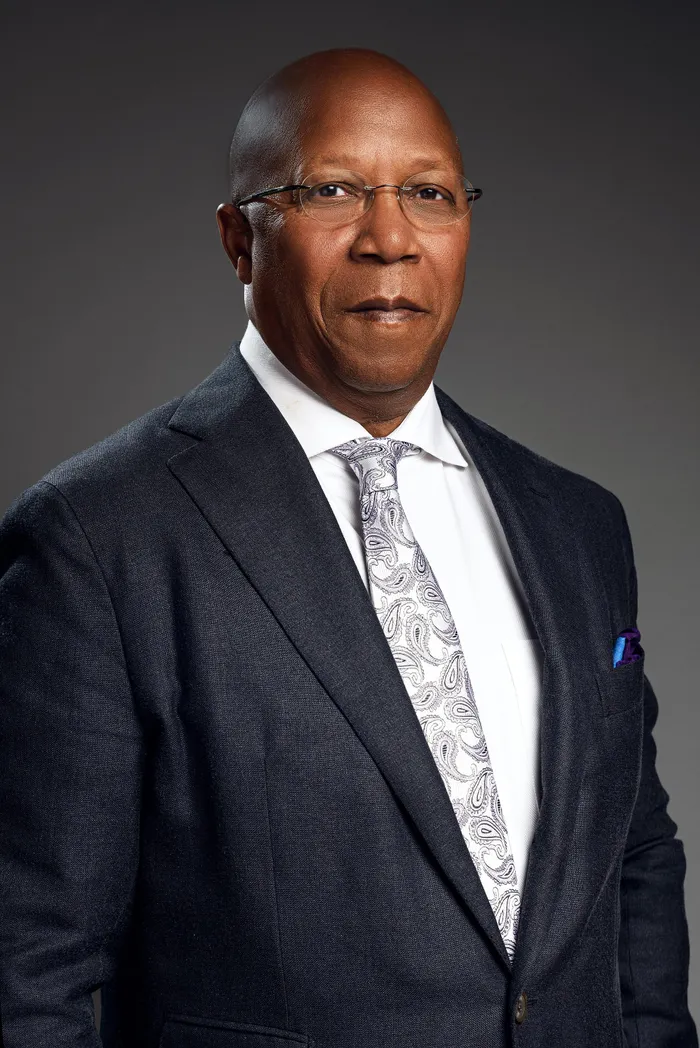
Charles R Stith, a former US ambassador to Tanzania, is non-executive chair of the Johannesburg-based African Presidential Leadership Centre and executive chairman of the Pula Group.
Image: Supplied
Whether your window to the world is a daily news show or a daily newspaper, you don’t need to be a political analyst or soothsayer to recognise that this is not America’s finest hour. But to paraphrase Mark Twain, the rumours of America’s death are greatly exaggerated.
When I served as the US Ambassador to Tanzania, I often said that the virtue of democracy is not that it guarantees great leaders, but that it guarantees the ability to remove bad ones. Democracy reflects human imperfection. Voters do not always choose wisely, and no system of government is immune to poor outcomes every now and then.
For those who point to Donald Trump’s return to office as proof that America’s day is done, that conclusion is understandable. Elections, however, are rarely about perfection. As I heard a politician once say, “elections are not about me versus the Almighty; this election is about me against the alternative.” Trump won because enough Americans believed, rightly or wrongly, that he offered the better alternative on election day. That does not mean the system is broken. It simply means the voters blew it.
Trump 2.0 has undeniably shocked the system. Yet history reminds us that shock has often preceded recalibration. Across administrations, the United States has stumbled, corrected, and moved forward. Some leaders steadied the system, others strained it, but even mistakes often produced unintended progress. That capacity for self-correction is what has sustained American democracy.
This is why the current moment feels so unsettling. Not because America has never faltered, but because its faltering is so visible and the consequences are so widely felt.
America will stabilise. Polls suggest change is coming, and experience suggests a course correction generally follows such disruptions. We see some of these corrections beginning to take shape right now.
Where policies push beyond constitutional bounds, public officials and private citizens are turning to the courts, and in many instances succeeding. Civic response is also visible on the streets. The tragic murders of Renee Good and Alex Pretti in Minneapolis stirred outrage that drew citizens into the open, even in the depths of winter, with people standing together in temperatures approaching minus twenty degrees Celsius to make their voices heard. Acts like these, some quiet and all resolute, remind us that public participation is not confined to elections alone and mobilization of every sort can result in change.
The prospect of change is also taking shape through renewed political engagement, with a new generation of candidates stepping forward to contest seats and bring different perspectives to Congress, in the short term and a new resident in The White House in the near term.
As disconcerting as this past year has been, the upside is that it offers is an opportunity to ask different questions about what comes next.
Democracy, or more precisely democratic values, have not only taken a hit in the United States, but globally as well. Restoring confidence in democratic institutions is not America’s task alone. Democratic societies must work together to re-establish cooperation instead of confrontation as the norm in biliteral or multilateral engagement. More mature democracies need to help emerging democracies translate accountability into tangible improvements in daily life.
This matters deeply for Africa.
Countries such as Tanzania, Ghana, Mauritius, Namibia, and Zambia, as well as other young democracies signal the possibility of a more hopeful future, not just for those countries but for world at large. A world in which democracy flourishes is better for everyone. The evidence is in. Over time, where democracy has flourished, institutions have strengthened, lives have improved. Progress has not been uniform, but it has been real. For democracy to continue to deepen its roots in Africa, existing democratic countries are going to have to continue to demonstrate that democracy, literally, provides a dividend. How the West engages Africa can have an impact. The current green energy revolution provides an opportunity for the West to re-calibrate its relationship with Africa and provide traction for Africa’s future development.
Africa’s role in this energy transition, its centrality to supply chains and future growth, places it firmly within the architecture of the world to come. Its resources, markets, and demographics give it agency in shaping that future, not merely reacting to it.
This is shared work. It extends before American and the rest of the West. Asian powers also have a role to play in supporting stability and prosperity beyond their borders. Engagement grounded in mutual interest strengthens and stabilizes the world as a whole.
Recent events have prompted Europe to reassess its responsibilities and dependencies. That reassessment is healthy. Regions that invest in their own resilience contribute to global balance.
America’s influence over the past century has been substantial. The dollar, global institutions, education, and democratic norms have provided structure and opportunity far beyond its borders. These did not endure by accident.
That influence is being tested, not erased.
I do not believe America’s sun has set. I believe it is navigating a difficult passage. If the world responds with steadiness rather than alarm, and if emerging democracies step forward with confidence and clarity, something constructive can emerge from the present uncertainty.
If America’s better instincts assert themselves, and if others use this moment to strengthen their own foundations, the years ahead can still deliver progress worth the effort.
Charles R Stith, a former US ambassador to Tanzania, is non-executive chair of the Johannesburg-based African Presidential Leadership Centre and executive chairman of the Pula Group.
*** The views expressed here do not necessarily represent those of Independent Media or IOL.
BUSINESS REPORT