

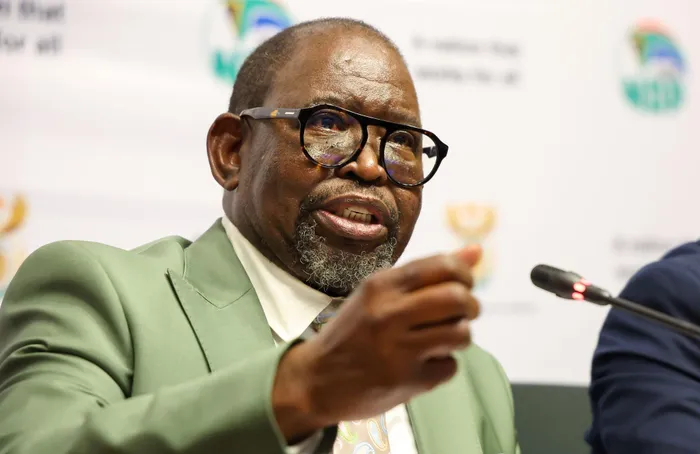
Finance Minister Enoch Godongwana will table the National Budget Review next week Wednesday in Parliament.
Image: Supplied/GCIS
The Congress of South African Trade Unions (Cosatu) alongside millions keenly awaits the Budget and Medium-Term Expenditure Framework due to be tabled at Parliament this week.
The challenges facing the working class and society are dire, in spite of important areas of green shoots.
The Budget must be grounded upon the lived realities of workers, the unemployed and the economy. The government needs to avoid the temptation to treat the Budget as a question of balancing the books. It must provide meaningful relief to workers and the poor and give hope to society that South Africa is turning the corner for the better.
President Cyril Ramaphosa’s State of the Nation Address (SONA) highlighted the pain felt by millions from our dangerously high 41.1% unemployment rate, to weak 1% economic growth, to embattled public and municipal services.
Whilst SONA outlined government’s plans, the Budget needs to match these with the funds if they are to materialise. Government needs to appreciate that society’s patience is not limitless, and in many instances, it is rapidly evaporating.
Finance Minister Enoch Godongwana correctly called for an end to austerity budgets in his 2025 Budget speech(es) to Parliament. 2026 needs to see a decisive break with the decade plus cycle of reckless budget cuts that have brought many public and municipal services to the brink of collapse.
It is easy with countless negative headlines to lose sight of the progress we have seen under President Ramaphosa and African National Congress led administrations, not withstanding the many burning fires.
The overcoming of loadshedding has been a massive victory but we are not out of danger as electricity has become unaffordable for millions of working-class families and the economy, resulting in thousands of job losses in smelters and industrial sectors. Reducing the price of electricity has to be one of government’s most urgent priorities.
This requires moving all consumers to prepaid billing, tackling the ever-rising municipal debt (currently R100 billion and growing by R20 billion annually), corruption, cable theft and other acts of criminality, and supporting Eskom’s expansion into clean energy.
Efforts to modernise Transnet and Metro Rail must be accelerated. A return to full capacity by our rail network and ports will unlock thousands of mining, manufacturing and agricultural jobs plus important revenue for the state. Transnet needs assistance to reduce its debt burden and upgrade infrastructure. The mining rights application system must be finalised.
Special attention is needed to rebuild Denel, the South African Broadcasting Corporation, the Post Office and Postbank. These once well-run institutions can be fixed but they require competent leadership and support.
If the state is to fulfill its constitutional, transformational and developmental mandates, then a fundamental break with failed neo-liberal policies and austerity budgets is essential to rebuilding public and municipal services. Yes, in some instances, government must digitise to enable the working class to access public services 24/7 but this on its own is not enough.
Frontline public services require doctors, nurses, paramedics, police and correctional officers, teachers, military and other skilled personnel. To retain these highly sought after professionals, not only must they be paid a living but a competitive wage. If the state is to provide the quality services that society and the economy depend upon, then it needs to appoint competent management, fill frontline vacancies, recruit critical skills, remove corrupt and criminal elements and invest in its infrastructure.
The turnaround at Eskom, Transnet, South African Airways and the South African Revenue Service (Sars) followed this path, and they are delivering the results. This must be replicated at other embattled state institutions.
Whilst SONA committed to finalising the White Paper on Local Government and a new municipal funding model, many municipalities cannot wait for these. 70% of our municipalities are in financial trouble, many fail to provide basic services, leading to companies closing and retrenching workers and more than a dozen routinely fail to pay their staff salaries and third-party deductions.
Drastic interventions are needed including deploying competent and qualified managers, auditors to route endemic supply chain corruption and the enlistment of Treasury, GTAC, Eskom, Sanral and the Department of Water and Sanitation to rebuild local government capacity to deliver basic services and collect rates.
2026 must see the finalising of the Public Procurement Act’s regulations and its rolling out across the state. This will be an invaluable boost to locally produced goods and the war against state capture and corruption.
Whilst appreciating the decrease in various serious crimes over the past quarter, no sober person will believe that we are winning the war against crime. Violent crime is rife, particularly in working class communities. Corruption has become normalised. Prosecution and conviction rates are depressingly low.
The Budget must provide the Police, Hawks, Prosecuting Authority, Judiciary and the National Defence Force with the personnel, skills, resources and infrastructure they require to win this war. This is not a matter we can continue to compromise upon.
To kickstart the economy and reach the 3% plus growth rate needed to create decent jobs, a bold industrial stimulus package is needed. The Presidential Employment Stimulus (PES) must be expanded to accommodate at least 1 million participants by April and 2 million by November. The SRD Grant must be accessible to all unemployed persons, raised to the Food Poverty Line and its participants included in skills and employment opportunities where possible.
We expect the Budget to honour SONA’s announcement of an additional 10 000 labour inspectors in addition to the 20 000 intern inspectors employed through the PES.
These high impact interventions require funding, and this must be sought by providing SARS the resources to raise tax compliance from 67% to 75% by 2029 and thus generating an additional R200 billion in monies owed to the state. Tax loopholes exploited by the rich must be closed and relief to the working and middle classes provided.
We need a Budget that will fix the state, stimulate growth, create jobs, provide relief for the poor and inspire hope across the nation.

Solly Phetoe is the general secretary of Cosatu.
Image: Doctor Ngcobo / Independent Newspapers.
Cosatu General Secretary Solly Phetoe
*** The views expressed here do not necessarily represent those of Independent Media or IOL.
BUSINESS REPORT