

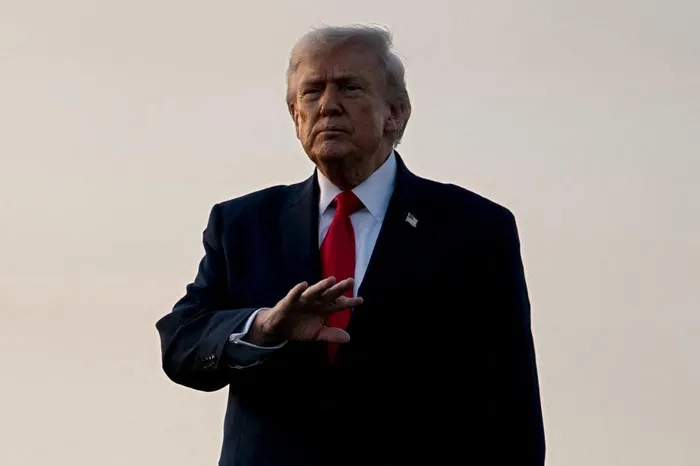
US President Donald Trump.
Image: AFP
Despite the decision by US President Trump to “invade” Iran by deploying “massive armada" to the region, that have left for Iran closing the Strait of Hormuz, building up geopolitical tensions in the Middle East, South African financial markets gained on these uncertainties. The decision by the US Supreme Court to put a roadblock to Trump’s global tariffs with the court ruling on Friday that the tariffs imposed by Trump are illegal, also boosted domestic market sentiment to the good. Trump had imposed a 30% tariff on South Africa.
Lower unemployment during quarter four 2025 of 3.4% (31.9% in quarter three), adding 44,000 new jobs and the inflation rate decreasing to 3.5% in January (3.6% in December 2025), also contributed to a stronger Rand, precious metal prices and equity prices on the JSE. On Friday afternoon, just after the news of the US Supreme Court judgement against Trump’s tariff policies, the gold price leaped by more than $100 to $5 109 to the dollar at the close of US markets. Bullion ended the week $68 higher and went up by 5.7% over the last month.
The Rand last Thursday, traded at one stage at nearly R16.20/$, up by 25 cents from R15.95/$ at the close of the previous Friday. The currency strengthened quickly again on Friday afternoon on the Trump tariff “embargo” to close on R16.03/$. Against the Pound the Rand appreciated by 16 cents last week to R21.61/£. This is the strongest level over the last three years. Against the Euro, the Rand traded flat last week, gaining only 3 cents to R18.89/€ on Friday. This has been the strongest level since December 2024.
Equity prices rallied
Share prices on the JSE continued to recover last week, after the speculative sales at the end of January, that led to the All Share index losing more than 5 000 points on Friday January, 30 2026. The index gained 2 438 or 2.02% last week. As a result of recovering Gold, Platinum and Palladium prices last week, the JSE Precious Metals and Mining index increased by 2.3%. On the JSE equity board, Mid-caps are up by 5.0% since the beginning of the year. The Financials index improved by more than 9.0% since the beginning of 2026, as well as the Resource 10 index shooting up by 11.0% for the year-to-date.
Will President Trump back down on the court order?
World financial markets await in anticipation on how the reaction of President Trump on the high court decision will affect global equity, prices, bond rates and exchange rates this coming week. The President already indicated that he will not back off on his tariff policies due to the high court decision. The BBC over the weekend reports that the President reacted aggressively by announcing that the court's was "deeply disappointing". He said that the justices who joined the majority opinion should be "absolutely ashamed" and lacked the courage to "do the right thing".
The President then announced that he would impose a temporary 10% global tariff under the Trade Act of 1974, a different law from the one that the court said did not grant him tariff authority. It is not clear if this tariff replaces all existing tariffs, including the current 30% tariffs on South African exports.
Prospects for the coming week
This coming all eyes will be on the South African National budget that will be delivered by Finance Minister Enoch Godongwana on Wednesday. The Minister will seem to have less of a daunting task than last year, with some manoeuvring ground that was not available for him during previous years after the Covid 19 pandemic.
Against these manoeuvring room of government, the crucial questions that the budget will deal with are:
It is expected that no changes to the three main budget income items namely Company Taxes, Personal Income tax and Value added tax will be introduced.

Chris Harmse is the consulting economist of Sequoia Capital Management and a senior lecturer at Stadio Higher Education.
Image: Supplied
Chris Harmse is the consulting economist of Sequoia Capital Management and a senior lecturer at Stadio Higher Education.
*** The views expressed here do not necessarily represent those of Independent Media or IOL.
BUSINESS REPORT