

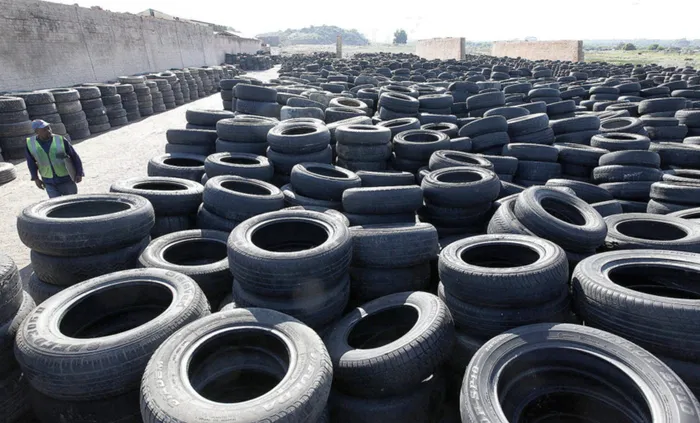
South Africa discards approximately 70,000 tyres every day, says the author.
Image: Jason Boud
As Parliament opens and the national budget is presented, public debate inevitably focuses on the headline issues: large infrastructure programmes, rail and port performance, market access, and other macroeconomic levers. These are undeniably important to South Africa’s growth prospects. But their sheer scale also creates the impression that only grand, multi-billion-rand interventions can make a difference.
In reality, some of the most effective economic reforms are not the largest or most expensive. They are often the practical, well-designed systems that once worked, delivered measurable results, and were later abandoned.
A case in point is waste tyre management. As recently as eight years ago, the Recycling and Economic Development Initiative of South Africa (REDISA) operated a functional national waste tyre programme. Between 2013 and 2017, it created more than 3,000 jobs and supported the establishment of 226 small and medium enterprises, all at zero cost to the State. It demonstrated how environmental management, job creation, and enterprise development could be aligned.
In 2017, REDISA was unlawfully removed, a finding confirmed by the Supreme Court of Appeal in 2019. Yet, it was never reinstated. Responsibility instead shifted to the Department of Forestry, Fisheries and the Environment’s Waste Management Bureau. The Bureau has for eight years consistently failed to meet its tyre diversion targets. In the past few months, the Bureau has gone to tender to establish a million square metres of waste tyre depot space – enough to store over a million tonnes of waste tyres – and to sell off some R100 million worth of tyre recycling equipment that it bought but could not put to use. This is not management, it is controlled dumping. The consequences have been stark: job losses, dangerously overcrowded depots that pose real fire risks, discarded tyres contaminating groundwater, along with widespread illegal burning that releases toxic fumes
Behind these failures lies a deeper problem: economic exclusion. Micro-collectors, transporters, and small recyclers — once the backbone of a functioning system — have been pushed out. Many now struggle to earn a living. These workers seldom feature in budget speeches or policy statements, yet they are essential to keeping communities clean, families fed and local economies active.
This neglect is economically short-sighted. Research indicates that effective management of just 13 waste streams could raise South Africa’s GDP growth by up to 1.5 percentage points. The REDISA model offered a practical proof of concept for a broader circular economy. It showed that environmental policy, if properly designed and implemented, can be a growth strategy.
The scale of the opportunity is significant. South Africa discards approximately 70,000 tyres every day. These represent a continuous stream of recoverable resources that are currently being lost.
At present, an environmental levy of R2.30 per kilogram is collected on tyre sales, generating cumulatively more than R5 billion since 2017. Yet less than half of this revenue is spent on waste tyre management — the very purpose for which it is raised. This undermines both public trust and policy effectiveness. The levy ring-fencing should be enforced and applied as an investment in sustainable economic infrastructure. Sound fiscal governance depends on credible, traceable use of public funds.
Equally concerning is the quality of information guiding decision-making. The Waste Management Bureau’s data is outdated, inconsistent, and riddled with definitional errors. These documents are publicly available and reveal a system operating without reliable evidence. That is troubling, particularly given that the same framework governs hazardous waste streams, including medical and radioactive waste.
Policy made in the absence of accurate data is policy made blindly. The good news is that government does not need to address these challenges alone. International experience shows that well-regulated private sector participation strengthens public institutions by bringing operational expertise, innovation, and accountability. Ultimately, expecting the state to manage South Africa’s waste crisis in isolation is neither realistic nor efficient.
Good economic governance also requires longer planning horizons. Short-term budgeting and annual adjustments discourage private investment and undermine partnership formation. Circular economy infrastructure takes time to develop and requires stable, multi-year commitments. While this demands upfront discipline, the cost of inaction — lost jobs, environmental damage, and public health risks — is far higher.
South Africa’s economic recovery will not be driven by megaprojects alone. It will also depend on restoring and scaling interventions that have already proven their value.
Reinstating effective, smaller-scale systems such as REDISA is not about nostalgia. It is about evidence-based policy. It is about recognising that growth is built from the ground up, through functioning institutions, empowered entrepreneurs, and credible governance.
If policymakers are serious about inclusive growth, sustainability, and fiscal responsibility, they should start by fixing what once worked.

Dr Chris Crozier, Executive Committee Member, Recycling and Economic Development Initiative of South Africa (REDISA)
Image: Suppllied
Dr Chris Crozier, Executive Committee Member, Recycling and Economic Development Initiative of South Africa (REDISA).
*** The views expressed here do not necessarily represent those of Independent Media or IOL.
BUSINESS REPORT