

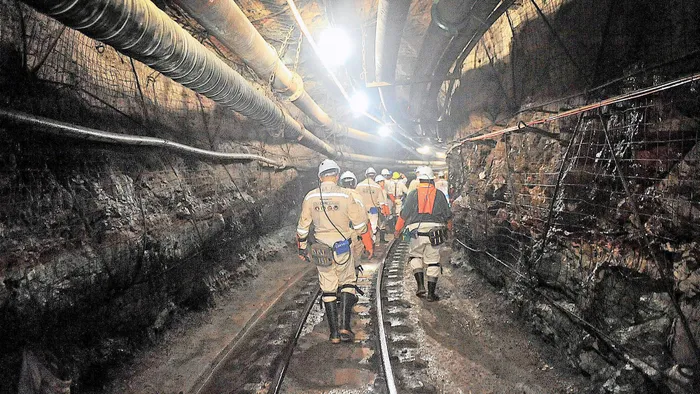
In 2024, mining in South Africa contributed 6.1% of nominal GDP in a R4.6 trillion economy.
Image: Itumeleng English/ Independent Newspapers
The 2026 Mining Indaba provided a good platform and brought together governments, investors, industry leaders, and civil society from across Africa and beyond. As a premier mining investment platform, it focused on partnerships, sustainable development, and the optimal beneficiation of critical minerals.
In 2024, mining in South Africa contributed 6.1% of nominal GDP in a R4.6 trillion economy, generated a quarter of export earnings, attracted 17% of private sector investment and employed 475,000 people. Yet performance has softened. Gross value added grew by only 0.3%, constrained by subdued commodity prices, logistics bottlenecks, rising operating costs and weak global growth.
Mining has acknowledged that it need to move faster from just “digging , shipping and dumping” - Key focus areas of the Indaba included: Africa’s critical minerals —including cobalt, lithium, manganese, and platinum group metals — are central to the global energy transition, yet they also carry the risk of fuelling new conflicts and irresponsible mining practices if not governed effectively.
Sustainability must, therefore, be at the core of the sector’s evolution, with robust environmental, social, and governance standards driving a just transition while simultaneously increasing output and improving development outcomes.
Innovation and technology, particularly artificial intelligence, green-energy solutions, and digitalisation, are modernising mining operations, however, there remains insufficient scrutiny of the employment implications as the sector mechanises and digitises, potentially displacing workers.
At the same time, there was a strong imperative to support downstream industries such as automotive, renewable energy, aerospace, and manufacturing to accelerate local beneficiation and industrialisation, thereby advancing economic growth across African economies. Central to all of this is meaningful community and indigenous inclusion to ensure equitable benefit-sharing, preserving cultural heritage, and respecting indigenous knowledge systems and traditional institutions of leadership and engagement.
At this moment, the mining sector sits at the intersection of three converging forces: climate urgency, geopolitical realignment, and rising global demand for critical minerals. Against this backdrop, the Indaba’s theme “Stronger together: Progress through partnerships” signals that collaboration will be essential if mining is to thrive in a low-carbon, inclusive, and globally competitive future.
Mining has moved from the periphery of climate debates to the core, supplying the minerals required for electrification, energy storage and green hydrogen while remaining a significant source of environmental and social risk.
The sector supports hundreds of thousands of additional livelihoods through extensive upstream and downstream value chains and remains a primary economic anchor in mining-dependent regions where alternative employment opportunities are limited.
Mining also plays a critical fiscal role, contributing to tax revenues and foreign exchange earnings that underpin South Africa’s macroeconomic stability and public service delivery. The sector therefore remains indispensable to South Africa’s economy — but increasingly exposed to structural, operational and market risks.
Climate alignment is accelerating this exposure. Global capital is becoming more selective, with high-emissions assets facing heightened scrutiny while demand for platinum group metals, manganese, vanadium, and copper rising sharply. South Africa’s geological endowment is strong, but competitiveness will depend less on mineral abundance than on policy certainty, infrastructure readiness, and social licence from communities to operate.
Industry and government recognise this, hence the Minerals Council South Africa supports the goal of net-zero emissions by 2050 and a Just Energy Transition, focusing on reducing Scope 1 and 2 emissions through renewable energy while arguing for a pragmatic, near-term role for coal to safeguard energy security. The Department of Mineral and Petroleum Resources similarly emphasises decarbonisation at a pace that preserves jobs, investment, and economic stability.
It is in this context that the Presidential Climate Commission is uniquely positioned to guide South Africa’s decarbonisation pathway across sectors — including mining — in a manner that is evidence-based, inclusive and country-specific. In mining, it means supporting a managed transition from coal, advancing responsible production of critical minerals, and ensuring that decarbonisation is accompanied by localisation, beneficiation, and skills development.
Our position is that mining has a future in South Africa, but only if it is future fit. That requires credible transition plans for coal regions, transparent management of closure and rehabilitation liabilities, and alignment between climate policy, industrial development, and fiscal planning. A just transition is a governance challenge that demands coordination, foresight, and accountability.
In a world defined by geopolitical uncertainty and climate urgency, South Africa cannot afford an unmanaged decline — where emissions fall, but so do jobs, investment, and trust. Nor can it rely on mineral endowment alone to secure prosperity.
The dust has settled in Cape Town, and Mining Indaba 2026 will be measured on whether the mooted partnerships deliver alignment: between capital and climate goals, policy and implementation, and short-term pressures and long-term resilience. In a fractured and fragile global economy, South Africa’s ability to manage this balance will shape not only its mining sector, but its place in the low-carbon world.
The task ahead is to convert climate responsibility into economic opportunity, and geological wealth into inclusive growth.

Dorah Modise, Executive Director at the Presidential Climate Commission.
Image: Supplied
Dorah Modise, Executive Director at the Presidential Climate Commission.
*** The views expressed here do not necessarily represent those of Independent Media or IOL.
BUSINESS REPORT