


Discover how South Africa's new two-pot retirement system is reshaping savings strategies for individuals. Learn about its components, tax implications, and what it means for your financial future.
Image: File picture.
South Africans saving for retirement are living through a significant shift. Since September 1, 2024, the Two-Pot retirement system has been in place, and it continues to shape how contributions are allocated and accessed today.
Before the reform, members’ retirement savings were held in a single pool, known as the vested component. This represents all contributions made before September 1, 2024 and remains separate under the new system.
Since the change, two new components – or “pots” – have been added:
For example, a monthly contribution of R3,000 is split into R1,000 for the savings pot and R2,000 for the retirement pot.
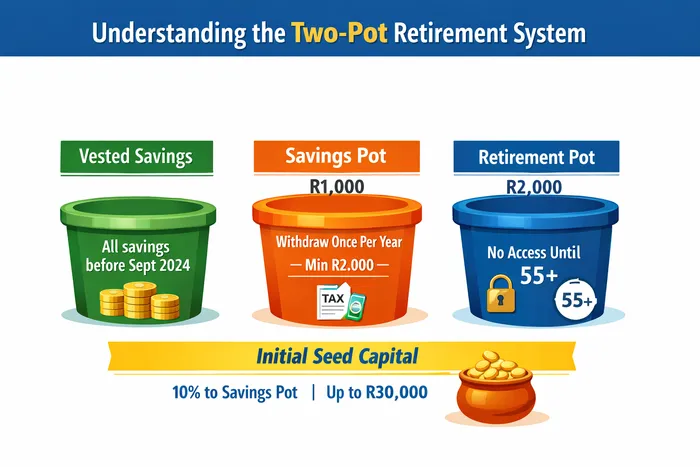
Understanding the Two-Port retirement system.
Image: Copilot
To ease the transition, members received seed capital when the system began. Ten percent of their vested component, capped at R30,000, was transferred into the savings pot. This ensured immediate access to funds, though withdrawals remain limited to the balance available.
The remainder of the vested component continues to sit outside the two-pot system. If a member resigns, this portion is paid out (after tax). Otherwise, it forms part of their retirement lump sum.
Withdrawals from the savings pot are subject to tax. This is because retirement contributions are tax-deferred: they are not taxed when earned but when eventually paid out. By withdrawing early, members access untaxed income, triggering immediate taxation.
Phil Le Feuvre, a member of the South African Reward Association (SARA), explained: "That means a member who withdraws R10,000 at a marginal rate of 31% may be disappointed to find that they lose R3,100 to tax, and only get R6,900 to spend."
Savings pot withdrawals are taxed at the member’s marginal rate, while vested component withdrawals continue to be taxed according to Sars’ severance benefit tax tables. Importantly, withdrawals require a tax directive, meaning members must be compliant with Sars before funds are released.
Fund administrators continue to play a crucial role in guiding members through the system. Clear communication about tax implications, withdrawal rules, and compliance requirements is essential.
Micaela Paschini, tax Attorney at Tax Consulting SA, emphasises: “Communication will be vital to ensure the two-pot system rolls out as smoothly as possible and is readily embraced by fund members.”
Members themselves also carry responsibility. They are legally required to provide administrators with up-to-date contact details to ensure they receive timely updates on new requirements.
For expatriates, the system introduces additional complexity. Withdrawals from the retirement pot are permitted upon ceasing tax residency, but only after a three-year lock-in period. The same applies to the vested component.
Khutso Makgoka, legal consultant: expatriate tax at Tax Consulting SA, notes: “For expats, the two-pot system may require the categorisation of each of the pots to be taxed separately in accordance with their differing values.”
PERSONAL FINANCE