


Discover why South Africans must consider liquidity in estate planning. An Event of Death Analysis can help prevent financial strain on heirs and ensure a smooth estate administration process.
Image: Unsplash
A recent case involving the winding up of a high-value property estate, comprising a hotel and a portfolio of residential properties, has exposed a costly and often overlooked gap in South African estate planning: liquidity at death. While the estate held significant value on paper, it was almost entirely tied up in immovable assets, leaving little to no cash available to settle estate duty, taxes, and administration costs.
As the estate moved through the formal winding-up process, these obligations became immediately payable, placing pressure on the executor to raise funds. With no liquidity available, the heir was forced to sell off assets, including income-generating properties, under time-sensitive conditions. The result was not only financial strain and disruption to the estate’s long-term value, but also exposure to interest and penalties from the South African Revenue Service.
While many South Africans believe that funeral policies or a valid Will are sufficient preparation for death, financial experts warn that this is far from the full picture. The reality is that death triggers a complex financial event, one that can leave heirs scrambling if not properly planned for.
This is where an event of death analysis becomes critical.
People tend to plan for the emotional aspects of death, but not the financial consequences. An Event of Death Analysis helps individuals understand exactly what costs will arise in their estate and whether there is enough liquidity to meet those obligations without placing strain on their loved ones.
The hidden costs of dying
At the centre of the issue is a widespread misunderstanding: funeral cover addresses immediate expenses, but does not account for the administrative and tax-related costs of winding up an estate.
When a person passes away, their estate must settle all outstanding obligations before any assets can be distributed to heirs. These costs can be high and, crucially, often require cash, not property or illiquid investments.
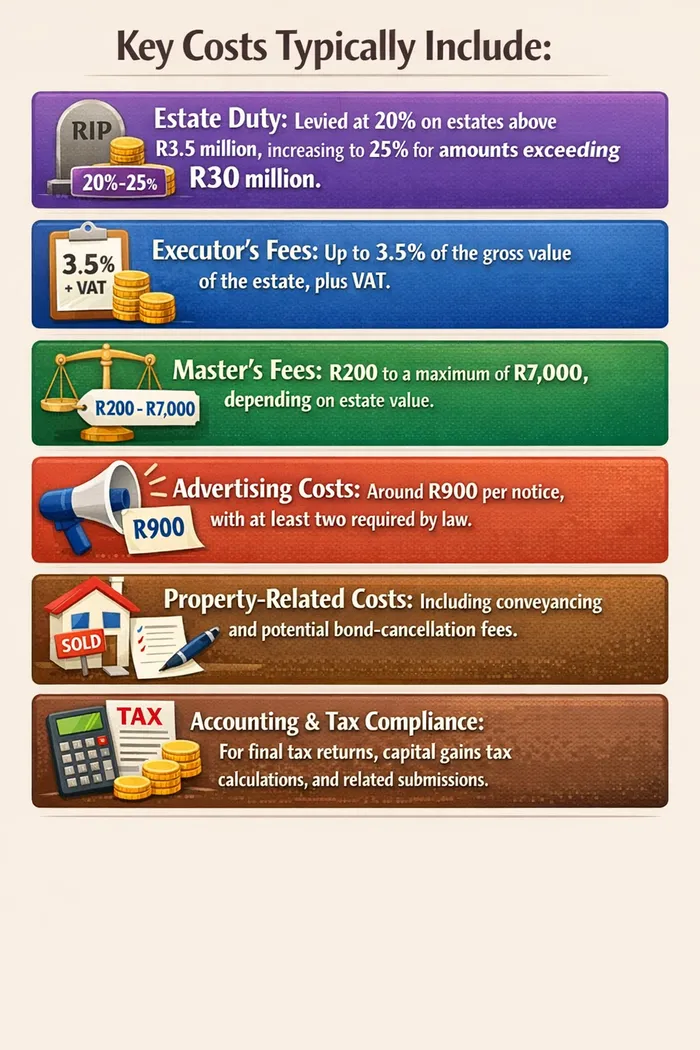
Key costs typically include:
Image: AI Lab
In addition, capital gains tax may be triggered on the deemed disposal of assets at death, and any outstanding debts, including personal loans, may become immediately due and payable.
Your estate doesn’t simply pass to your heirs; it must first settle with Sars and any creditors. If there isn’t sufficient liquidity, even a solvent estate can become practically unworkable.
The recent case highlights a common problem: estates that are asset-rich can be cash-poor. In such situations, executors may be forced to ask heirs to contribute funds to cover shortfalls. If this is not possible, assets, often family homes or investment properties, may need to be sold to settle debts and administrative costs.
This can undermine long-term wealth preservation and derail carefully intended inheritance plans. It’s not uncommon for families to lose generational assets simply because there wasn’t enough cash in the estate to cover the costs of death. That’s exactly what an Event of Death Analysis aims to prevent.
Planning beyond the Will
While having a valid Will remains essential, experts stress that it is only one component of effective estate planning.
A comprehensive approach should include:
Estate planning is not about death; it’s about protecting the people you leave behind. By taking the time to assess the financial impact of death in advance, individuals can ensure that their legacy is preserved, rather than eroded by avoidable costs.
Ultimately, an Event of Death Analysis is a practical exercise that can mean the difference between a smooth estate administration process and a financial crisis for surviving family members.
As the recent case illustrates, failing to plan for liquidity can turn an inheritance into an obligation and a legacy into a liability.
Proper planning gives families options. Without it, they may be left with no choice at all.
* Rouchos is the managing director of Hobbs Sinclair Legacy.
PERSONAL FINANCE