


Will the new measures introduced by private medical schemes be enough to reverse the trend of downgrading and abandonment? As healthcare costs continue to rise, South Africans face an urgent call to secure their health and protect their wellbeing amidst economic uncertainty.
Image: Pixabay
In a nation where health and well-being are increasingly prioritised, the stark reality of South Africa's medical aid landscape reveals an alarming gap.
Only 15% of the population have access to private healthcare, forcing the vast majority to rely on an already overburdened public health system.
As soaring costs of living continue to dominate household budgets, many are reluctantly downgrading their medical aid or abandoning it altogether.
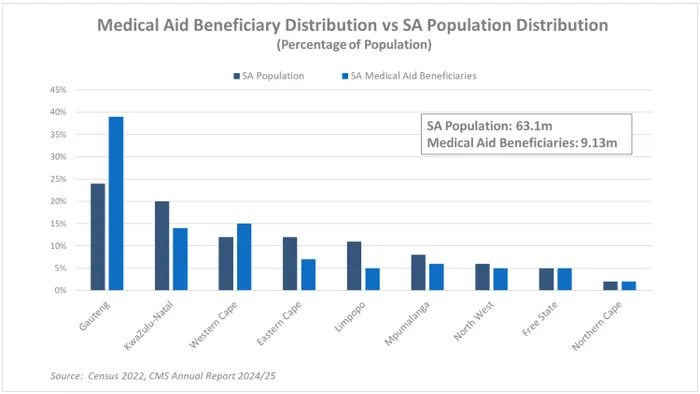
According to Andrew Fulton, Director at Eighty20, fewer than 10 million of the country’s 63 million citizens are members of various medical schemes.
"This leaves roughly 85% of the population dependent on public healthcare, which struggles to meet demand," he said.
The financial burden of the existing members, however, is striking. The 9.13 million beneficiaries funded R227 billion in medical scheme contributions, along with R24.3 billion directed towards medical savings accounts, culminating in a staggering total of a quarter of a trillion rand.
In comparison, the government's allocation to healthcare was set at R277 billion for the 2024/25 fiscal year, highlighting a significant imbalance in funding.
The demographic analysis presented in the MAPS and BrandMapp reports via the Eighty20 Data Portal provides further insights into the flawed landscape of medical aid coverage.
Notably, medical aid penetration is substantially higher among affluent segments—50% of Heavy Hitters and 40% of Comfortable Retirees—while economic status and educational background heavily influence access to these services.
The notion of 'over-indexing' emerges as an essential tool to understand these disparities. Households led by individuals with post-matric qualifications show a marked increase in medical aid uptake, suggesting that financial capacity and health literacy play crucial roles in determining coverage.
Marriage and parenthood also serve as pivotal moments for health protection prioritisation—decisions often influenced by increased responsibilities.
Further compounding these issues, inflationary pressures have continued to push medical aid premiums skyward.
Will the new measures introduced by private medical schemes be enough to reverse the trend of downgrading and abandonment? As healthcare costs continue to rise, South Africans face an urgent call to secure their health and protect their wellbeing amidst economic uncertainty.
Image: Supplied.
The Council for Medical Schemes (CMS) noted that medical inflation typically surpasses consumer price index (CPI) figures by two to three percentage points. In 2025, contribution increases outpaced inflation by a staggering 7.1 percentage points.
Amidst ongoing economic volatility, the ripple effect is clear: 14% of consumers are contemplating downgrading their medical aid schemes, with medical insurance coverage having experienced a 50% growth since 2023.
Discovery Health, South Africa's largest open medical scheme, has notably shifted in response to these trends.
Their recent annual report indicated membership declines in nine of their sixteen core plan options as constituents continue to seek affordability over comprehensive coverage. While many are not entirely exiting the medical aid system, they are instead opting for lower-cost coverages. In response, the company introduced 'Active Smart' in early 2025—tailored to attract younger professionals and new entrants to the medical aid market.
Dr Ron Whelan, CEO of Discovery Health, stated, “Active Smart delivers a bespoke solution at a competitive price to expand access to medical scheme cover.” Offering a product that appeals to young professionals with an income threshold of approximately R20,000 per month, the new initiative taps into an expansive demographic, with 300,000 individuals under 35 fitting the financial profile.
While the overall growth of the Smart Series has been recorded at 17%, the specific uptake of Active Smart remains cautiously monitored. The data indicates that major schemes like Discovery Health, GEMS, and Bonitas, representing over half of all beneficiaries, face a pressing need to broaden access while also addressing the worrying trend of members downgrading or exiting their schemes altogether.
As South Africa grapples with a stark healthcare divide, this landscape exposes both challenges and opportunities.
Addressing the needs of an increasingly budget-conscious consumer base while navigating public expectation will demand creativity and commitment from the private health sector.
PERSONAL FINANCE