

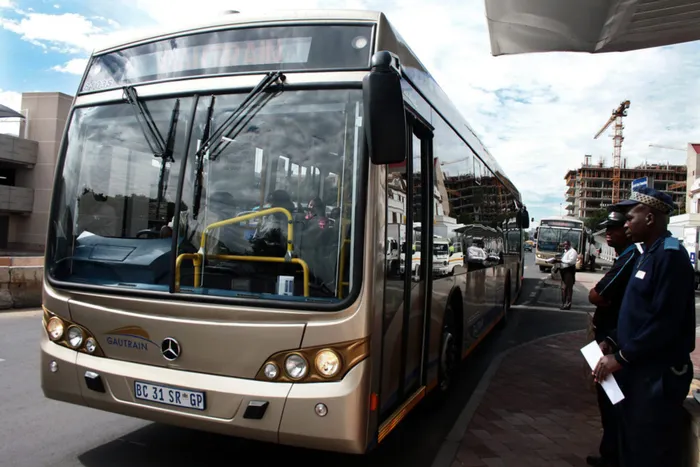
Gautrain bus services have been frequently disrupted. Gautrain bus services have been frequently disrupted.
In all the frenetic debate over the e-tolling of Gauteng’s freeways, one aspect has been seriously overlooked – the availability (or rather the lack) of an effective public transport alternative.
In 2003, the then mayor of London, Ken Livingstone, introduced a “congestion charge“. All private cars entering a large area of the city during the morning peak hour were required to pay a fee. As I write, it stands at about R120 per day. The move was understandably unpopular, but its effect was softened by the fact there was an alternative in the form of an integrated public transport network, and even more by the promise the fees would be used to improve that network. And they were – lots of new buses were introduced and were able to use priority lanes made possible by the reduction in car traffic.
Singapore was one of the first cities to bring in congestion charges of this kind. Like London, the decision was unpopular but – like London – Singapore already had a high-quality public transport system. It was possible to get from any part of the city to any other using a “seamless“ integrated network, and using just one ticket for the whole trip. There has been a continuous programme of public transport improvements since the implementation of the congestion-charging scheme.
The existence of a quality public transport alternative has been the pattern wherever urban road tolls have been introduced – but it is self-evidently not the case in Gauteng. It must be accepted Gauteng cannot develop a modern integrated public transport network in a matter of months. But the good news is the government has said quite clearly public transport will be improved as part of the e-tolling package.
On February 4, 2011 Sanral announced the tariffs that were to be applied on Gauteng freeways when e-tolling started a few months later, in June. The public outcry was immediate and angry.
Two weeks later, on February 22, Transport Minister Sibusiso Ndebele said the implementation of the tolls would be suspended. A task team was to be set up to review the entire financial model. Ndebele said: “Government will also be looking at various short-term improvements in public transport and take necessary remedial actions.”
On March 2 a follow-up announcement from the Department of Transport, headed “Gauteng Public Transport Transformation Committee”, said: “A steering committee chaired by Director General of Transport George Mahlalela held its first in a series of meetings today to discuss solutions to the public transport challenges facing Gauteng. Minister of Transport Sibusiso Ndebele is leading a growing chorus in government which believes that while long-term solutions are being rolled out, immediate remedial solutions will go a long way in easing the lives of frustrated commuters around our major centres.”
The sense of anticipation about “immediate remedial solutions“ was increased when, on March 29, the Department of Transport placed display advertisements in Gauteng newspapers inviting members of the public to make submissions to the steering committee. They were requested to submit their proposals in line with the committee’s two workstreams:
l Financial and tariff modelling.
l Public transport transformation.
The phrase “public transport transformation“ was used again. But then – silence. The attention turned instead to a different steering committee, one set up by Gauteng Transport MEC Ismail Vadi. This was announced on June 6, 2011. It is intended to oversee the development of a Gauteng Integrated Transport Master Plan (ITMP). The plan has a 25-year time frame. As far as public transport is concerned, that is somewhat different from the “immediate remedial solutions“ envisaged by the national Department of Transport.
However, the Gauteng Steering Committee was also required to ensure there was a short-term, five-year implementation plan for approval by January 31, 2012 which, in the words of Vadi, “we can operationalise immediately, to change and improve our public transport system”.
The downside is that the short-term plan appears not yet to have been delivered to the MEC. Newspaper reports said it was not now expected until June this year. Whatever the reason, it might be thought to reflect unfavourably on the urgency with which public transport improvements are being viewed – and e-tolling is due to start on April 30.
What should be done in the short-term? The answer is the introduction of a set of province-wide trunk (or corridor) bus routes. It must be recognised Gauteng is a city region. Municipal boundaries do not confine its trunk roads. Its public transport trunk routes must equally serve Gauteng City.
Gautrain is an example. We need to replicate its trunk/corridor characteristic. The difference is while Gautrain took about five years and R25 billion to build, the Gauteng City trunk bus network (let’s call it GauBus) must be in place in something closer to five months, and with a couple of zeroes knocked off the implementation cost.
The core of the network must be a number of north-south and east-west GauBus routes. Mamelodi to Roodepoort via Randburg is an example.
These trunk routes will offer many trip opportunities. But just as important is, because they will intersect, they will provide a basic network enabling users to get from any part of Gauteng City to any other. The route sketched above would intersect with a route from, say, Benoni to Laudium via Midrand. Local services, designed by individual municipalities, will feed into the intersect points and elsewhere along the trunk routes.
In the first instance the interchanges, and the trunk services, will be fairly rudimentary. They must not be oversold during the early stages. The important thing is the network will actually exist on the road, rather than in yet another plan. The early experience of operations can be used to fine-tune the system. The important thing is to get the rubber to hit the road.
Inevitably some GauBus services will initially run with few passengers. But it is accepted throughout the world that an effective public transport system is essential to the economic success of any large city in a developed economy. Financial support for operations is provided in recognition of this crucial role.
One consideration must be that of the effect on taxi operators. They currently carry as many passengers as Gauteng’s bus and rail services combined. Existing government policies envisage taxi owners becoming shareholders in formal-sector bus companies. That avenue must be pursued in the case of GauBus.
This is a bare outline of what can and should be done in the very short term. It cannot be implemented before April 30, so this might be another factor to be taken into account in the e-tolling debate.
But given political will, an empathetic national Treasury, and the right administrative capacity, Gauteng City can in a very short time have a basic integrated public transport system which, at the moment, simply does not exist.
l Paul Browning is an independent transport consultant