

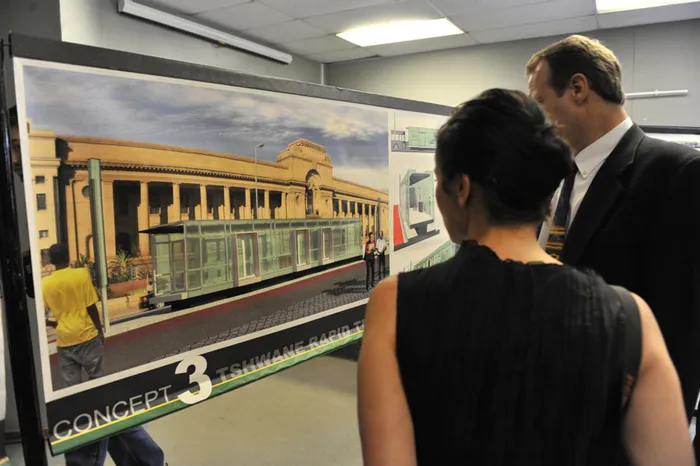
A concept poster depicting the BRT system for the city. Picture: Masi Losi A concept poster depicting the BRT system for the city. Picture: Masi Losi
Tomorrow at the CSIR a national workshop has been arranged about developments in bus rapid transit (BRT), the high-speed bus system which uses dedicated lanes and has mini-stations rather than bus stops.
The workshop comes at an appropriate time for the City of Tshwane.
The first BRT route in the city will run between Hatfield and Paul Kruger Street in the CBD.
Perhaps by coincidence, construction work on the first station – next to the Gautrain station in Hatfield – was due to begin yesterday. So Tshwane is poised to join other cities operating BRT lines.
However, it may be necessary to exercise some caution.
Despite efforts and genuine political will over the past five years, there is only one full-scale BRT line in operation, in Joburg; and one “starter” line in Cape Town.
What we have seen is a situation where the infrastructure has been completed only to lie unused while the “soft” issues are dealt with.
Tshwane must avoid this.
Legislation allows the local authority to offer a 12-year negotiated (not tendered) contract with the existing bus and taxi operators whose businesses will be affected by the BRT. This is where the delays arise.
In the first – and so far only – full-scale BRT line, Rea Vaya Phase 1a in Joburg, it was agreed that the only affected operators were minibus taxis. Discussions with the taxi associations began in 2007.
By mid-2009 the infrastructure and a brand new new fleet of buses were ready, with the intention that they would be used for the Confederations Cup in June that year. But the BRT roll-out was deferred until after that event, and when it began in August 2009, the city authorities had to bring in a temporary operating company.
It was not until February last year that the 200 or so taxi operators agreed to form a company to take over.
And that was in a situation where the only operators involved were taxis.
In nearly all other instances, including Tshwane, there will also be bus operators. The taxi leadership may bring up all sorts of irritating issues and engage in endless debates, but the big bus companies have more sophisticated means of protecting the interests of their shareholders.
In Cape Town the major operator, Golden Arrow Bus Services, said it was going to take court action to prevent the city authorities from bringing in the first full BRT contract.
Infrastructure for Joburg’s second Rea Vaya line is in place, but the city expects to spend another full year in negotiations with bus and taxi operators.
These are matters which the Tshwane BRT planners must take into account.
The delays stem from arguments over who gets what or, more formally, the allocation of shareholdings in the BRT operating company.
This will be on the basis of market share. In turn, this means there must be agreement on the existing passengers carried and income.
Bus companies have ticketing systems, so they can put forward claims backed by figures.
By contrast, taxi operations are cash-based. There are no statistics. The planners may overcome this by arranging sample head counts.
No matter how well these surveys are done, there will always be disputes over the figures that emerge.
The situation is reminiscent of the old poem about the ship that was lost “for a ha’porth of tar”.
Billions of rand are being spent on infrastructure and new buses which can’t be used – because there is no accurate way of establishing how many passengers are using the taxis.
A solution may be at hand in Tshwane. Just down the road from the CSIR, a small team at the Blue IQ Innovation Hub has developed a webcam-based system to be installed in taxis.
It uses time-lapse photography to count the number of passengers.
It is yet to be tried in a real-life application, but if it works it might free up the BRT implementation logjam.
Tshwane has lagged somewhat behind Joburg and Cape Town.
But even those cities have found the going slow. The city planners can learn from what has gone wrong elsewhere in implementing the BRT.
The evidence will show the need to do something different; something that will improve public transport more quickly. If they are able to do that, Tshwane will jump from being the laggard to being the leader.
l Paul Browning is a public transport analyst with TransForum Business Development.