

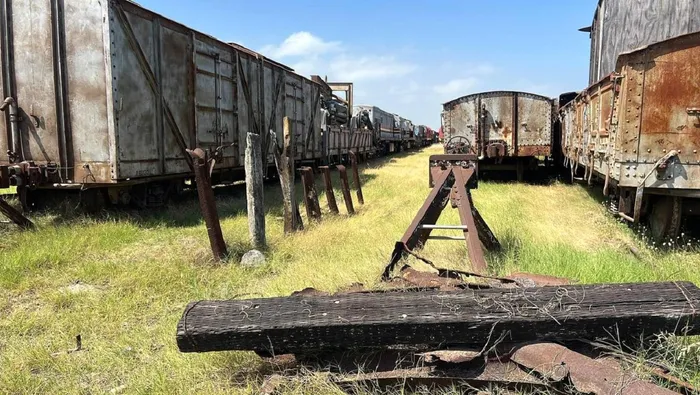
Angola’s Lobito Corridor, a flagship infrastructure project, has drawn the attention and funding of American and European investors.
Image: Supplied
THE Lobito corridor project is as much a laudable critical infrastructure initiative as it is an incident of a complex geopolitical manoeuvre by Washington and Brussels. It is born out of a deep revulsion that China has cultivated a lot of infrastructural and political leverage over three mineral-endowed countries, represented by Angola, the Democratic Republic of Congo (DRC) and Zambia.
For one, Angola holds 26 of the 51 internationally recognised critical minerals. The DRC, for its part, supplies over 70% of the world’s cobalt, and many other rare earths besides. Zambia leverages the copper vantage, so much so that between the DRC and Zambia, they hold 91 million tons of copper reserves, 80 million tons and 11 million tons, respectively.
According to the International Energy Agency projections, the copper demand could triple by 2040, and the cobalt demand could increase sixfold over the same period.
The pedigree of this initiative is long and legendary, almost to the status of a phoenix that has risen out of the ashes of despair of colonialism, civil war and dereliction. Today, it stands at the centre of a highly emotive narrative of critical minerals transfer for the advancement of technology in the 21st century.
Originally called the Benguela corridor, it was first built by the Portuguese in 1903 on the basis of a 99-year lease, running the length of occupied Katanga to the Lobito port. It was completed in 1929, permitting the first load of copper and uranium to reach Lobito in 1931. In 2001, the original 99-year lease concession terminated.
As a consequence, the railway and its associated infrastructure reverted to the Angolan government as the successor state to the Portuguese. A year later, in 2002, the Angolan civil war ended.
That first uranium stock produced in the Union Minera Katanga was so important that it was used in the 1942 Manhattan Project. When fully enriched to weapons grade, it was fitted in the Little Boy bomb that was dropped in Hiroshima, Japan, in August 1945.
Beijing’s interest in the region had begun to manifest in earnest. As early as 2006, China provided a $2 billion (R34bn) rail rehabilitation loan-for-oil repayment program to Angola. The plan was to revitalise the facility and deck it with 67 stations along its length, permitting 20 million tons of cargo, including 4 million passengers per annum. The Lobito deep seaport and Benguela rail renovation program was destined to conclude in 2014.
In order to curtail the Chinese expansion in this mineral-rich triangle, Washington promoted the formation of the Partnership for Global Infrastructure and Investment (PGII) in 2022. The objective of this partnership, according to the US Institute of Peace, was to manage 1344 kilometres of rail commencing from Kabwe in Zambia to the Lobito port in Angola, with an added 400 km diversion to the mineral-rich enclave of Kolwezi in the DRC.
The following year, a pact among four sets of stakeholders emerged. The first set of stakeholders was between the United States of America and the European Union, both pledging to invest in this critical infrastructure that would define regional dominance in the access and transfer of critical minerals. The second set was between and among the countries concerned, to wit, Angola, the DRC and Zambia.
The third set involved African-based financial institutions. These were the African Development Bank and the African Financial Corporation. The fourth and most interesting was composed of the private sector. These were Trafigura of Switzerland, Mota-Engil of Portugal and Vecturis of Belgium.
In 2023, Angola advertised a tender to operate the Benguela railway line to Lobito over a 30-year concession. The fourth stakeholder set, consisting of Trafigura, Mota-Engil and Vecturis, duly morphed into a concessionaire called the Lobito-Atlantic Railway. For reasons which are not apparent, the Chinese, who had financed $2bn of the first phase of rehabilitation, lost the bid to the Trafigura-led consortium, which is struggling to raise the $1.7bn for the expanded mandate of the concession.
The Chinese may have lost the bid, to whatever degree of prescience lost can be defined. But they hold a significant 50-year lead advantage. Between 1968 and 1970, President Kaunda of Zambia and President Nyerere of Tanzania deliberated on how to resolve the difficulty that Zambia faced in its inability to efficiently export its copper ores in quantities that were commercially sustainable.
Approaching Chairman Mao Zedong of China, they found him preoccupied with promoting a resolution in the United Nations which would recognise the People’s Republic of China as the sole representative of the Chinese people, thereby derecognising the Republic of China.
The newly independent African countries quickly rallied in favour of the Chinese initiative. The ‘quid’ was Resolution 2758 in 1971 in favour of China. The ‘quo’, was the Tanzania-Zambia Railway, a 1860-kilometre line commencing from Kapiri-Mposhi terminating in Dar-es-Salaam, affectionately known as the ‘Uhuru Railway’. Built at a staggering 980 million Yuan interest-free, with 50 000 Chinese technicians, it was an amazing teamwork that was commissioned in 1975.
And so, the table was set. The Lobito Atlantic Railway was preparing for a celebration. Joe Biden even took his only visit to the African continent to Angola, as part of the celebratory victory lap of his war-ridden presidency. But neither he nor the multi-decked categories of stakeholders could foretell the political tremor that would visit the land of the free and the home of the brave.
The only permutation the program did not accommodate, nor did the entirety of the commonwealth of nations for that matter, is the fact that every US presidential election outcome is, like a category 5 hurricane, a tumultuous, destabilising dread. Or to be exact, that US President Donald Trump, whether in his first term or in the current stint as POTUS 47, was and continues to be an unrelenting force majeure.
President Trump despises a lot of things that so many of his predecessors accomplished in their successive terms of office, at least those that served more than one term. But he reserves a special vitriol for former US President Joe Biden, who, for a laundry list of comical reasons, served only one term.
To the extent predictable, everything that Joe Biden and his administration proposed during his incumbency was bound to be vitiated or insouciantly ridiculed and, no sooner overturned, the Lobito corridor initiative could not conceivably escape the tempest of a cantankerous Donald.
While the Donald preoccupied himself with the overarching powers of the newly minted Department of Government Efficiency, DOGE for short, closing some aid agencies as well as defunding others, his sphincter of thrift viciously swung Lobito’s way. And so, the rail to port geopolitical strategic ambition designed to counter the Chinese Belt and Road Initiative was accordingly guillotined.
No matter who wins the consequentiality of this wrestling, substantially or in whole, the victory, however measured, will inevitably complicate whatever geopolitical leverage the losing competitor would have dutifully been vying for.
* Amb. Bheki Gila is a Barrister-at-Law.
** The views expressed here do not reflect those of the Sunday Independent, Independent Media, or IOL.