

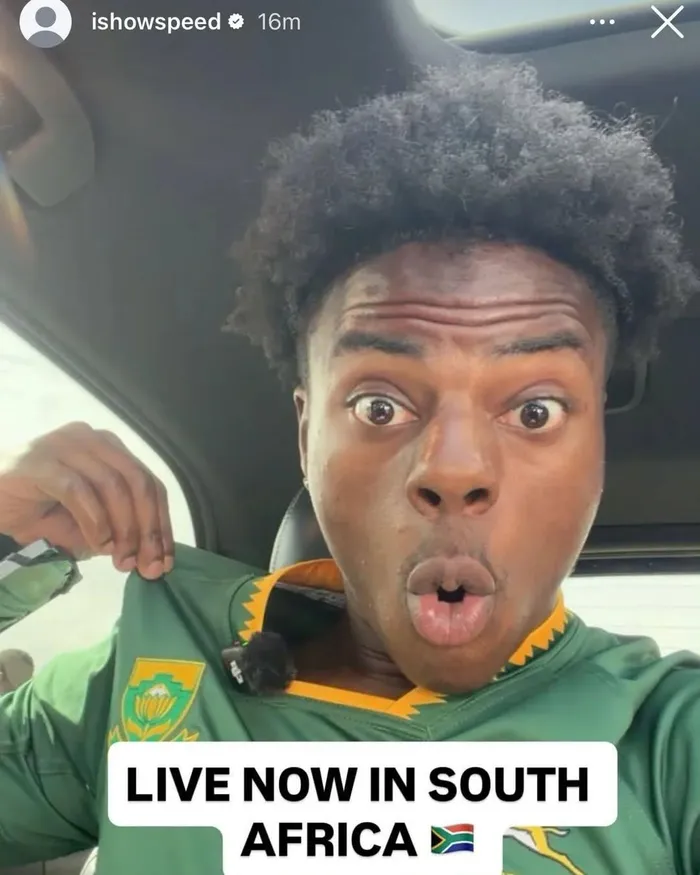
Popular American YouTuber IShowSpeed reached 47 million subscribers while touring South Africa, inadvertently challenging long-held stereotypes and transforming how Americans view the country through his authentic livestreams and positive experiences
Image: Instagram
WHEN YouTuber and live-streaming star IShowSpeed landed in South Africa, the internet did what it always does: laughed, judged, and unleashed an avalanche of memes.
A boisterous American streamer barking at sharks, sprinting alongside a cheetah, losing his mind over kota and KFC? That’s just easy content. Disposable entertainment, even.
And yet, to dismiss moments like these as frivolous is to fundamentally misunderstand how online power operates — a power that increasingly sets the tone for social norms, influence, and cultural authority today.
What happened during Speed’s visit was not just viral chaos — it was narrative disruption. It showed how a single stream can recalibrate what the world thinks about a place, a people, and an entire culture.
For decades, South Africa has been packaged for global consumption in painfully narrow ways. Either we are a postcard: Table Mountain at golden hour, wine farms, safaris and sunsets. Or, we are a giant warning label: crime stats, corruption headlines, rolling blackouts, GBVF, poverty, porn, and so much more.
What often goes unseen are the moments between the extremes — the rhythm, the routines, the quirks, the warmth, and the chaotic normality that really defines our society.
This is exactly why moments like these are so important. They show what always gets left out of the shiny G20 images and the curated safari snapshots — they show raw, real, unfiltered South African life.
Speed’s livestreams reached millions of viewers worldwide, many of whom had never meaningfully encountered South Africa beyond headlines or Hollywood tropes. And instead of a polished tourism reel, they saw the country as it actually breathes: chaotic streets, excited kids, unfiltered reactions, awkward exchanges, laughter that needed no translation. This is exactly what defines our society: the ordinary moments that are met with extraordinary energy.
We often underestimate how deeply global perceptions shape material reality. Investment decisions, diplomatic relations, tourism flows, and even how our citizens are treated abroad — are all influenced by our story. Throughout history, for far too long, South Africa’s story has been told about us, rarely with us, and almost never by us. In that vacuum, stereotypes calcify. But the digital age — through social media, blogs, streamers, and more — is rapidly changing that.
Livestream culture isn’t neat, nor is it curated. And that’s exactly why it matters. It allows people to see places not as abstract problems or exotic destinations, but as lived spaces populated by humans with personalities, humour, flaws and agency. When millions watch a streamer get overwhelmed by South African energy in real time, the country stops being a concept to outsiders and becomes a real, relatable place.
Of course, this is not to romanticise the moment or the medium. A streamer’s visit does not fix inequality, end violence, or resolve deeply-rooted structural and institutional injustices in our society. A viral clip cannot replace policy, nor should entertainment distract us from the very real crises South Africans face daily. But representation and reality are not mutually exclusive — they are vividly intertwined.
The danger is not that the world sees us laughing; it is that it only ever sees us suffering.
There is also something deeply democratic about who gets to carry the narrative now. For decades, global storytelling power sat with legacy media, foreign correspondents and Euro-Western institutions that frequently disregard cultural context or accountability. Today, a phone and a data connection can rival a broadcast studio.
A photo’s timestamp can stand as key legal evidence. An IP address can lead to the crackdown on rampant criminal syndicates. The rules have certainly changed: now, power travels at the speed of a click. Stories no longer need bureaucratic permissions — they just need someone bold enough to capture them.
Young people across the continent understand this instinctively. They know that culture travels much, much faster than policy. That visibility certainly precedes legitimacy. That being seen — truly seen — is a major form of power in today’s society.
What Speed’s visit revealed is not that South Africa needs more visibility or validation, but that the world is hungry for an unfiltered African presence. Not curated excellence, or trauma narratives. Just real-life people, their society, their streets — moments that can’t be staged, scripted, or sanitised.
When viewers saw kids confidently approaching a global star, when they heard local slang, saw vibrant township streets, shared delectable traditional meals, spontaneous dancing, and more, they were forced to completely reconsider what they thought they knew about South Africa.
And perhaps that is the most transformational part: the quiet undoing of assumptions.
If we are serious about reclaiming our global image, we cannot only rely on official campaigns, glossy ads or diplomatic soundbites. We must also make peace with the messy, decentralised, people-driven storytelling that defines this era.
That includes influencers, streamers and creators who may not fit neatly into respectability politics or conformity — but whose reach is absolutely undeniable. This isn’t just entertainment. It’s a serious wake-up call about who really has the power to tell the story.
Even in reaction videos and commentary on Speed’s visit, what stood out was how little the world truly knows about SA. From butchered history to recycled stereotypes to obsession with our worst headlines, outsiders see a narrow, lazy, oversimplified reality. Narrative power — now in everyone’s hands — is helping South Africans reclaim their story.
Storytelling power isn’t in brochures or press releases — it’s in the chaos, the streets, the people refusing to be boxed in. That’s how the world meets South Africa, and that’s how we take back the narrative.
We can’t control every frame, but we can flood the world with reality: streets, slang, laughter, chaos, life that refuses to be simplified. The cameras, the streams, the phones — the tools are ours. We have the power to shape how the world sees us.
As Brené Brown wrote: “Owning our story is the bravest thing that we’ll ever do.”
* Tswelopele Makoe is a gender and social justice activist and editor at Global South Media Network. She is a researcher, columnist, and an Andrew W Mellon scholar at the Desmond Tutu Centre for Religion and Social Justice, UWC.
** The views expressed here do not reflect those of the Sunday Independent, IOL, or Independent Media.