

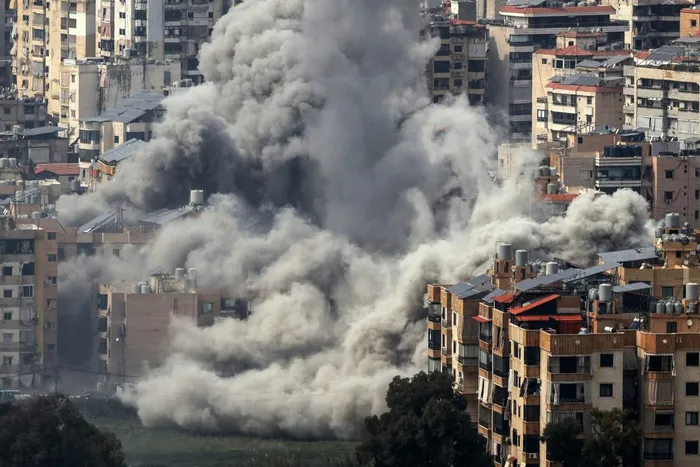
Smoke rises from the site of an Israeli airstrike in Beirut’s southern suburbs on March 6, 2026.
Image: AFP
Mansour Shakib Mehr, Iran's ambassador to South Africa, has harshly criticized the United States over the intensifying Middle East conflict, charging Washington with violating international law and operating without consequence.
Speaking about the escalating hostilities, Mehr warned that the international legal order is threatened by powerful nations attacking others without repercussions.
“When a country feels powerful and attacks others, it resembles the law of the jungle, and that cannot be accepted,” he said.
“The sovereignty and independence of countries must be respected. Countries must raise their voices in condemning aggression against Iran.”
Mehr also warned that world leaders should not remain silent about the actions of US President Donald Trump, arguing that similar actions could eventually target other nations.
“Yesterday, the President of Venezuela was kidnapped. Today, the Leader of Iran was assassinated, and Iran is subject to an illegal attack. Tomorrow it may be the turn of South Africa or any other independent country,” he said.
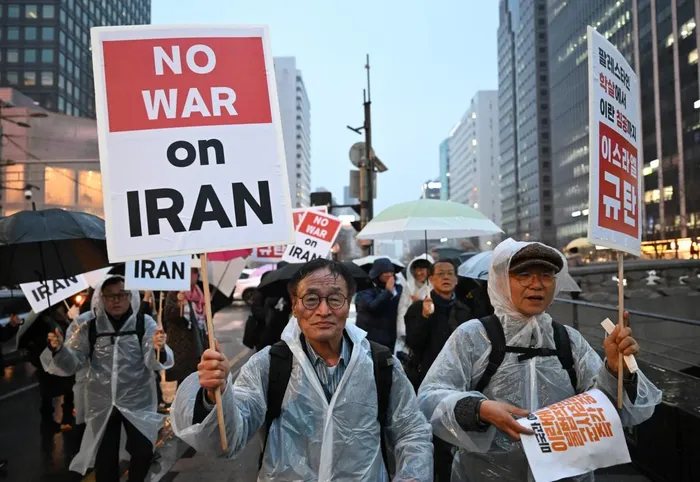
Protesters carry placards reading "No war on Iran!" as they march toward the US embassy during a rally condemning the US and Israeli attacks on Iran in Seoul on March 5, 2026.
Image: AFP
“Power does not create right. All countries possess equal sovereignty, and this sovereignty must be respected.”
The ambassador’s comments come after the United States and Israel launched coordinated strikes on Iran on February 28, following weeks of military build-up and warnings from Trump. The attacks targeted Iranian military facilities and senior leadership, killing Supreme Leader Ali Khamenei.
Iran’s clerical body, the Assembly of Experts, subsequently appointed his son, Mojtaba Khamenei, as the new Supreme Leader.
Iran responded with strikes on US military installations and key energy infrastructure in the Gulf. Israel has also intensified air strikes in Lebanon after Hezbollah launched rockets into Israel in support of Iran.
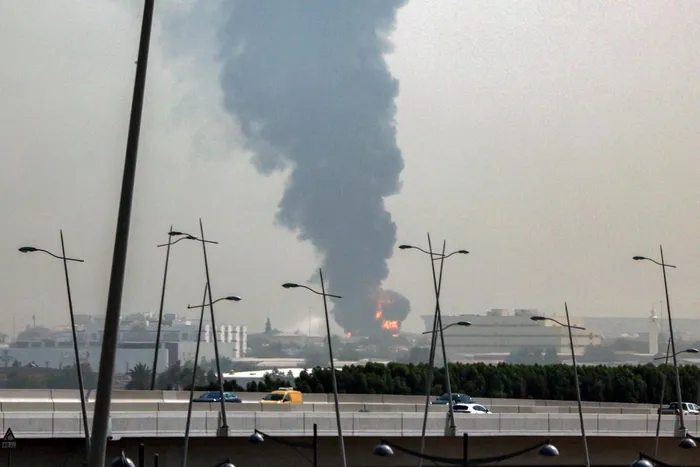
A smoke plume rises from an ongoing fire at Dubai International Airport in Dubai on March 16, 2026.
Image: AFP
More than 1,800 people have reportedly been killed so far, including eight US service members and at least 175 children who died in a reported US strike on an Iranian elementary school. Trump has issued conflicting statements about Washington’s objectives and the potential trajectory of the conflict.
The confrontation has rapidly escalated into a wider regional war with global economic implications. Iran’s partial closure of the Strait of Hormuz, a key global oil shipping route, has triggered a major energy shock, prompting the International Energy Agency to release about 400 million barrels from strategic reserves.
Mehr insisted that the roots of the conflict lie in Iran’s longstanding pursuit of independence and resistance to external domination.
“The origin of the conflict and aggression by the United States against Iran lies in Iran’s pursuit of independence and its refusal to submit to domination,” he said.
He added that the country’s 1979 revolution was driven by public resistance to U.S. influence, and argued that Iran is also facing pressure for its support of the Palestinian cause.
“Regarding Israel, Iran is paying the price for supporting the Palestinian people and for rejecting Israel’s occupation and genocide against the Palestinian people and the region,” Mehr said.
He rejected the justification used by Washington and Israel for the attacks.
“The claim of pre-emptive self-defence has no basis in international law. Iran poses no imminent threat to the United States,” he said.
Mehr further argued that the strikes violated international law, specifically the prohibition on the use of force under the United Nations Charter.
According to him, attacks on civilian sites, including the reported strike on the Shajareh Tayyebeh School in Minab that killed around 170 children aged between seven and 12, amount to war crimes.
“Institutions responsible for maintaining international peace and security, particularly the United Nations Security Council, must fulfil their legal duties by condemning this aggression and acting to stop the illegal attacks,” he said.
Mehr also expressed deep scepticism about the prospects for diplomacy, saying Iran had twice been attacked while negotiations were under way.
“Iran wants to break the defective cycle of diplomacy, negotiation, attack, ceasefire, and then negotiations again,” he said.
“Our main priority is ensuring that aggression is not repeated and establishing lasting security in the region. We support diplomacy and de-escalation, but we must ensure that the other side will not exploit a ceasefire again.”
karabo.ngoepe@inl.co.za