

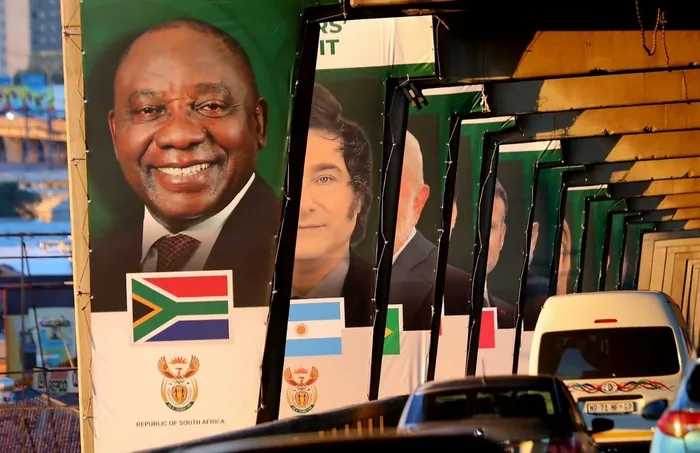
Washington’s absence, viewed from the massive attendance of the G20 members, highlights its waning influence, silent differences with many leaders who attended the summit, or a misreading of the contemporary geopolitical moment related to a rejection of transactional bilateralism in preference for equal, mutually representative, and beneficial multilateralism.
Image: Timothy Bernard / Independent Newspapers
The 20th Summit of the G20 held in Johannesburg, the first in African soil, offered a snapshot of shifting global power in ways that reinforce the need for sustainable focus, mutual solidarity and unity in Africa and the Global South.
The US, the biggest economy in the world, elected to snub the summit over its unsubstantiated ideological diplomatic criticism of South Africa. Washington’s absence, viewed from the massive attendance of the G20 members, highlights its waning influence, silent differences with many leaders who attended the summit, or a misreading of the contemporary geopolitical moment related to a rejection of transactional bilateralism in preference for equal, mutually representative, and beneficial multilateralism.
The Trump Administration has indicated that South Africa may not be invited to the G20 processes and summit to be held in Miami under the US presidency. The BusinessTech reported that Washington tabled a new bill that could exclude South Africa from the African Growth and Opportunity Act (AGOA). This suggests that Washington may escalate its coercive, punitive, and divisive foreign engagement, particularly with Africa and much of the Global South.
Gideon Chitanga, PhD, is an international relations and political analyst.
Image: Supplied
South Africa successfully held the G20 Summit with strong participation of key leaders from Europe, the Asia-Pacific region, Latin America, and the Caribbean regions. The participation of the Global South signified by the presence of the BRICS member countries, Asian, and Caribbean countries, and the presence of prominent African leaders, suggests the realisation of the need for geopolitical recalibration and strong solidarity in the Global South.
The BRICS+ has emerged as a multilateral game changer, bringing together emerging powers and other countries from the Global South to collectively advance self-help projects while consolidating the voices of the Global South.
South Africa in particular, and the African continent in general, seized this crucial moment to strongly advance priorities centred on energy transition, critical minerals, debt sustainability, and inclusive artificial intelligence (AI). Pretoria’s successful coordination of the G20 Summit also demonstrated the global resonance of multilateralism at a time when the has chosen to roll back from crucial shared global commitments.
The G20 is the premier forum for international economic cooperation and plays an important role in shaping and strengthening the global architecture and governance on all major international economic issues. The members of the G20 include the leading economic giants, China and the USA, members of the Group of 7 rich countries, Canada, France, Germany, Italy, Japan, and the United Kingdom, emerging economies such as Argentina, Australia, Brazil, India, Indonesia, the Republic of Korea, Mexico, Russia, Saudi Arabia, South Africa, Türkiye, the European Union (EU) and the African Union (AU) amon others.
Yet the process of the G20 demonstrated that multilateralism is alive and there is huge appetite to sustain equal global cooperation. The agenda and outcomes of the G20 showed concerted focus amongst participating countries on the key issues affecting the Global South and the rest of the world.
China, the second biggest economy in the world, unequivocally backed South Africa’s G20 Presidency and its role as the host of the its 20th summit. Speaking ahead of the arrival of Premier Li Qiang to South Africa, Lin Jian, a spokesperson for the Chinese foreign ministry stated that China supports South Africa's G20 presidency and stands ready to work with various parties under the theme "Solidarity, Equality, Sustainability" to build up consensus for upholding multilateralism, building open global economy, and promoting cooperation on shared development by all humanity.
China engaged with the processes of, and the G20 Summit with grace and maturity, demonstrating stable and reliable cooperation in the spirit of the Global Security Initiative. Beijing provided substantial financial support for South Africa’s G20 Presidency in addition to the broader bilateral investment and aid, generously contributing RMB 2 million (R5.34 million) to DIRCO and an additional US$2 million (R36.8 million) in support of the Leaders’ Summit.
In his speech to the summit, Premier Li Qiang highlighted the global governance challenges and called on global leaders to work together in upholding multilateralism and accelerating reforms of institutions such as the World Bank (WB), the International Monetary Fund (IMF), and the World Trade Organization (WTO) while emphasising the importance of unity and solidarity.
Li called for solidarity and the need to enhance the voices of developing countries in building a fairer and more open international economic and trade order. He reminded global leaders of the wisdom shared by President Xi Jinping during the 17th Summit of G20 that solidarity is strength, but division leads nowhere, noting that although G20 leaders came from diverse regions, with different systems and cultures, they have managed to overcome one challenge after another and promote global progress and development based on the spirit of solidarity.
He urged leaders to confront rising unilateralism and protectionism, escalating trade restrictions and divisive confrontation through the spirit of international solidarity and cooperation.
Premier Li informed the Summit that China has released its "Action Plan for Implementing the G20 Initiative on Supporting Industrialization in Africa and Least Developed Countries" in efforts to support debt reduction in developing countries. Working together with South Africa, which has also proposed a cooperative initiative to support Africa's modernization, China will establish the Institute of Global Development to promote common development among all nations.
During a courtesy meeting with Deputy President Mashatile, Li reinforced the commitment of China to work with South Africa to further enhance mutual political trust and maintain support, deepen mutually beneficial cooperation.
Both parties committed to deliver more outcomes of the all-round strategic cooperative partnership in the new era guided by the consensus between Presidents Xi and Ramaphosa as enunciated in their meeting in September 2024 in Beijing. The two leaders agreed to advance the implementation in South Africa of China's zero-tariff treatment for 100 percent of tariff lines for African countries which have diplomatic relations with China.
The two parties continue to broaden and upgrade bilateral cooperation and multilateral cooperation to advance shared mutually beneficial modernization. South Africa continues to see growing Chinese support, investment, and enhanced cooperation in such areas as new energy, automobiles, healthcare, digital economy, and infrastructure, among others.
China-South Africa cooperation in many ways demonstrates China-Africa cooperation and solidarity rooted in mutual respect, respect to national sovereignty and non-interference in the domestic affairs of partners. Premier Li emphasised China’s willingness to strengthen communication with South Africa within frameworks including the Forum on China-Africa Cooperation (FOCAC), ensuring the implementation of the outcomes of the FOCAC Beijing Summit, and jointly create a bright future of development and prosperity for China and Africa.
The Fourth Session of the South Africa-China High-Level People-to-People Exchange Mechanism (PPEM) and the 13th South Africa-China Strategic Dialogue to be held back-to-back in Beijing in December 2025, and the Bi-National Commission (BNC) to be held in South Africa in March 2026 will ensure stronger Africa-China cooperation.
Indeed, South Africa and the African continent have expressed strong support for the four major global initiatives proposed by President Xi, the need to promote multilateral communication and coordination, and uphold multilateralism and the authority of the United Nations.
The African Union (AU) and its sub-regions must equally strongly deepen intra-continental solidarity, and stand firmly with South Africa and the Global South.
Gideon Chitanga is a political science and international relations expert.