

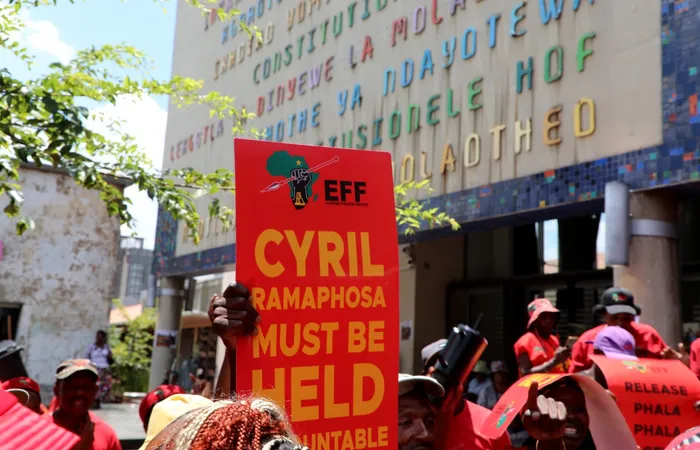
The promise made by EFF to put pressure on the Constitutional Court to release the findings of the investigation into the foreign currency found at President Ramaphosa’s Phala Phala ranch saw the EFF ground forces picketing outside the Constitutional court for the release.
Image: Timothy Bernard / Independent Newspapers
There is a haunting line once spoken by Steve Komphela that feels strangely appropriate for South Africa’s political condition in the age of Phala Phala:“I cry the language they don’t understand.”
Whether intentionally philosophical or instinctively poetic, the phrase capturessomething much larger than football, because South Africa today increasingly resembles a country trapped inside a constitutional conversation it can stillrepeat procedurally, but no longer fully understands morally, politically, orinstitutionally.And perhaps that is the deepest danger now confronting the republic.
Because South Africa’s real crisis is no longer whether President Cyril Ramaphosa survives the Phala Phala affair, nor even whether the African National Congress can continue managing the fallout of a scandal that has lingered over the presidency with unresolved constitutional weight. The deeper crisis is whether the country still understands the democratic language it oncespoke with certainty during the early constitutional era of the republic.
The language of accountability. The language of consequence. The language ofequality before the law. The language of institutional trust.
The language of constitutional morality. Because what began as a scandal involving foreign currency hidden on a private farm, a burglary, disputed reporting obligations, contradictory explanations, andwidening allegations of misconduct has gradually evolved into something farlarger than a political controversy attached to one president.
Phala Phala hasbecome a national mirror reflecting the widening gap between constitutional performance and constitutional conviction inside South African democracy. That is why the matter continues haunting the political imagination of the country long after the original shock faded from the headlines, because South Africans are no longer simply debating whether Ramaphosa acted improperly orwhether legal thresholds for misconduct were crossed.
They are confronting afar more unsettling question concerning what happens when the enforcement of accountability itself begins to feel too politically dangerous, too economically disruptive, and too psychologically destabilising for the governing system topursue decisively.
That is where democracies begin wandering into dangerous territory. Not through dramatic authoritarian rupture. Not through the overnight collapse ofconstitutional institutions. But through a quieter and psychologically undermining process in which principle slowly becomes negotiable wheneverpower, stability, and political convenience collide.
What South Africans have witnessed throughout the Phala Phala saga is notmerely scandal management in the ordinary political sense, but the rise ofsomething more sophisticated and more dangerous: governance theatre.
The performance of institutional seriousness without institutional closure, where investigations continue unfolding, parliamentary mechanisms continue activating, legal interpretations continue multiplying, and political actors continue staging competing narratives of innocence, conspiracy, and constitutionalism, while the republic itself remains trapped in a permanent stateof unresolved democratic suspension.Everything appears active. Everything appears procedural.
Everything appears constitutionally alive.Yet despite all this visible movement, the country remains psychologically stranded in a strange middle ground where accountability is continuously discussed, endlessly processed, and publicly dramatised without ever producingthe moral clarity necessary to restore collective trust in the equal application ofconstitutional principle.
This is the true meaning of governance theatre: the display of democratic motion without democratic certainty. And the danger of governance theatre lies precisely in how normal it eventuallybegins to feel inside societies exhausted by scandal fatigue, institutionaldisappointment, and permanent political crisis.
Democracies do not lose legitimacy only when institutions collapse spectacularly or openly abandon constitutional obligations. They also lose legitimacy when institutions remainvisibly operational while simultaneously failing to convince citizens that constitutional standards still apply equally regardless of political importance, economic consequence, or elite proximity to power.That distinction matters enormously because a state can continue functioningadministratively while weakening morally underneath its own constitutionalarchitecture.
Budgets may still pass. Courts may still operate. Parliament may still sit.Commissions may still release reports. Investors may still issue cautiousstatements praising institutional resilience.The machinery of democracy may continue moving publicly and continuously. Yet beneath that visible continuity, something essential can begin evaporatingfrom the republic itself: public belief that the system still means what it claimsto mean.
And once that belief begins eroding psychologically, democratic decline nolonger arrives dramatically.It arrives through emotional exhaustion.Citizens gradually stop asking whether accountability will happen and beginasking whether accountability is still realistically possible when sufficiently powerful political figures are involved.
That transition is historically dangerousbecause it alters not merely institutional behaviour but the moral culture surrounding democracy itself.The law may remain formally intact. Courts may still function independently. Elections may still occur regularly.
Political parties may still campaign vigorously.Yet accountability increasingly begins appearing conditional rather than fixed,dependent less upon constitutional principle than upon political timing, coalition arithmetic, market sensitivities, factional balance, and elite fears regarding whatthe system believes it can safely absorb without destabilising itself.
And once a democracy enters that terrain, it becomes increasingly difficult todistinguish constitutional prudence from constitutional hesitation, institutionalrestraint from institutional fear, and democratic stability from democraticavoidance.
That is why the deeper significance of Phala Phala extends far beyond the future of one presidency.
Even South Africans who continue supporting Ramaphosa, and even those whofear that his weakening could unsettle financial markets, intensify ANC instability, or deepen uncertainty inside an already fragile governingenvironment, must still confront the larger constitutional tension exposed by thismoment: whether a democratic order can remain morally legitimate once
accountability itself becomes entangled with calculations concerning politicalutility and systemic stability.Those fears are not irrational. They are real.But they do not erase the constitutional dilemma confronting the republic. Ifanything, they sharpen it.

nyaniso Qwesha
Image: Supplied
Because once a society begins quietly calculatingwhether certain leaders are simply too politically important to confront fullythrough ordinary constitutional standards, it has already entered dangerousdemocratic territory where equality before the law weakens beneath the weightof political exceptionalism.
History repeatedly demonstrates that constitutional democracies rarely decaythrough one spectacular authoritarian break. Far more often, they weakengradually through accumulated exceptions, each justified in the language ofstability, responsibility, prudence, and national necessity, until what was onceextraordinary slowly becomes acceptable, then familiar, then normal, andeventually expected.
Over time, entire political systems begin operating within cultures of suspendedaccountability where process substitutes for resolution, procedural endurance substitutes for legitimacy, and political survival itself becomes mistaken for democratic vindication.That is the greater danger of governance theatre. It does not merely protect the political present.It educates the political future.The next generation of South African leadership is therefore watching thismoment carefully. They are learning what power can survive.
They are learningwhether public trust must truly be restored or merely managed until outragefades. They are learning whether constitutional ambiguity can remain politicallysurvivable if prolonged carefully enough through procedural complexity andinstitutional delay.
And perhaps most dangerously of all, they are learning whether survival itselfhas become the highest modern form of political competence. If that becomesthe lesson ultimately absorbed by future leaders, then the damage inflicted by Phala Phala will outlive this presidency by many years, because governance
theatre does not simply shape public perception temporarily. It graduallyreshapes elite political behaviour structurally by teaching politicians thatperformance can replace clarity, endurance can replace accountability, and democratic outrage can often be survived rather than resolved.
In such an environment, leadership slowly ceases to function as a moralresponsibility anchored in constitutional trust and instead becomes a tactical exercise in managing perception, controlling narrative velocity, and survivingpublic exhaustion long enough for national attention to shift elsewhere.
And perhaps that is where Steve Komphela’s haunting phrase acquires its deepest political meaning.“I cry the language they don’t understand. ”Because South Africa today increasingly resembles a democracy still speaking the language of constitutionalism procedurally, while struggling to understand it morally.
The country still knows how to perform accountability. The more urgent question is whether it still possesses the courage to enforceaccountability consistently when doing so becomes politically uncomfortable,economically risky, or institutionally destabilising for powerful actors within thesystem itself.
Until South Africa can answer that question convincingly, the republic risks remaining trapped inside a politics of permanent suspension defined by allmotion without closure, all process without certainty, all constitutional performance without constitutional conviction, and all democratic theatrewithout the moral line capable of restoring public trust.
And when a constitutional democracy reaches the point where it can still speakthe language of accountability fluently while no longer fully understanding itsmeaning, it is already confronting a crisis far deeper than any single scandal,presidency, or political controversy can adequately explain.
Qwesha is a trade finance consultant with expertise in global commerce and risk management and regularly contributes to a number of publications