

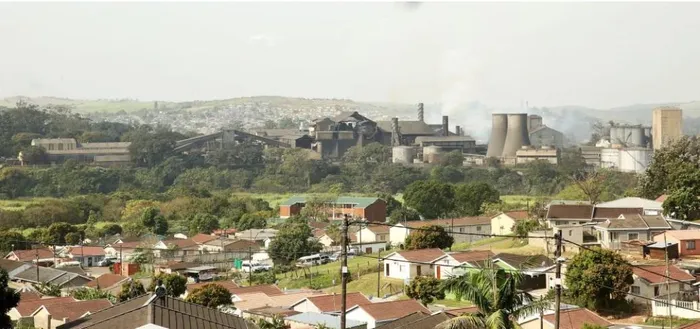
The Maidstone Mill today.
Image: File
SUGAR cane farmers on the North Coast face an uncertain future as major processor Tongaat Hulett is expected to enter provisional liquidation.
With crops ready for the upcoming harvest season and no guarantee that the Tongaat Hulett Maidstone Sugar Mill will operate, farmers describe the situation as “catastrophic” and “distressing”.
Pratish Sharma, a fourth-generation sugar cane farmer in Isinembe, said his family had been supplying the Maidstone Sugar Mill in Tongaat, for decades. He said he was currently preparing for the harvesting season in April.
“The sugar cane harvesting season ended in early December. The off-season – which is now – is usually when we do all the maintenance on the farm. Farms are living entities so there is always a need for it to be cleaned and maintained. The Maidstone Sugar Mill also closed in December, and they used this time to do all their maintenance.”
Sharma, who is also a director of SA Canegrowers, and chairperson of its branch, Maidstone Local Grower Council, said the announcement of the provisional liquidation was “distressing”.
“It was a shock to the system because we had done so much of work to try and prepare a crop for next season. Now we are faced with the possibility that there may not be a mill to crush that cane. It is very distressing because our businesses are dependent on the ability to process the cane. We cannot sell our cane directly to any market. It has to be sent to a mill for processing.
“However, if the mill does not open this year, the farmers will look at alternate mills to crush their sugar cane. But this will come at a great cost. A huge investment goes into growing a crop. Without any way to process it, it would be a huge loss, something that most farmers, including myself, would never be able to recover from,” he said.
Sharma added there were a few different ways in which the liquidation process could go.
“One is that if sufficient funding or a willing funder is found, the business may be able to continue operating until the liquidation process is finalised. We hope this scenario plays itself out.”
Keval Bodasingh, a fifth-generation sugar cane farmer in New Guelderland, KwaDukuza, said their family had a long history with Tongaat Hulett dating back more than a century.
“Our family used to supply the company’s Darnall Sugar Mill for more than 100 years. However, when it was closed in 2020, we began supplying the Maidstone mill.”
Bodasingh said the news of the liquidation was “catastrophic”.
“Nobody would have thought this would happen. I remember days where you could apply for a bank loan using a letter from Tongaat Hulett, and it would be approved. That is how strong the company was. The current situation which impacts the company’s employees and the sugar cane farmers could also lead to a disaster for our economy.
“The liquidation would not only affect the livelihood of our staff, but also a range of businesses we deal with. There are some businesses that purely service the sugar industry,” he said.
Bodasingh said the future of sugar cane farmers was uncertain.
“I have not thought about what my plan will be if the mill does not reopen. We have invested everything into preparing for the next harvesting season. It feels like having a fully-stocked shop, but you cannot open the doors because you do not know if there will be any buyers.
“However, our farmer associations have had some discussions with the government, hoping to get some high-level intervention. We are hopeful that some solution will be reached,” he said.
Another sugar cane farmer in Emona, Tongaat, who declined to be named, said the news of the provisional liquidation was a “devastating blow”.
The man, who is a third-generation sugar cane and vegetable farmer, said his family also rented out portions of their land to small-scale sugar cane farmers.
“For some farmers who also run other businesses, we can still generate an income. But what about those who are reliant on the income they earn from supplying the Tongaat Hulett mills? Many have already started preparing for the new season. What will they do after investing a lot of their money? We can only hope there is some resolution soon.”
Meanwhile, Dr Thomas Funke, the chief executive officer of SA Canegrowers, said: “The liquidation will directly threaten the earning potential of thousands of small-scale and large-scale growers across KwaZulu-Natal and Mpumalanga. If an unfunded liquidation proceeds, the growers supplying Tongaat Hulett’s three mills, as well as the entire industry, would face immediate non-payment for cane, levies and other legislated funding requirements.
“Operations at the mills will immediately cease and many growers in the Tongaat-serviced areas will immediately lose access to the only mechanism to process their sugar cane. Because sugar cane must be milled soon after harvesting to ensure a viable yield and due to the distance to other mills, it will leave vast amounts of this season’s sugar cane unmilled,” he said.
Last week, the Business Rescue Practitioners (BRPs) of Tongaat Hulett filed for provisional liquidation in the high court after Vision Group failed to secure financing from the Industrial Development Corporation (IDC).
The BRPs said the business rescue plan adopted by shareholders, creditors and other stakeholders last year was “no longer being implementable as a result of the lapsing of the sale agreements” with Vision Group.
Vision Group was seeking funding from the IDC to fulfil implementation of the business rescue plan, especially components related to refinancing of the post commencement facility and satisfaction in relation to the amounts due to the South African Sugar Association.
Vision Group and the IDC were unable to conclude binding funding arrangements, especially after Vision Group introduced new demands “that were never contemplated in, nor capable of accommodation” under the adopted business rescue plan.