

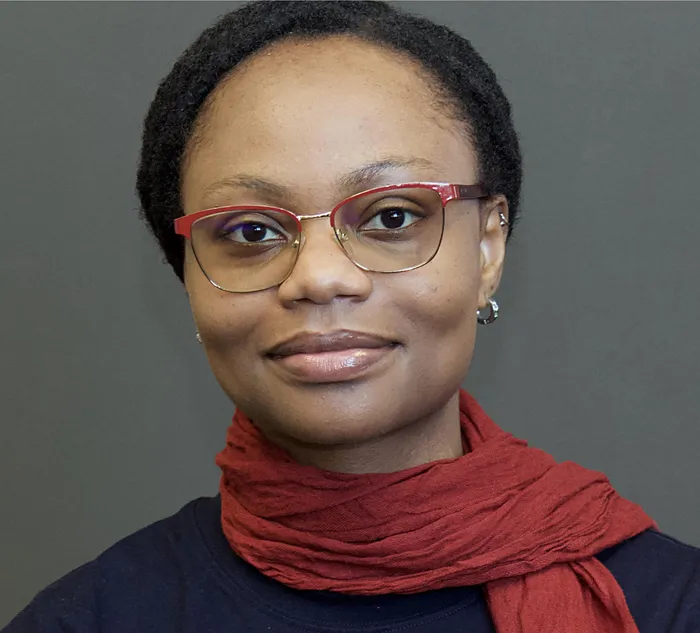
Ruth Useh is a junior researcher and a PhD candidate at the institute for Life Course Health Research at Stellenbosch University.
Image: Supplied.
Ruth Useh
Imagine being invited to a meeting that could significantly shape your future, only to have your opinions ignored. People say you are too vulnerable or less competent and so your presence begins to feel a lot more like mere formality. Picture the frustration of wanting to participate and share your ideas, but conversations move too fast to follow, or the processes are not designed to include you altogether.
Daily reality
For many people with disabilities, particularly children and young people, this is not an occasional experience - it is their daily reality. Yet, how often do we pause to ask whetherwe are truly listening, or just checking a box? Every year, on the first Friday in September (this year on 5 September), Casual Day invites us to show support for people with disabilities. However, the 2025 theme, “Beyond the Label: Embracing Unity Through Inclusion and Diversity”, asks us to go further. It challenges our assumptions about what children and young people with disabilities can achieve, and how they can contribute.
This is important to note because in South Africa, children aged five and above with disabilities constitute more than 7.5% of the population. This is more than 2.5 million South Africans. Beyond awareness and fundraising, this year’s theme calls for action: recognising ability rather than limitation, and creating spaces where young people’s voices can shape the programmes and policies that affect their lives. It is an invitation to listen, to learn, and to move from sympathy to genuine empowerment.
Disability inclusion
As a researcher focusing on disability inclusion, I examine how high-level decisions about this issue in targeted policies and programmes are made in low-and middle-income countries. Based on my work on this topic and engagement with policymakers and programme managers, I understand how the absence of genuine engagement leads to failure. A programme may look promising on paper yet stumble in practice because it never asked the people most affected what they needed, overlooking them at the most crucial stage—the beginning.
When invited into decision-making spaces, people with disabilities are not included in transformative ways. This highlights the problem of tokenistic consultation - where people with disabilities are invited in but never truly heard - creating the illusion of inclusion while entrenching marginalisation. For children and young people with disabilities, real participation, by contrast, recognises them as rights holders and equal partners. Their lived experience brings a richness that policymakers and programme managers simply cannot replicate. Where children with disabilities have been involved in programme design, the results speak for themselves. They highlight barriers adults often overlook such as inaccessible classrooms, confusing communication, or the sting of stigma from peers and teachers.
The overlooked frontier
As I write this piece, I’m also putting together an evidence-based brief to support the relevant stakeholders in thinking about the importance of including children and young people with disabilities in programme design and evaluation. This is another overlooked frontier. Too often, assessments of ‘success’ rely on adult definitions. Yet children and young people may have an entirely different view of what works and what doesn’t. Additionally, children and young people with disabilities also bring creativity to the table. A young person navigating the world differently may suggest a solution no one else may have considered. These insights shouldn’t be seen as just a ‘nice-to-have’ but as indispensable and valued.
Their involvement ensures that evaluations capture unintended consequences, identify gaps, and propose meaningful solutions. Involving people in evaluation transforms programmes into systems of continuous learning, not static blueprints. For stakeholders seeking to drive change, optimism lies in the practical steps that can betaken to make this real. Age-appropriate methods—storytelling, visual tools, role-play, or digital platforms—help children, including those with disabilities, express themselves comfortably. Programmes should endeavour to open multiple doors to participation.
Co-creation is key
This can be in the form of advisory groups, focus discussions, and co-creation workshops. Feedback must never disappear into a void; children should see how their contributions shape real decisions. Facilitators must be trained to create safe spaces, recognise power dynamics, and encourage dialogue that is authentic rather than symbolic. This is what I understand “Beyond the Label” to really mean. Disability is only one part of a child’s or young person’s identity. Labels can obscure individuality and set low expectations, reducing children and young people to their challenges instead of recognising their strengths.
Moving beyond the label allows us to see the youth as innovators, potential leaders, and citizens—agents of change, not passive recipients of care. Casual Day’s message is, therefore, more than symbolic—it is a challenge. It calls on policymakers, programme managers, and society to open up and facilitate spaces fo rchildren with disabilities and start valuing their insights. It pushes us to use participatory practices that are based on evidence, inclusive, empowering, and not superficial. There is something profoundly human in this approach. When young people feel heard, respected, and valued, they gain confidence and agency.
Active citizenship
They step into leadership roles. They become active citizens shaping the world around them. And for programmes, the payoff is enormous: interventions are grounded in reality, embraced by communities, and more likely to last. Ultimately, meaningful participation is about more than inclusion. It is about seeing the person behind the label, recognising children and young people with disabilities as equals in shaping their futures. Yes, it requires resources and commitment. Yes, it demands patience and humility. But the rewards are immense—programmes work, societies thrive, and a generation of children and young people with disabilities knows they are valued. As we celebrate Casual Day, let us not stop at wearing a sticker or dressing up in bright colours. Let us take its message and run with it. Let us ensure policies, programmes, and interventions listen to, respect, and amplify the voices of children and young people with disabilities. Only then will we truly move beyond the label—and into a future of genuine inclusion.
*Useh is a junior researcher and a PhD candidate at the institute for Life Course Health Research at Stellenbosch University.
Weekend Argus