

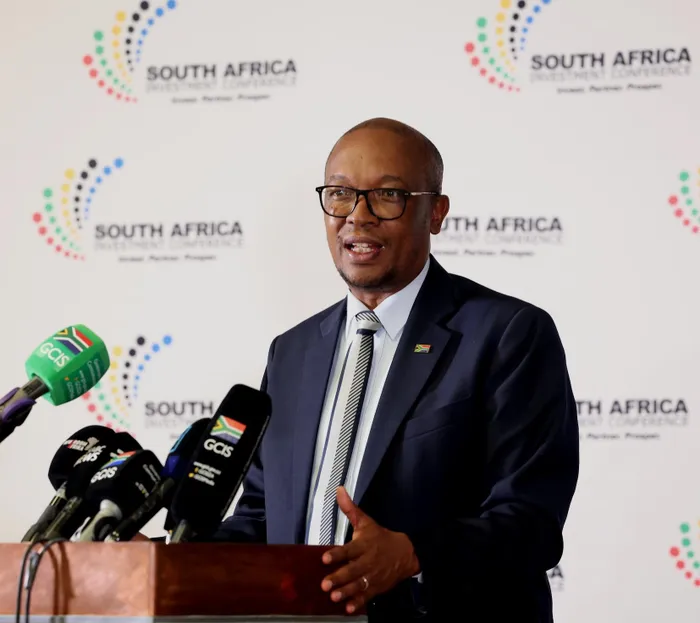
Minister of Trade, Industry and Competition, Mr Parks Tau, briefs members of the media on Government’s state of readiness for the Sixth South Africa Investment Conference (SAIC 2026).
Image: GCIS
Rising geopolitical tensions in the Middle East are beginning to ripple through global investment flows, but South Africa remains confident that its flagship investment drive will proceed with strong backing from international partners.
Speaking at a media briefing on Monday ahead of the sixth South African Investment Conference (SAIC), Trade, Industry and Competition Minister Parks Tau acknowledged that the evolving conflict is already influencing investor sentiment and travel logistics, but insisted it would not derail the country’s investment ambitions.
The conference, spearheaded by Cyril Ramaphosa since 2018, has become a cornerstone of South Africa’s strategy to attract both domestic and foreign capital. This year’s gathering is expected to host delegates from more than 30 countries, reinforcing the country’s positioning as a gateway to the African continent.
However, Tau conceded that the conflict in the Middle East—particularly disruptions to air travel routes and global supply chains—has introduced a level of uncertainty.
“We are appreciative of the reality of the impact that the war is likely to have on investment decisions going forward,” Tau said. “Some of the guests we had anticipated not only to attend, but also to make announcements, are still assessing whether they will be able to travel.”
Tau noted that flight availability and logistical disruptions linked to instability in the region could affect attendance, with some international investors adopting a wait-and-see approach. Despite this, he emphasised that many partners remain committed to engaging with South Africa.
“For us, it’s a message of confidence,” Tau said. “There are those who are saying they remain committed to investing and partnering with South Africa, and they will participate if conditions allow.”
The Middle East crisis has already had visible effects on global markets, including elevated oil prices and strained shipping routes—factors that directly influence investment decisions, particularly in emerging markets. For South Africa, these developments present both risks and potential opportunities.
Tau suggested that disruptions in traditional trade corridors could reposition South Africa as a more strategic logistics hub, particularly for companies seeking alternative supply chain routes.
“When logistics are impacted in the Middle East, it means we can play a much greater role in global logistics management,” he said, adding that the country must ensure its infrastructure is ready to support such a shift.
The government is also closely monitoring the potential impact on fuel supply, a key concern given South Africa’s reliance on imports. Tau indicated that authorities, including the Department of Mineral and Petroleum Resources, are actively managing supply risks and exploring alternative sourcing options.
While the broader geopolitical environment remains fluid, the government stressed that the SAIC is not solely about new pledges, but also about demonstrating progress on existing commitments.
Since its inception, the conference has secured over R1.5 trillion in investment pledges, with the current phase focused on implementation and tangible economic outcomes.
Tau emphasised that South Africa’s investment case is grounded in evidence rather than promises, pointing to ongoing reforms, infrastructure development and sectoral opportunities in areas such as renewable energy, technology and manufacturing.
“We are not asking investors to take a leap of faith—we are inviting them to follow the evidence,” he said.
Despite global uncertainty, the government believes South Africa’s fundamentals remain attractive. These include a stable constitutional framework, an independent judiciary and access to a rapidly growing African market of more than 1.4 billion people under the African Continental Free Trade Area.
Private sector partners at the briefing echoed this sentiment, highlighting long-term commitments to the country. The development finance community also reaffirmed its role in bridging the gap between public sector priorities and private investment, particularly in infrastructure projects designed to unlock growth.
Still, analysts caution that geopolitical instability—combined with rising energy costs—could temper investor appetite in the short term. Much will depend on how prolonged the Middle East conflict becomes and how global markets respond.
For now, South Africa is pressing ahead, positioning the upcoming conference as both a signal of resilience and a platform to showcase its readiness to compete for global capital in an increasingly uncertain world.
“The opportunity is real, and the opportunity is now,” Tau said.
BUSINESS REPORT