

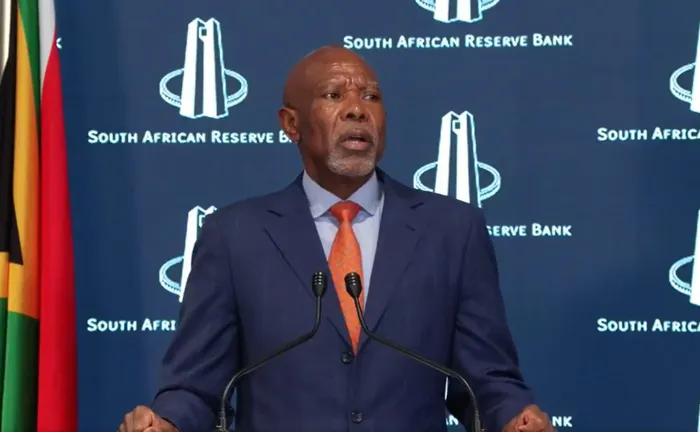
Governor Lesetja Kganyago on Thursday announced that the South African Reserve Bank’s Monetary Policy Committee (MPC) unanimously decided to hold the repo rate at 6.75%, with the prime lending rate remaining elevated.
Image: Sarb screengrab
South Africa’s central bank has opted for caution, keeping interest rates unchanged as escalating tensions in the Middle East inject fresh uncertainty into the inflation and growth outlook.
Governor Lesetja Kganyago on Thursday announced that the South African Reserve Bank’s Monetary Policy Committee (MPC) unanimously decided to hold the repo rate at 6.75%, with the prime lending rate remaining elevated.
The decision reflects a balancing act between maintaining price stability and supporting a fragile economic recovery.
The move comes amid a sharp rise in global commodity prices following the outbreak of conflict in the Middle East. Oil, gas, and fertiliser costs have surged, while global financial markets have experienced volatility. Although the adjustment in markets has remained orderly, policymakers warned that the full economic impact of the crisis is still unfolding.
Kganyago said the conflict represents a classic supply shock, pushing prices higher while simultaneously weakening demand.
“Global inflation will rise in the near term, while growth is likely to be constrained by supply chain disruptions and higher costs,” he said, adding that the longer-term implications remain uncertain.
Domestically, inflation stood at 3.0% in February, aligned with the central bank’s target.
However, this stability is expected to be short-lived. The Sarb forecasts inflation could climb to around 4% in the coming months, with fuel inflation alone projected to exceed 18% in the second quarter due to rising oil prices and a weaker rand.
Economists broadly supported the MPC’s decision, describing it as prudent given the uncertain global backdrop.
Standard Bank economist Shireen Darmalingam said the central bank is likely to remain in a holding pattern until there is greater clarity on the duration and severity of the conflict.
“The direct impact of higher oil prices will soon filter through to inflation, and upside risks remain significant,” she said. “If the conflict persists, the possibility of rate hikes may need to be considered to prevent second-round inflation effects, although the bar for tightening remains high.”
Similarly, Professor Raymond Parsons of North-West University Business School said the pause in rate adjustments reflects a broader global trend among central banks, many of which are adopting a wait-and-see approach in response to the energy shock.
Parsons warned that South Africa faces a “triple price shock” in April, driven by higher fuel prices, increases in administered costs such as electricity tariffs, and tax adjustments including the carbon levy. These combined pressures are expected to weigh heavily on both households and businesses.
“The outlook has deteriorated sharply due to global price pressures,” Parsons said. “Interest rates are likely to remain higher for longer, and economic recovery could be interrupted.”
The Sarb’s own projections underscore these risks. In a scenario where the conflict subsides within a few months, inflation could exceed 4% temporarily, potentially requiring a modest rate hike. In a more prolonged conflict lasting over a year, inflation could breach 5%, prompting a more aggressive tightening cycle and delaying a return to the 3% target until 2028.
Just a month ago, the Brent crude oil price was around $70 per barrel. Currently, the price is hovering around the $110 per barrel mark, a sharp increase from having touched below $60 per barrel early in January.
Despite these risks, the central bank remains committed to anchoring inflation expectations. Kganyago emphasised that monetary policy would focus on preventing temporary price shocks from becoming entrenched in the broader economy.
Economic growth, meanwhile, remains subdued. South Africa’s GDP expanded by just 1.1% in 2025, with modest improvements expected in the coming years. However, the conflict threatens to derail this recovery, particularly if supply disruptions persist and input costs continue rising.
Independent economist John Loos also cautioned that the current interest rate pause may dampen consumer activity. Sectors reliant on credit, such as housing and durable goods, are likely to see slower growth as borrowing costs remain elevated.
"I project a slightly better 1.3% growth rate for this year, on the assumption that the Middle East conflict is short-lived. The reasoning is that the full impact of last year’s interest rate cutting still has to fully feed through to the entire economy, and could thus yet still provide a mild boost to the “co-incident to lagging” sectors of the economy," Loos said.
"This rests on the assumption that a solution is found for the Strait of Hormuz supply disruptions very soon, which allows the Reserve Bank to keep interest rates unchanged through the rest of the year, as a manageable near term inflation uptick work sits way through the system."
BUSINESS REPORT