

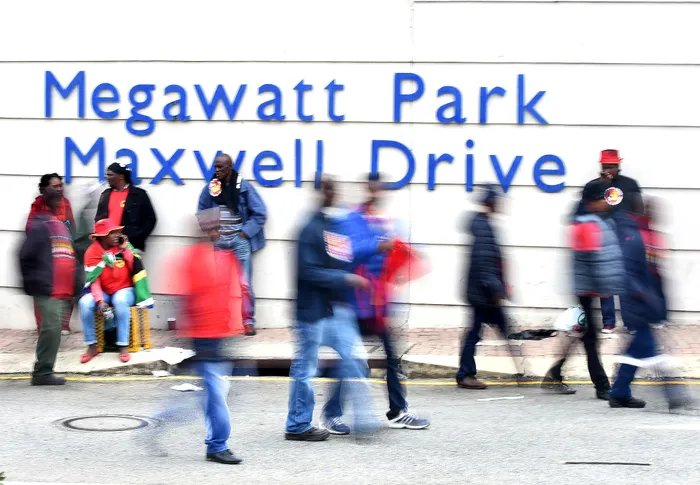
Earlier this week Numsa declared a deadlock in wage negotiations with Eskom, rejecting the State-owned power utility’s offer of a 7% annual increase over three years and warning of escalating tensions if the impasse is not urgently resolved.
Image: Itumeleng English/Independent Newspapers
Eskom has moved to clarify what it describes as “incorrect and misleading” claims made by the National Union of Metalworkers of South Africa (Numsa) regarding its 2026 wage budget and executive remuneration, following the breakdown of wage negotiations.
Earlier this week, Numsa declared a deadlock in wage negotiations with Eskom, rejecting the State-owned power utility’s offer of a 7% annual increase over three years and warning of escalating tensions if the impasse is not urgently resolved.
In a statement on Friday, Eskom said recent public commentary by Numsa — including assertions that the utility had budgeted for a 9% salary increase for bargaining-unit employees — does not accurately reflect its financial planning processes.
The dispute comes after wage negotiations concluded within Eskom’s Central Bargaining Forum (CBF), where two of the three recognised unions — the National Union of Mineworkers (NUM) and Solidarity — signed a three-year wage agreement. The deal provides for a 7% salary increase over three years, effective from 1 July 2026, alongside revised benefits.
With NUM and Solidarity representing more than two-thirds of employees in the bargaining unit, the agreement is binding across the workforce.
Numsa, however, declared a deadlock and opted not to sign the agreement. It argued that the 7% proposal contradicts Eskom’s own budget projections, which it said provided for a 9% salary increase for bargaining unit employees.
However, Eskom said it was necessary to “set the record straight” in the interest of factual accuracy and responsible public engagement.
“References to a 9% figure are not correct,” Eskom stated, explaining that wage allocations are not determined by a single pre-set percentage but rather by broader financial constraints and regulatory frameworks.
The power utility pointed to the role of the National Energy Regulator of South Africa (Nersa), whose multi-year price determination framework establishes Eskom’s overall revenue envelope.
This framework governs how much Eskom can spend on producing electricity over a defined period but does not ring-fence funds for wage increases in any given year.
Within these constraints, Eskom said it must carefully balance employee costs with competing priorities such as maintenance, infrastructure investment, debt servicing and ensuring system reliability.
“Eskom’s internal budgeting for wage adjustments is determined by what is affordable and sustainable within approved parameters,” it said.
Eskom also addressed claims by Numsa that certain executives and managers received salary increases exceeding 100%, allegations that have fuelled tensions between labour and management.
According to Numsa, top management such as Monde Bala, Bheki Nxumalo and Segomoco Scheppers received salary hikes of more than 100%, with annual packages rising from about R2.8 million to R5.8m, alongside bonuses of at least R2m.
Eskom categorically rejected these assertions, stating that there were no across-the-board increases of that magnitude.
According to the utility, only three executive roles underwent remuneration adjustments during the period under review. It said these changes were implemented to align salaries with market benchmarks following shifts in job scope and disclosure requirements.
“These adjustments were limited, role-specific, and related to alignment and disclosure considerations,” Eskom said.
“Eskom further confirms that all remuneration practices are governed by established governance frameworks and oversight processes, with any adjustments implemented within approved controls, guidelines, and budgetary parameters.”
Eskom emphasised that all remuneration decisions are subject to established governance frameworks and oversight mechanisms, and are implemented within approved controls and budgetary limits.
The ongoing dispute highlights growing tensions between Eskom and Numsa, which has criticised the wage offer as inadequate and accused the utility of failing to fairly reward workers despite its improving financial position.
Eskom, however, maintained that it remained committed to constructive engagement with organised labour and has encouraged continued dialogue grounded in factual information.
“We remain committed to responsible and respectful engagement with organised labour and other stakeholders,” the utility said.
The power utility reiterated that its workforce is central to its long-term sustainability and operational performance, particularly as it works to stabilise electricity supply and strengthen its financial position.
The utility reported a R24 billion profit in its mid-year results in November 2025 and expects to post a full-year profit of around R18bn. Longer-term projections indicate further growth, with profits forecast at R22bn in 2027 and R35bn in 2028.
This marks a sharp reversal from previous years when Eskom posted significant losses.
BUSINESS REPORT