

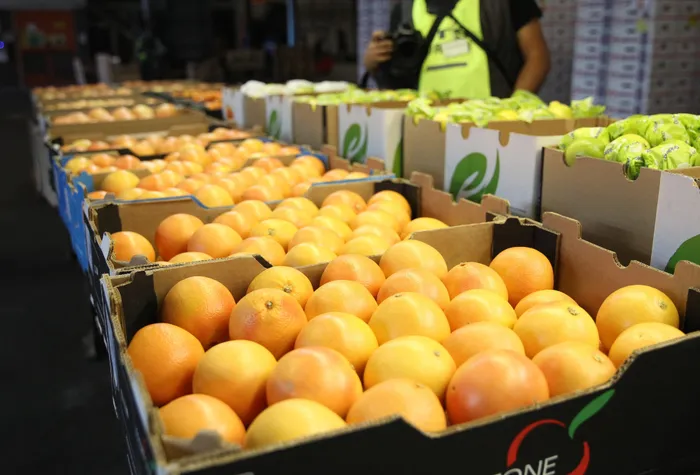
In its latest estimate released on Monday, the CGA said late mandarins show a slight year-on-year decrease overall, although performance varies across individual varieties.
Image: Doctor Ngcobo / Independent Newspapers
The Citrus Growers' Association of Southern Africa (CGA) has reported a marginal decline in late mandarin export volumes for the 2026 season, signalling a period of stabilisation after several years of robust growth in the category.
In its latest estimate released on Monday, the CGA said late mandarins — typically excluded from initial seasonal forecasts due to their later harvesting window — show a slight year-on-year decrease overall, although performance varies across individual varieties.
Despite the modest dip, the industry body emphasised that production remains broadly stable, with no major disruptions expected at this stage of the season.
Among the varieties, Leanri mandarins continue to gain ground, with export volumes projected to rise to 2.6 million 15kg cartons, up from 2.3 million cartons in 2025 — a 13% increase.
In contrast, Orri mandarins are expected to decline by 11%, falling to 2.4 million cartons from last year’s 2.7 million.
The “other late mandarins” category is set for notable growth, increasing by 11% to an estimated 4 million cartons. This expansion is largely driven by the Royal Honey Murcott (RHM) variety, which continues to gain traction among growers and exporters.
However, the largest segment — Nadorcott/Tango — is expected to record a slight contraction. Volumes are projected to decrease by 1.6%, from 31 million cartons in 2025 to around 30.5 million cartons this season.
The CGA attributed this decline primarily to slightly weaker crop expectations in key producing regions such as the Western Cape and the Eastern Cape, which together account for nearly 60% of total Nadorcott/Tango output.
The Western Cape contributes about 36%, while the Eastern Cape adds roughly 23%, meaning regional fluctuations have a significant impact on overall volumes.
Hendrik Warnich, chair of the CGA’s Mandarin Focus Group, said the latest figures point to a steady outlook rather than significant change.
“The figures reflect a relatively steady position. There are no massive changes really,” Warnich said.
One of the key uncertainties facing exporters is the ongoing geopolitical situation in the Middle East, which could affect both demand and shipping logistics. Disruptions in transit routes and shifting market conditions are being closely monitored by the industry.
“It should be said that this is, of course, an estimate, and there are a lot of variables at play. One significant variable is the situation in the Middle East, where both demand and transit times are expected to be affected,” Warnich said.
“We are monitoring the situation and the CGA will provide regular updates to growers.”
With the inclusion of late mandarin projections, the CGA has now finalised its overall citrus export estimate for the season.
Southern Africa is expected to export approximately 209 million 15kg cartons of citrus in 2026, representing a 2% increase from the 203.9 million cartons packed for export in 2025.
While the slight decline in late mandarins may temper overall growth in that segment, the broader citrus industry continues to show resilience, supported by steady demand and incremental expansion across other categories.
BUSINESS REPORT