

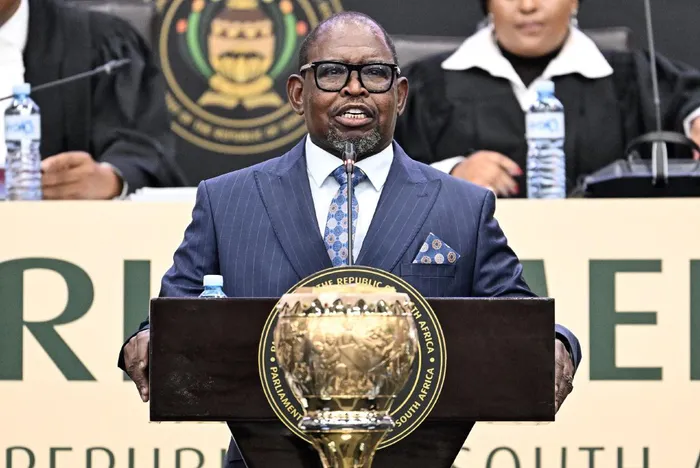
Finance Minister Enoch Godongwana delivered the Budget Speech in Parliament in February. The Moody's report estimated that South Africa’s general government debt peaked at 86.8% of GDP in 2025 and would ease gradually to 84.9% by 2028.
Image: GCIS
Ratings agency Moody’s Ratings has expressed confidence that South Africa’s debt burden will stabilise and gradually decline as fiscal consolidation and economic reforms gain traction.
In a new sovereign credit assessment released on Thursday, Moody’s said South Africa’s improving fiscal position and reform momentum were supporting confidence that debt levels had peaked.
“South Africa’s improving fiscal performance and steady reform momentum support our view that government debt will stabilise this year before gradually declining,” Moody’s said.
The agency said the 2026 Budget reinforced government’s commitment to fiscal consolidation and forecast that the general government deficit would narrow to 4.3% of GDP in 2026 and 3.8% in 2027, from 4.5% in 2025.
Moody’s said stronger revenue collection, spending restraint and lower funding costs were helping improve South Africa’s fiscal outlook.
“We expect the primary surplus to rise and interest bill to gradually decline, supported by strengthening fiscal credibility and the shift to a lower inflation target,” the agency said.
However, it cautioned that the country’s debt burden remained elevated.
“Government debt still exceeds 80% of GDP, limiting fiscal space to absorb shocks,” Moody’s warned.
The report estimated that South Africa’s general government debt peaked at 86.8% of GDP in 2025 and would ease gradually to 84.9% by 2028.
According to National Treasury, South Africa’s debt is projected to rise in nominal terms from R6.12 trillion in 2025/26 to R6.94trln in 2028/29, meaning that the government is projected to borrow at an average of about R1.5 billion per day.
Earlier this year, the International Monetary Fund recommended that South Africa adopt clearer fiscal rules and a credible debt target to stabilise its public finances and restore investor confidence.
Moody's remarks about debt sustainability are in line with the South African Reserve Bank Governor, Lesetja Kganyago, who warned that soaring sovereign debt levels globally are becoming a major threat to economic stability.
Speaking at the PSG annual conference on Wednesday, Kganyago echoed concerns over debt sustainability, warning that sovereign debt had become one of the most significant risks facing the global economy.
“The second big risk factor after geopolitics is high and rising sovereign debt levels,” Kganyago said.
“Government over-indebtedness has typically been a problem of poorer countries but today the warning lights are also flashing for developed countries.”
Kganyago pointed to the United States, where the debt-to-GDP ratio has climbed above 120%, the highest level since World War II.
“Meanwhile, the political will to lower debt is hard to find, while new spending pressures are building for items like defence as well as pensions for ageing populations,” he said.
The central bank governor said excessive borrowing diverted resources away from development priorities and weakened economic resilience.
“Excessive government borrowing poses many challenges. It diverts government resources to interest costs and away from other priority areas. It crowds out private sector activity by driving up interest rates and tax burdens,” he said.
Kganyago said South Africa had learnt difficult lessons after years of fiscal deterioration following the global financial crisis.
“In South Africa, we are unusual because we are not in denial,” he said.
“We endured large and costly fiscal deterioration after the global financial crisis. Debt rose from about 30% of GDP to nearly 80%, and we lost our investment-grade credit ratings.”
He said the country was now benefiting from a determined effort to restore fiscal credibility.
“The result of this painful experience is that we are now pursuing fiscal adjustment with determination – and the market believes us,” Kganyago said.
Meanwhile, Moody’s also credited the Government of National Unity for maintaining fiscal discipline and supporting reforms in electricity, logistics and infrastructure.
“The change from majority to coalition governing will reduce the probability of a sharp shift toward more credit-negative policy choices,” Moody’s said.
The agency added that reforms in the energy and logistics sectors could lift medium-term growth above 2% if sustained.
Still, both Moody’s and Kganyago warned that risks remained significant, particularly from geopolitical tensions and rising oil prices linked to conflict in the Middle East.
Moody’s said South Africa, as a net oil importer, remained vulnerable to prolonged high fuel prices, although it expected policymakers to maintain macroeconomic stability.
Kganyago said South Africa’s resilience in financial markets showed investors were increasingly rewarding countries with credible policy frameworks.
“Markets have become steadily smarter at differentiating between emerging markets, and I am confident that, if we get policy right, we will be rewarded,” he said.
BUSINESS REPORT