

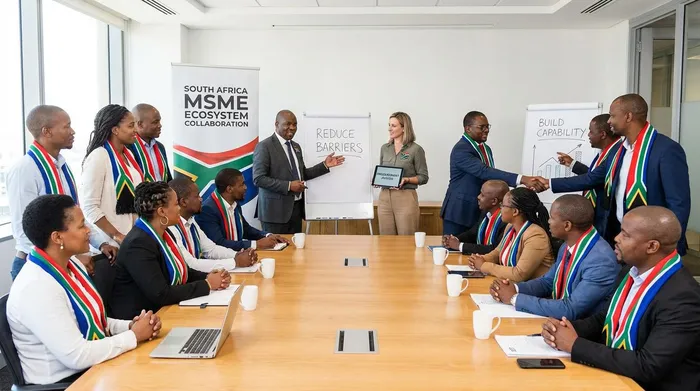
Small businesses are often expected to solve unemployment, drive innovation, and stimulate local economies, yet many remain excluded from formal financing systems.
Image: Supplied
Khwezi Jackson
Across Africa, access to funding remains one of the greatest barriers to small business growth. While conversations around entrepreneurship often focus on venture capital, high-growth startups, and investor ecosystems, the reality is that many small businesses do not necessarily need millions to scale. In many cases, relatively modest amounts of accessible capital can unlock operational growth, create employment, and improve long-term sustainability.
I was once part of a Corporate Social Investment committee that allocated a R20,000 grant to a micro poultry farmer. At the height of load shedding, the founder used these funds to buy a gas heater, which meant his chicks had a higher survival rate compared to farms that relied solely on electric heat. Another portion of the funds was used to purchase a chicken plucker machine, which improved operational efficiency and created an additional income stream by allowing local chicken resellers to pay for plucking services. The remaining funds went toward additional feed, enabling the business to double the number of chicks purchased per production cycle. Increased production also meant hiring an additional temporary worker, creating employment in the process.
That experience reinforced an important lesson: when deployed strategically, even relatively small amounts of capital can unlock significant value for a small business.
South African MSMEs operate within an estimated funding gap of R350 billion, one of the biggest constraints to entrepreneurship, growth, and job creation. Yet despite this reality, many founders continue to dream about the day they receive that big venture capital cheque.
The challenge is that venture funding remains inaccessible to the overwhelming majority of entrepreneurs. Beyond the highly competitive nature of venture capital, founders must also navigate extensive due diligence processes and investor readiness requirements, all while competing against thousands of other startups seeking the attention of the same limited pool of funders.
In many cases, founders may be waiting for funding they are not yet structurally prepared to absorb. Others may mistakenly believe that venture capital is the only legitimate pathway to scaling a business. This is where the conversation around entrepreneurship in Africa requires greater nuance.
Small businesses are often expected to solve unemployment, drive innovation, and stimulate local economies, yet many remain excluded from formal financing systems. Traditional banks still view many small businesses as too risky to finance, particularly in their early stages. As a result, entrepreneurs are frequently trapped between being "too small" for institutional funding and not yet attractive enough for venture capital.
In recent years, fintech lenders have emerged to help bridge this gap by offering founders more accessible pathways to capital with streamlined requirements. Many of these providers simply require a business to have operated for at least three months and generate a minimum monthly revenue of around R40,000, while maintaining a registered entity with a business bank account. These are thresholds that are increasingly attainable for early-stage ventures.
With funding solutions available from as little as R10,000, the question becomes less about access and more about readiness. Are founders actively identifying the levers within their businesses that could unlock additional revenue or open new markets? For many entrepreneurs, leveraging debt strategically while awaiting venture capital can become a practical growth enabler, allowing them to scale operations, retain greater equity, and ultimately enhance long-term valuation.
Some may argue that small business owners should instead turn to angel investors. In practice, however, these investors are neither easy to find nor readily accessible. Many are seasoned professionals with demanding careers, for whom investing forms just one part of a broader portfolio rather than a primary focus.
The process of securing angel investment can therefore be both complex and intimidating. There are relatively few structured, trusted platforms that consistently connect founders with credible investors, and even within established networks, success rates remain exceptionally low with one prominent Gauteng-based angel investor network reportedly approving just 0.58% of more than 8,000 applications received. While this may partly reflect application quality, it also highlights the highly competitive and often prohibitive nature of accessing this kind of funding.
For small business founders whose growth is constrained by capital limitations, perhaps it is time to look beyond traditional financiers. The current funding gap did not emerge by accident, traditional financiers identified it but often chose not to serve it. New fintech debt providers are stepping in, lowering barriers to entry, improving accessibility, and helping founders scale without distracting them from running their businesses.
Venture funding absolutely has a place in the growth journey of ambitious businesses. But perhaps founders should also be asking a simpler question: what could a R10,000 or R20,000 investment unlock today?
For many entrepreneurs across Africa, that smaller investment may be the difference between survival and scale.

Khwezi Jackson is the business and partnerships manager at 22 On Sloane.
Image: Supplied
* Khwezi Jackson is the business and partnerships manager at 22 On Sloane.
** The views expressed do not necessarily reflect the views of IOL or Independent Media.
BUSINESS REPORT