

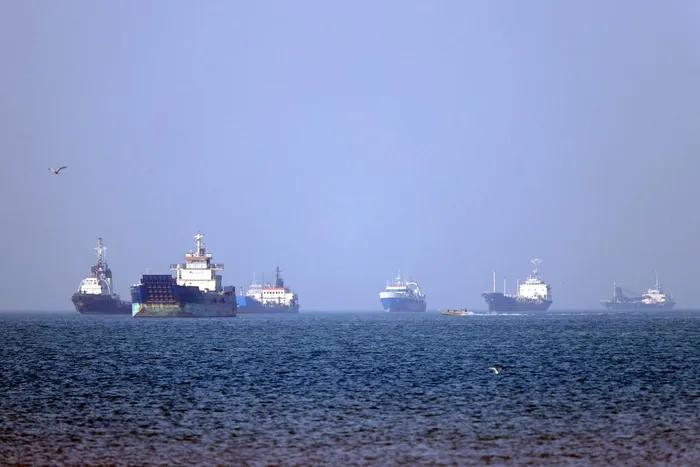
The global economic outlook has darkened. In the latest WEF Chief Economists’ Outlook, 89% of surveyed chief economists expect global growth to weaken, while 94% expect inflation to rise.
Image: ISNA / AFP
The global economic outlook has deteriorated sharply in recent weeks, with economists warning that escalating conflict in the Middle East and prolonged disruption to the Strait of Hormuz could trigger a severe shock to global growth, trade and inflation.
According to the latest May edition of the World Economic Forum’s (WEF) Chief Economists’ Outlook released on Thursday, nearly nine out of 10 surveyed chief economists expect global growth to weaken over the next 12 months, reversing the cautious optimism that marked the start of the year.
The report found that 89% of respondents anticipate weaker global growth, while 94% expect inflation to rise as energy and food costs surge following the closure of the Strait of Hormuz, one of the world’s most critical shipping routes for oil, liquefied natural gas and fertilizer-related goods.
The WEF said the worsening outlook stems largely from the conflict in the Middle East, which has disrupted global supply chains and heightened volatility across financial markets.
“Only months ago, the chief economists community was cautiously optimistic. The conflict in the Middle East changed that, and the economic scarring from the situation thus far is already expected to last into the months ahead,” said Saadia Zahidi, managing director at the WEF.
The report warned that if the Strait of Hormuz remains closed into the second half of 2026, the global economic impact could approach the severity of the COVID-19 pandemic.
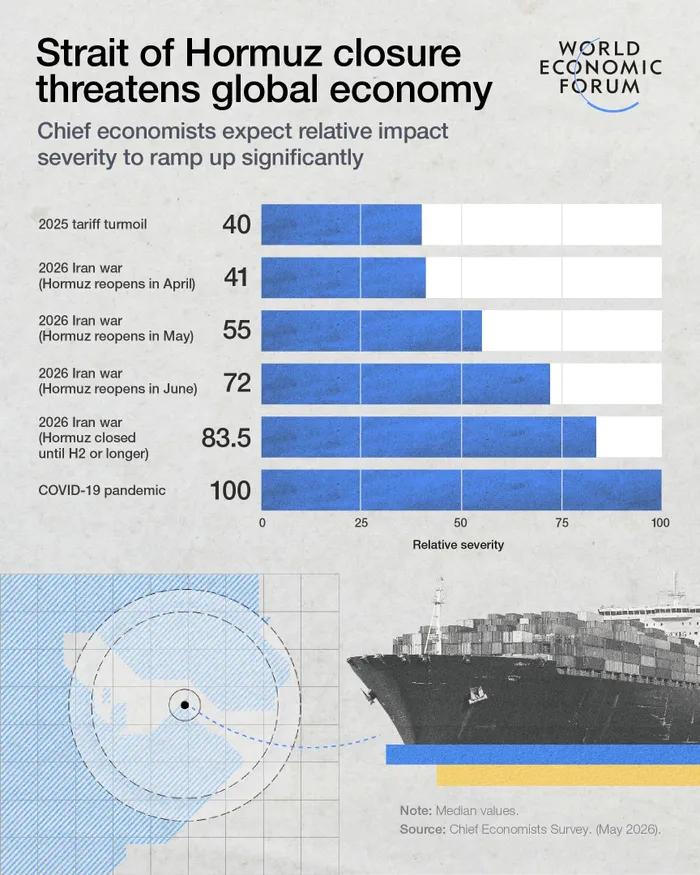
The global economic outlook has darkened. In the latest WEF Chief Economists’ Outlook, 89% of surveyed chief economists expect global growth to weaken, while 94% expect inflation to rise.
Image: Supplied
Chief economists surveyed already rank the current disruption as more damaging than the tariff turmoil experienced in 2025. The closure has sharply reduced oil and gas flows through the strait, while fertilizer shipments have also been disrupted, raising concerns about future food production and food inflation.
Although most economists do not yet foresee a global recession within the next year, they expect the world economy to remain fragile and increasingly volatile. Around 79% of respondents expect greater instability in private debt markets, while 74% foresee higher public debt market volatility and 68% anticipate increased stock market turbulence.
The outlook varies sharply across regions. The sharpest deterioration was recorded in the Middle East and North Africa region, where 88% of economists now expect weak or very weak growth after the region had earlier been viewed as one of the brighter spots in the global economy.
For Sub-Saharan Africa, the report paints a mixed picture. While growth expectations have remained relatively stable, inflation risks have intensified significantly. About 54% of surveyed economists expect moderate or strong growth in the region over the next year, with economic activity projected to remain steady at around 4.1% in 2026.
However, inflation has emerged as the region’s biggest concern. The survey found that 67% of chief economists expect high or very high inflation in Sub-Saharan Africa over the coming year — the highest inflation expectation of any region surveyed and a sharp jump from 25% in the previous edition.
The report attributed these pressures to rising fuel, food and fertilizer prices, compounded by tighter financial conditions and ongoing supply chain disruptions.
More than a third of respondents also expect significant energy price increases in Sub-Saharan Africa as the impact of constrained oil and gas supplies filters through the global economy.
Food prices are also expected to rise sharply across the region as fertilizer shortages worsen. The report warned that disruptions to fertilizer trade through the Strait of Hormuz could eventually trigger a broader global food shock, particularly in import-dependent economies.
Employment growth in Sub-Saharan Africa is also expected to remain weak, with 61% of surveyed economists forecasting weak or very weak job creation over the next 12 months. The report noted that economic growth remains insufficient to absorb the region’s rapidly expanding labour force.
Despite the mounting pressures, central banks across the region are expected to remain cautious. The report noted that major central banks, including the South African Reserve Bank, have largely kept interest rates unchanged while monitoring inflation risks closely.
The report also highlighted growing concerns about the attractiveness of Sub-Saharan Africa for multinational companies. Only 3% of surveyed economists ranked the region among the top three most attractive business environments globally over the next year, reflecting concerns over infrastructure constraints, inflation and geopolitical risks.
BUSINESS REPORT