
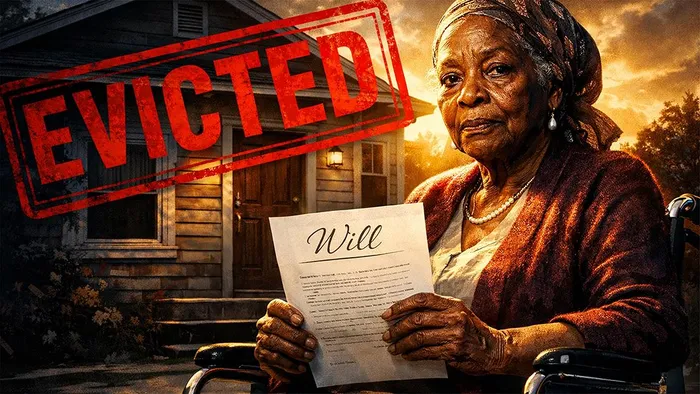
A woman was declared of legally sound mind, so her son stayed evicted.
Image: Manus
Family members were pitted against each other in a recent Johannesburg High Court case that highlighted just how contentious a will can become.
The Modises took each other on legally, with Nehemia Modise arguing that the last will and testament of his late mother, Matsatsi Khutsoane, be declared invalid.
There have been many other cases, some no doubt similar to the Modise battle, and some that are exceptionally laughable. But, even bizarre requirements have to be honoured – as long as they are legal and properly executed – because there is freedom of testation in South African law.
The Modises’ legal battle extends back to 2012, when Khutsoane died and left her property to her grandchildren, namely Thabang Modise, Nthabiseng Modise, Karabo Modise and Rifilwe Modise.
Then, Rifilwe Modise (who was also the executor of the will) obtained an eviction order against Nehemia Modise to throw her out of the Brakpan house that was part of the estate Khutsoane bequeathed to her grandchildren, which, for the sake of clarity, included Rifilwe Modise.
It gets more complicated when Nehemia Modise appealed the eviction order and, upon losing, went to court to try to have the will declared invalid “on the basis that the deceased was not in a healthy state to have executed the will on 13 November 2012”.
Nehemia Modise specifically argued that “the deceased was not well and could never have been able to travel from Brakpan to Springs to have a will drawn up and signed… it is said that the deceased suffered from mild hemiplegia and was unable to walk and needs a wheelchair”.
Moreover, Nehemia Modise said the mark that Khutsoane – born in 1938 – made indicating she signed the will “does not comply with the requirements of the statute”.
At this point, Rifilwe Modise says she took her grandmother, who she was living with, “drove to Absa Bank in Springs with the deceased, where the deceased executed the will”.
Absa was also listed as a defendant but indicated that it would abide by the ruling.
Wrong timing
The court noted that the will was signed by the making of a mark and witnessed by two witnesses, although the commissioner of oaths only attached her certificate on 20 December 2012, some two weeks after the death of the deceased, who died on 5 December 2012.
This was also a point of contention for Nehemia Modise, who argued that the commissioner’s late stamp of the will made it invalid, even though it "had been placed in possession of the will since 2013”. As the court noted, he knew about its contents well before the court matter was heard.
In addition, the court noted that a bank official could not have witnessed the will if the grandmother was “of unsound mind,” the judgment read.
The judge ruled that Nehemia Modise had unsuccessfully argued that the will was invalid, and he lost the case, being ordered to pay costs.
“I have accordingly come to the conclusion that the Applicant has failed to make out a case and that the application should be dismissed with costs.”

People have requested strange and wonderful things in their wills.
Image: ChatGPT
Locally, funny stories include when a man who reportedly left a substantial sum to his wife – on one very specific condition: She had to marry a specific man he despised.
Apparently, he wanted to ensure there would be at least one other man who would truly understand the misery he had endured during their marriage.
Many South Africans also want a wake after their funeral. This Irish concept has been turned into a local reason to party – or have a braai.
One Cape Town local famously left a portion of his estate specifically to ensure the local pub remained open for 24 hours after his burial, with instructions that no one should leave sober.
There are several accounts of South Africans requesting their ashes be dealt with in ways that cause a bit of a scene.
One individual requested their ashes be mixed into a specific brand of boerewors or fertiliser to be used in a communal garden, though legal health regulations usually step in before these requests can be fully realised.
Some South Africans also request their ashes be scattered at the 18th hole of their favourite golf course – specifically so they can "finally stay on the green for once”.
There is also, from Wikipedia, the case when a mom executed a will leaving her estate to her daughter, her grandchildren, and her great-grandchildren.
Two days before her mother died, she revoked the will and bequeathed her entire estate to her doctor. The court held that she wasn’t capable of rational thought and the second will was declared invalid.

Why not leave your entire will to a chicken?
Image: Freepik
While not South African examples, under freedom of testation, these examples collected by the UK’s Bascom Law would be legitimate.
When Sir John Bentinck died in the 19th century, he didn’t want any ordinary grave. He had a large pyramid-shaped tomb built in a village churchyard. The structure still stands out among the smaller headstones.
Harry Houdini, an American hotelier known for his escape acts and interest in the afterlife, left instructions for séances to contact him after death and funded supernatural investigations. Though no séance has reached him so far, his will kept his passion for the paranormal alive.
Charles Vance Millar, a wealthy and quirky Brit, used his will as a final source of entertainment. He left a remarkable sum to his pet chicken, instructing that she be pampered.
Another odd provision created a “baby contest,” promising a reward to the Toronto woman who had the most children within ten years, which stirred up excitement throughout the city.
There is also the matter of revenge. Portuguese aristocrat Luis Carlos de Noronha Cabral da Camara famously left his fortune to 70 complete strangers, randomly selected from the phone book. Reports suggest he did this to defy family members whom he felt were not trustworthy enough to manage his estate.
IOL BUSINESS