


The value of the rand slumped 1.5% overnight.
Image: ChatGPT
The rand weakened sharply overnight as investors pulled back from emerging market assets amid rising geopolitical tensions in the Middle East.
The currency fell about 1.5% overnight to roughly R16.60 to the US dollar in mid-morning trade, its weakest level since late December.
Data from Trading Economics showed the South African rand depreciated to around 16.62 per dollar as a firmer US currency and easing prices for key precious metals, particularly gold and platinum, weighed on the exchange rate.
The move came as investors reduced exposure to emerging market assets while the conflict in the Middle East continued.
This slide highlights how movements in the exchange rate can affect everyday costs in South Africa, where many key goods are priced internationally in dollars.
If the currency had remained around R15.90 – levels seen before tensions escalated and the best price point since 2022 – imports would be cheaper in rand terms, easing pressure on consumer prices.
Crude calculations show that a depreciation of about 4.4% – roughly the move from R15.90 to R16.60 – could add about 0.7 percentage points to inflation over time as higher import costs move through supply chains.
Johann Els, senior economist at PSG Financial Services, said a few days after the war broke out that the recent volatility could make the South African Reserve Bank more cautious in the near term.
“The MPC is probably going to keep rates on hold in March where, as previously, I expected them to cut,” Els said, referring to the bank’s Monetary Policy Committee.
“They're very sensitive to global sensitivities and global risk issues.”
Els said the outlook for inflation still remained relatively contained despite the recent market turbulence.
“I do think inflation is still going to be okay,” he said, adding that it could average between 3.2% and 3.4% for the year.
However, he warned that the duration and scope of the Middle East conflict could influence both oil prices and the currency.
“It all depends on how long that war lasts and if it expands into other areas or not,” Els said.
Research published by the South African Reserve Bank has shown that exchange rate changes gradually feed into consumer prices through what economists call exchange rate pass-through.
Fuel is the clearest example. South Africa imports much of its crude oil and some refined petroleum products, and oil is traded globally in US dollars. The domestic petrol price is calculated each month using a formula that includes the international oil price and the rand–dollar exchange rate.
When the rand weakens, the cost of buying oil in rand rises even if the global oil price remains unchanged. That feeds directly into the basic fuel price used to determine South Africa’s monthly petrol and diesel adjustments.
Higher fuel costs then filter through the economy, affecting transport, logistics and food distribution costs.
Food prices can also be affected by currency movements. South Africa produces many agricultural goods locally but imports large volumes of wheat each year to meet domestic demand. Wheat is priced internationally in dollars, meaning a weaker rand increases the cost of those imports for millers and food producers.
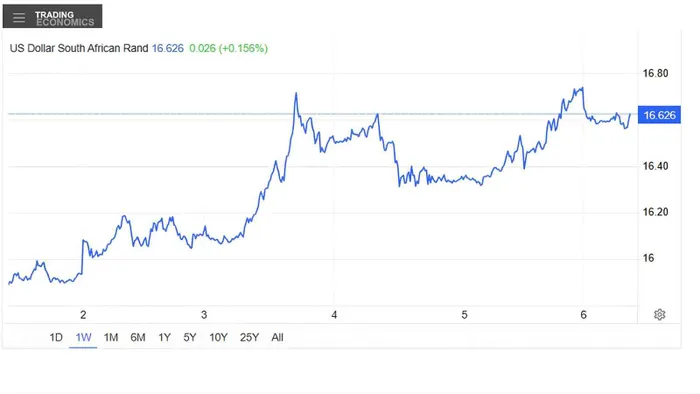
The rand has slumped dramatically over the past week due to the war in the Middle East.
Image: Trading Economics
Consumer goods are another channel. Much of the electronics sold in South Africa – including smartphones, laptops and televisions – is imported. These products are generally priced internationally in foreign currencies, so a weaker rand raises the cost of bringing them into the country.
The vehicle market also reflects currency movements. While South Africa has a large automotive manufacturing industry, many vehicles sold domestically are imported and even locally assembled cars rely on imported components.
A weaker currency increases the cost of those parts and finished vehicles.
Travel abroad is another area where the exchange rate is felt directly by consumers. Flights, accommodation and other travel expenses overseas are priced in foreign currencies, meaning South Africans need more rand to pay for the same trip when the currency weakens.
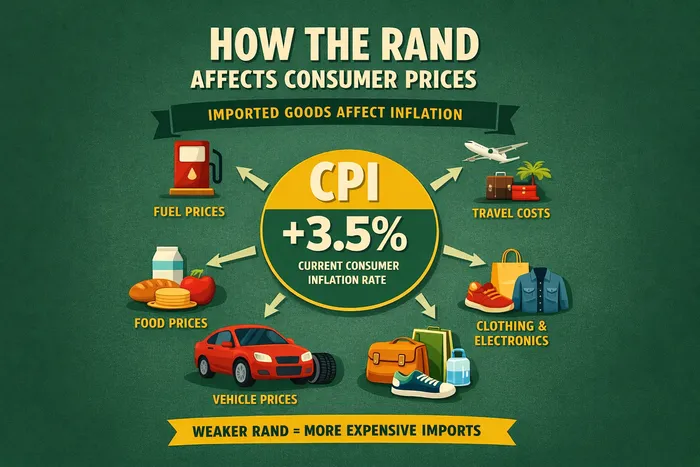
The war in the Middle East could theoretically push inflation up to 4.2%.
Image: ChatGPT
The doubt over the duration of the war and its impact could delay interest rate cuts expected later this year, Els had said, although this was before oil skyrocketed.
“That uncertainty means the Reserve Bank will probably not want to cut in March and will want to wait.”
Els added that rate cuts were still likely in 2026 but could come later than previously expected.
“I do think we're still going to get rate cuts this year. They might be delayed a little bit, but it's also uncertain at the moment.”
The longer-term shift in the currency also illustrates the same dynamic. Two years ago, at the start of April, the rand was trading around R19.60 to the dollar. A move from R19.60 to R16.60 represents an appreciation of roughly 15%.
Using the same exchange rate pass-through estimates, such a strengthening could theoretically ease inflation pressure by around two percentage points over time as imports become cheaper in rand terms.
South Africa’s consumer inflation rate stood at 3.5% in the latest data from Statistics South Africa. The next consumer price index figures, for February, are scheduled for release on 11 March.
The latest currency move will only be visible in the data when March’s numbers and printed in April.
The relationship between the rand and the US dollar has changed dramatically over the past six decades.
When the rand was introduced in 1961, it formed part of the global fixed exchange rate framework created after the Second World War under the Bretton Woods system.
At the time two rand equalled one British pound, and the pound itself was fixed to the US dollar. This meant the rand traded stronger than the dollar, with one US dollar worth roughly 70 cents in the early 1960s.
That global currency system began to unravel in the early 1970s when the US ended the dollar’s convertibility into gold, a move known as the Nixon Shock.

The relationship between the rand and the US dollar has changed dramatically over the past six decades.
Image: ChatGPT
Countries gradually shifted toward market-determined exchange rates, and the rand began floating more freely.
Over the following decades the currency weakened as South Africa faced sanctions, capital outflows and financial instability because of the atrocious apartheid era.
One of the most significant moments came in 1985 when the country declared a debt standstill after foreign lenders refused to roll over short-term loans, triggering a sharp fall in the currency.
After 1994 South Africa reintegrated into global financial markets and the rand became a fully traded emerging-market currency.
Today its value moves daily in response to commodity prices, global investor sentiment and capital flows into and out of emerging markets.
While those forces determine where the currency trades, the effects are often felt most clearly by consumers – particularly when exchange rate swings influence the cost of fuel, food and imported goods.
IOL BUSINESS