

Brokers urge caution during times of market fluctuations and wars.
Image: Manus
The conflict in the Middle East is beginning to filter through global financial markets, affecting everything from oil prices to currencies and equity markets – and ultimately the retirement savings of investors.
The JSE’s All Share Index has also come off, although not dramatically, as it is only 3% down over the past month and is not tracking oil prices. However, it could well be being buoyed by Sasol, which is likely benefiting from elevated oil prices and was up 11.5% on the day as of lunchtime yesterday.
Over the past month, the petrochemical company is up 55.7% and was trading at R193 a share as of Friday afternoon. Its 52-week low is R53.
Brokers and asset managers’ advice during a period of shock, such as now, is to hang tight and take a longer-term view – in fact, over a five-year period, the ALSI is up 71.54%. Last July, the index hit a record high.
As of midday yesterday, the S&P 500 was down 1.52% on the day, although it’s up 69.21% over the past five years. A careful comparison between the rand’s rocky ride and that bourse’s gains will indicate where it may have been better to invest although the thesis remains the same – don’t change out of stocks on a whim, especially not for pension funds.
However, investors will still be impacted. Stephan Erasmus, investment analyst at Anchor Capital, said the war has several channels through which it affects South African savers.
“The Iran war is a significant event for South African savers, as it negatively affects them through falling equity values, a weaker rand, and rising oil prices,” he said.
Erasmus added “how long the conflict lasts is really what determines the damage. A short, sharp shock is painful but more manageable. Keep the Strait of Hormuz closed for months, however, and the problem compounds, eroding portfolio values, squeezing household budgets and slowing growth, all at once.”
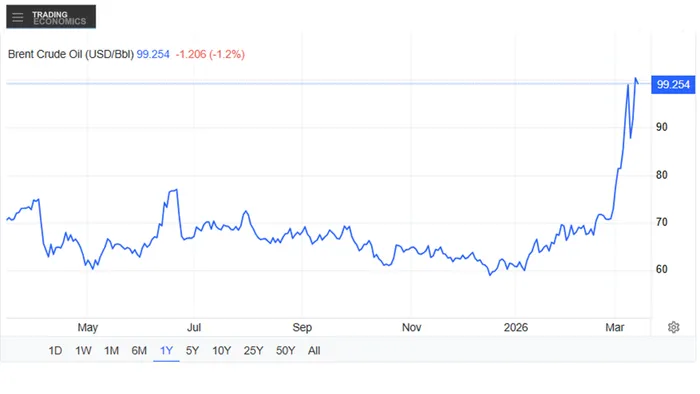
A one-year view of brent crude oil.
Image: Trading Economics
Financial markets have already responded to the escalation in the conflict, particularly through energy prices and currency movements.
Kevin Lings, chief economist at STANLIB, said oil prices rose quickly on fears that the conflict could disrupt supply, triggering broader market volatility.
“Markets responded quickly to the outbreak of war. Oil prices moved higher on fears of supply disruptions, energy equities outperformed, broader global equity markets saw increased volatility and periods of risk aversion, while safe-haven assets, including the US dollar, attracted inflows,” he said.
The rand has also come under pressure. According to Lings, the currency weakened about 4.3% against the US dollar since late February as of Monday.
“Interestingly, the rand is the third-worst-performing emerging market currency in March. This is largely understandable given the country’s vulnerability to a spike in international oil prices,” he said.
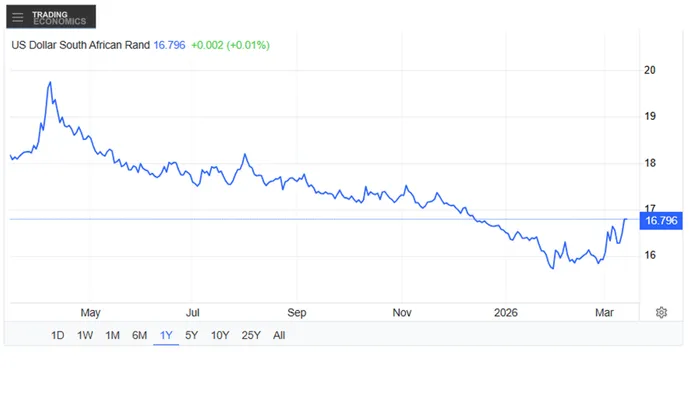
A one-year view of the rand.
Image: Trading Economics
Trading Economics data shows the rand weakened to around R16.81 to the dollar as of yesterday afternoon. Over the past month it has lost more than 5%, though it remains stronger over the past year.
Bianca Botes, director at Citadel Global, said oil markets have swung sharply since the conflict began.
“Two weeks into Operation Epic Fury has seen the global energy market swing between severe supply shock and brief relief, before returning to renewed pressure,” she said.
Botes said the question asked by markets last week was “How high will oil prices go?” This week, the question has shifted to a more difficult one: “How long will they stay at these elevated levels?”
Brent crude briefly moved above $100 a barrel for the first time since Russia’s invasion of Ukraine in 2022 before falling back and then rising again.
Botes said tanker traffic through the Strait of Hormuz has dropped dramatically, disrupting a key global oil route. “The disruption has already suspended roughly 20% of global crude and natural gas supply,” she said.
Higher oil prices also feed through into inflation and growth expectations. Old Mutual Wealth investment strategist Izak Odendaal said even modest oil price increases can affect the global economy.
“As a rule of thumb, a sustained $10 per barrel increase in the oil price reduces global economic growth by about 0.1 to 0.2 percentage points,” he said.
Odendaal added that “when it comes to inflation, the rule of thumb is that a $10 per barrel increase will push global inflation rates up by about 0.4 percentage points, all else equal.”
Higher energy costs also increase uncertainty for businesses and consumers, said Odendaal.
“The longer the conflict drags on, the bigger the chance of serious damage to energy infrastructure in the region, ongoing price pressures and negative consequences for the global economy,” Odendaal said.
Locally, higher fuel costs remain a key risk for inflation and growth. Annabel Bishop, Investec chief economist, said imported fuel prices remain a major risk for South Africa’s economic outlook.
Despite the volatility, advisers say geopolitical shocks rarely have a lasting impact on diversified portfolios.
Holburn Asset Management said geopolitical tensions typically trigger rapid shifts in investor behaviour, with money moving out of riskier assets and into perceived safe havens such as gold, the US dollar and government bonds.
These moves can lead to short-term volatility and sector rotation rather than a broad market collapse, with commodity producers often benefiting while consumer sectors come under pressure.
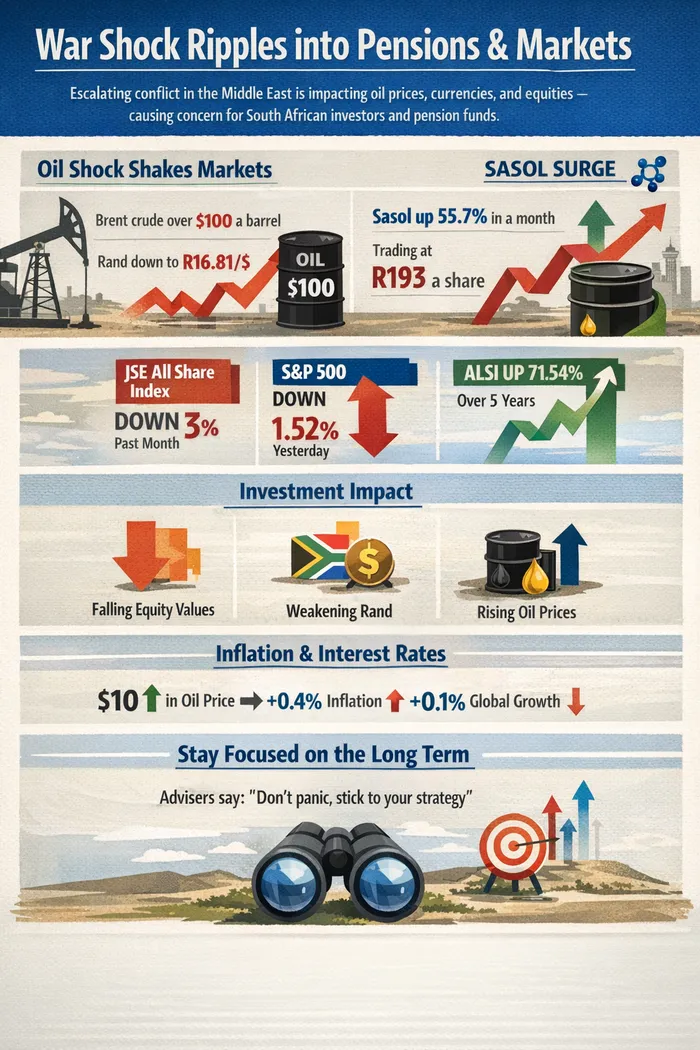
The ripple effect of the Middle East war.
Image: ChatGPT
Cornerstone Wealth said the biggest risk during periods of market stress is often investor behaviour rather than the underlying economic impact.
“The biggest risk in moments like this is usually our own behaviour,” the firm said. “History shows that selling into geopolitical shocks often means exiting just before markets begin to recover.”
For investors, analysts say the key question is whether the conflict materially changes the long-term earnings outlook for companies – rather than reacting to daily market movements.
IOL BUSINESS