

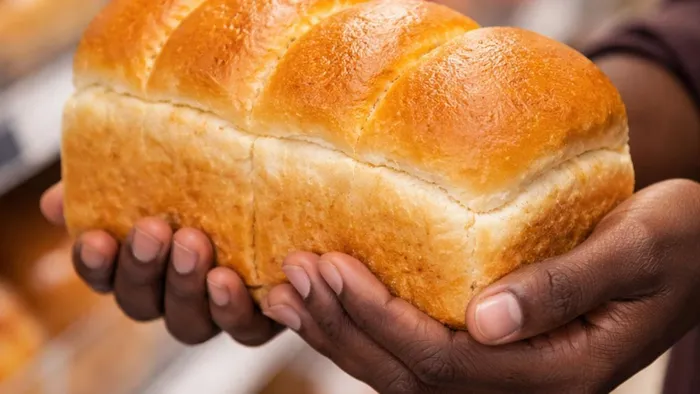
The price of a loaf of bread has escalated faster than headline inflation.
Image: ChatGPT
Even as the rate of increases in the cost of living, especially food, has slowed, economists do not expect the South African Reserve Bank (SARB) to cut interest rates next week, at a time when calculations show that basic food items are far outpacing headline inflation.
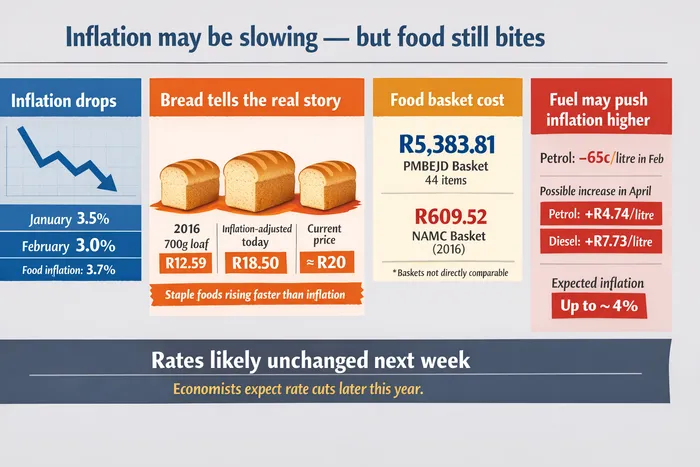
South Africa’s annual inflation rate slowed to 3% in February, from 3.5% in January, according to Statistics South Africa.
However, food and non-alcoholic beverage inflation stood at 3.7% year-on-year, continuing to place pressure on household grocery budgets even as the monthly pace of increase slowed 0.3 percentage points.
But the pressure on household food costs becomes clearer when one steps back and takes a 10-year view. In 2016, for example, a 700g loaf of sliced white bread cost about R12.59 based on a mid-range price. Adjusted for headline inflation since then, that loaf should now cost roughly R18.50.
Instead, it typically retails closer to R20, illustrating how staple food prices have risen faster than overall inflation over the past decade.
Broader household food basket research shows similar pressure on grocery budgets.
The Pietermaritzburg Economic Justice and Dignity Group’s latest Household Affordability Index puts the cost of a household food basket at R5,383.81 in February, based on the prices of 44 food items tracked across supermarkets and butcheries.
Earlier research by the National Agricultural Marketing Council, while not directly comparable, found that a 23-item basic food basket increased by 16.29% in a single year between June 2015 and June 2016 to R609.52.
While the baskets are not directly comparable because they track different products, quantities and retailers, the figures illustrate how sharply the cost of basic food items has increased over time.
Statistics South Africa said the consumer price index increased 0.4% month-on-month in February, with housing and utilities, food, and insurance and financial services the main contributors to annual inflation.
Annabel Bishop, Investec chief economist, said February’s lower inflation reading was largely due to statistical base effects and lower fuel prices.
Bishop said the Middle East conflict did not affect February’s data because the war began only toward the end of the month and fuel price adjustments lag movements in oil prices.
“The lagged effects mean that only April will reflect the fuel price change from the war as the full month of March’s rand petroleum costs first need to be estimated before a change in fuel costs occurs,” she said.
The data shows how the cost of living has gone up in the past decade.
Image: ChatGPT
The petrol price dropped by 65c/litre in February in South Africa, adding to the downwards pressure on February’s inflation, said Bishop.
March’s petrol price rose by only 20c/litre, calculated on February’s rand petroleum cost, she added.
So far this month, a R4.74/litre increase in the petrol price and R7.73/litre rise in the diesel price is building for 1 April, although the state may temporarily absorb some of these costs where it can do so, Bishop added.
Dr Elna Moolman, Standard Bank Group head of South Africa macroeconomic research, said the February figure reflected relatively benign inflation conditions. She added that it “exactly” matched SARB’s new inflation target of 3%.
Moolman, however, noted that the data preceded the recent surge in oil prices and weakening of the rand.
“At this stage, we expect the Reserve Bank to sound hawkish about the inflationary risks brought about by the war, but for now, we expect this to merely delay the interest rate cuts that we previously expected.”
Johan Els, PSG chief economist, predicted ahead of the reading that the print would come in at 3.1%. He added that a significant petrol price increase in April will likely lead to an inflation jump to between 4% and 4.2%.
April’s data will be out in May. “So, a significant uplift coming,” said Els.
“That leads us into a discussion around the stance of the Reserve Bank at next week's Monetary Policy Committee meeting,” said Els.
While he believes it's far too soon to talk about the possibility of rate hikes, if the war in the Middle East should expand or last a lot longer than what everybody expects at the moment, then that will likely become a discussion point in the months ahead.
“For now, I think the events that has unfolded and the impact on inflation will likely lead to more hawkish Reserve Bank, more warning around the risks around inflation, and I think the Reserve Bank next week will keep rates unchanged,” said Els.
Assuming the war is over in weeks rather than months, Els still expects three 0.25 percentage point rate cuts this year.
IOL BUSINESS