


Women are heavily represented in roles such as CFO and human resources leadership, where they account for more than half of positions.
Image: Freepik
South African businesses have largely closed the gender gap in senior management. What they have not closed is the gap in power.
New data from the SNG Grant Thornton Women in Business 2026 report shows women now hold about a half of senior management roles locally, far ahead of the roughly one-third global average.
No surveyed local companies reported all-male senior management teams, signalling that representation has become embedded, according to the report.
But that headline progress masks a more persistent imbalance.
According to BDO South Africa’s Women in Business report, women hold about 47% of senior management roles locally, one of the highest levels globally. Women also occupy about 38% of board seats at companies listed on the JSE, while executive committee representation stands closer to 31%.
Yet, Buhle Hanise, national head of business restructuring at BDO South Africa, said the distribution of real power tells a different story, with chief executive officer positions across major listed entities still overwhelmingly held by men.
Hanise said that while women are increasingly present in senior management and board roles, the highest levels of corporate authority remain largely male-dominated.
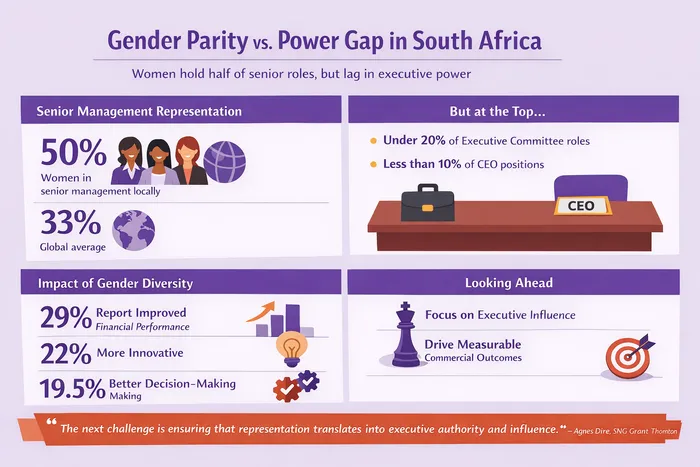
How women fair in executive positions.
Image: ChatGPT
Taken together, Grant Thornton and BDO’s two datasets point to the same conclusion from different angles: South Africa has solved for entry into leadership, but not for progression to power.
BDO’s Hanise said “women already sit across board tables and executive committees in significant numbers. Yet when the most consequential mandates arise, the distressed asset, the turnaround, the high-risk Profit & Loss, authority remains disproportionately concentrated.”
Grant Thornton’s data helps explain how leadership roles are distributed.
Women are heavily represented in roles such as CFO and human resources leadership, where they account for more than half of positions. They hold close to two-fifths of chief operating officer roles and about a third of chief information officer roles, according to the report.
Agnes Dire, board chairperson and director at SNG Grant Thornton, said the “next challenge is ensuring that representation translates into executive authority and influence in roles that shape capital allocation and strategic direction”.
Grant Thornton’s report shows investors, regulators and prospective employees are increasingly assessing companies on gender balance in leadership, while most mid-market firms have formal diversity, equity and inclusion frameworks in place.
At the same time, companies maintaining these strategies are seeing measurable gains, Grant Thornton’s report shows.
Nearly three in ten South African firms report improved financial performance linked to gender diversity, alongside stronger decision-making and more inclusive workplaces, according to the report.
Global data shows similar trends. As a result of putting gender equality strategies in place, 22.1% of firms say their businesses are more innovative, 19.5% say teams make better decisions, and 18.8% say financial performance has improved.
Greg Keith, CEO of Grant Thornton International, said in the report that the link between inclusion and performance is becoming clearer.
“Businesses in the mid-market have held firm on their investment in DE&I [diversity, equity, and inclusion] and gender equality, driven by strong leaders.
"Positively, they’re seeing clear benefits of doing so, both in terms of commercial performance and attracting talent,” Keith said.
IOL BUSINESS