

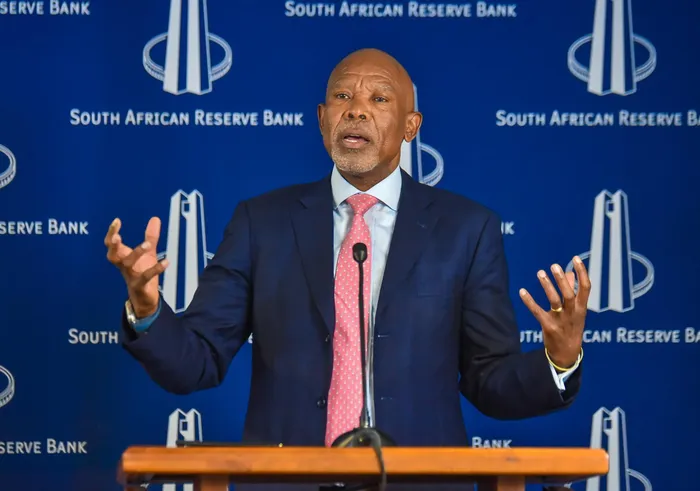
Lesetja Kganyago, Governor of the South African Reserve Bank.
Image: SARB | Facebook
The South African Reserve Bank has, for now, held its growth outlook steady, even as global risks intensify and inflation pressures build.
“For the time being, our growth projections are largely unchanged,” governor Lesetja Kganyago said during his announcement of the bank’s decision to keep the prime lending rate unchanged at 10.25% yesterday.
However, Kganyago cautioned that risks to the outlook are now skewed to the downside, even though the bank expects growth to rise to around 2% over the next few years. The economy grew 1.1% in 2025.
“South Africa has made important macroeconomic progress recently, with a lower inflation target, improved fiscal prospects and steadier growth. Prudent monetary policy will help sustain these gains, despite difficult global conditions," Kganyago said.
The Organisation for Economic Co-operation and Development (OECD) yesterday trimmed South Africa’s growth forecast alongside many countries, highlighting the impact of rising oil prices and global uncertainty.
The OECD now expects South Africa’s economy to grow 1.1%, down from a previous estimate of 1.2% this year, as higher energy costs weigh on demand. For 2027, however, the global body sees a gain of 0.2 percentage points to 1.7%.
Global GDP growth is projected to ease to 2.9% in 2026 before edging up to 3.0% in 2027.
“A significant downside risk to the outlook is that persistent disruptions to exports from the Middle East that raise energy prices even further than assumed and aggravate shortages of key commodities, add to inflation and reduce growth,” the organisation said.
At the same time, inflation risks are rising. The OECD said inflation is likely to increase to 3.9% this year, before easing to 3.3% in 2027, as fuel and energy costs feed through the economy. February’s print was exactly in line with the SARB’s 3% target.
Nolan Wapenaar, head of fixed income and co-chief investment officer at Anchor Capital, said the SARB has also revised its headline inflation forecast for 2026 upward to 3.7% from January’s 3.3% forecast.
“For 2027 and 2028, it now expects a 3.3% and 3.0% inflation rate, respectively,” said Wapenaar.
However, there are risks to those figures, with the central bank’s modelling indicating that inflation could rise to as high as 5%, a level last seen in November 2024.
Kganyago said the bank modelled two scenarios.
In the first, the conflict continues for about two months, with oil prices averaging close to $100 a barrel and the rand weakening by around 5% against the dollar. In this case, inflation rises above 4%, requiring one additional interest rate increase this year before inflation returns to the 3% target by 2027.
In a more severe scenario, the war lasts for over a year, with oil prices remaining above $100 a barrel and the rand about 10% weaker. Under these conditions, inflation exceeds 5%, and several interest rate increases would be required before inflation returns to target by 2028, he said.
“In both cases, growth is weaker initially but there is some catch-up later,” Kganyago said.
Stephan Potgieter, chief executive of BetterHome Group Mortgage Origination and BetterBond, said while the economy has shown some momentum, uncertainty remains elevated.
“Although the economy has shown encouraging signs of momentum this year, with GDP growth projected at around 1.6%, the impact of prolonged geopolitical tensions remains uncertain,” he said.
Investec economist Lara Hodes said that while domestic growth forecasts remain “largely unchanged”, risks to the outlook have shifted firmly to the downside.
The bank’s GDP growth forecast of 1.4% contrasts with that of 1.7% from Johann Els, senior economist at PSG. He said the Bank’s forecast reflects both upside and downside risks, with the trajectory now hinging on how quickly the conflict in the Middle East subsides.
Kristof Kruger, head of fixed income at Prescient Securities, said the latest signals from the Bank point to a more hawkish stance, with markets being guided towards a “higher for longer” interest rate environment. “This is no longer a clean-cut story,” he said.
Shireen Darmalingam, economist at Standard Bank, cautioned that tightening monetary policy could adversely affect the economy in the event of a severe escalation in the war.
A similar stance was taken by Samuel Seeff, chairman of the Seeff Property Group, who said the bank should avoid reacting too aggressively to what may prove to be a temporary shock.
“The bank must guard against any premature or reactionary rate hikes triggered by the temporary oil price spike,” he said.
Greg Dart, director of the High Street Auction Company, said “the only certainty is uncertainty at the moment”.
IOL BUSINESS