

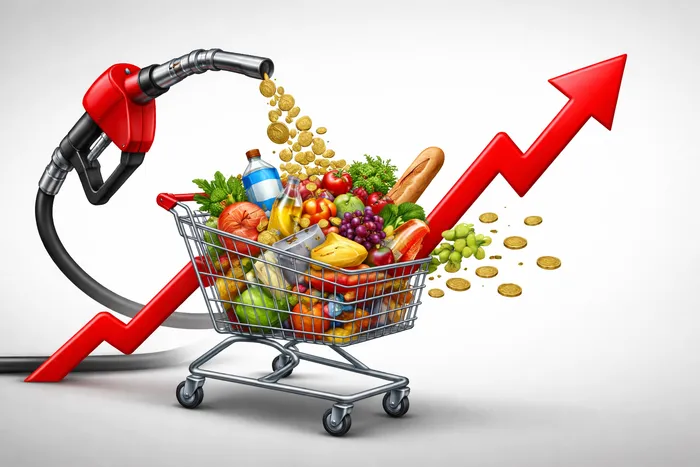
Higher inflation could see interest rate hikes by mid-year.
Image: ChatGPT
South Africans, already facing the burden of rising fuel, food and energy cost are bracing for yet more bad news.
Interest rates are likely to rise by 0.25 percentage points by mid-year, a move that could happen as soon as May.
Yet, the central bank’s latest repo rate forecast still points to a 0.25 percentage point cut by the end of 2026, suggesting a near-term hike could be followed by easing later in the year, said Annabel Bishop, chief economist at Investec.
The Monetary Policy Committee left the repo rate unchanged last week but materially revised its inflation outlook as fuel price shocks began to filter through the economy, raising the risk of second-round effects.
Johann Els, chief economist at PSG, said uncertainty remains high, but risks have shifted. He said the milder scenario assumes one 25 basis point rate hike.
As it stands, and assuming there is no last-minute government intervention, month-end data from the Central Energy Fund is pointing to petrol price increases of between R5.31 for 93 Unleaded and R5.82 for 95 Unleaded.
Diesel looks set to increase by between R10.13 in the case of 500ppm and R10.27 for the cleaner 50ppm.
These increases are expected to feed through into food prices and broader consumer inflation, as diesel-intensive supply chains pass higher costs on to consumers.
Trading Economics said earlier today Brent oil started the week about 3% higher, trading above $115, and remaining at its highest level since July 2022 when Russia’s invasion of Ukraine disrupted energy markets.
“Businesses’ margins will not be able to absorb these fuel price increases, and the pass through to consumers is expected to occur quite soon, with some second-round effects potentially apparent in April’s consumer price inflation index, but certainly from May onwards,” said Bishop.
Governor Lesetja Kganyago said the central bank is closely monitoring second-round effects, noting that while supply-side shocks are typically looked through, persistent inflationary pressures may require policy tightening.
In the first, the conflict continues for about two months, with oil prices averaging close to $100 a barrel and the rand weakening by around 5% against the dollar. In this case, inflation rises above 4%, requiring one additional interest rate increase this year before inflation returns to the 3% target by 2027.
In a more severe scenario, the war lasts for over a year, with oil prices remaining above $100 a barrel and the rand about 10% weaker. Under these conditions, inflation exceeds 5%, and several interest rate increases would be required before inflation returns to target by 2028, Kganyago said.
Markets have already begun to reflect this shift, with the rand weakening in recent weeks and oil prices climbing to multi-year highs, adding to inflationary pressure.
Trading Economics said today that the exchange rate rose to R17.1802, 2026, up 0.48% from the previous session.
“Over the past month, the South African rand has weakened 6.78%, but it's up by 6.14% over the last 12 months,” it said.
Bishop said monetary policy conservatism has allowed for a more robust environment better able to withstand shocks, as has the improvement in South Africa’s investor climate over the last eighteen months too.
Both the rand and the bond market have seen a less severe impact from the Middle East war than would have occurred if South Africa was still in the same investor climate of early 2024 or prior to that, while monetary policy is already restrictive.
“Crucially, the governor did mention a couple of times how difficult it is under these circumstances to change forecasts. We have to wait and see and that's exactly my position as well,” said Els.
IOL BUSINESS