

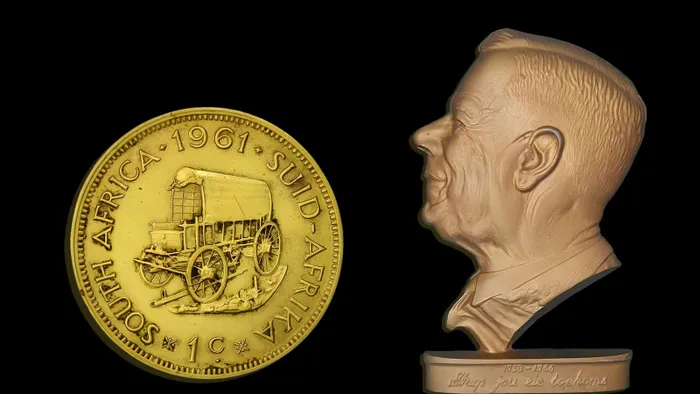
A rare 1961 one-cent coin linked to former prime minister Hendrik Verwoerd is set to go under the hammer.
Image: Graphic: Nicola Mawson
Some of the world’s most valuable coins are worth millions. Not because of what they are made of, but because of how rare they are and the stories behind them.
While the world’s most valuable coins tend to be centuries old and linked to major global events, closer to home, even relatively ordinary coins can carry significant value under the right circumstances.
A rare 1961 one-cent coin linked to former prime minister Hendrik Verwoerd is set to go under the hammer, alongside a gold R1 coin personally struck by him, highlighting growing interest in South African numismatics.
According to Bassani Auction House, the coins are expected to attract strong interest from both local and international collectors, reflecting how provenance and historical association can significantly increase a coin’s value.
What makes the example notable is that the 1961 one-cent coin itself is not inherently rare. Standard versions of the coin were widely circulated as part of South Africa’s first decimal currency system introduced in 1961, meaning most examples are worth very little today.
The coin under auction, the 1c Full Ground variety, is believed to have been specially struck for select members of parliament and prominent figures at the time. With a rumoured mintage of just 80 coins, only around 20 examples are believed to exist today.
Accompanied by an official South African Mint letter, the 1c coin is confirmed as the 5th coin ever minted in 1961. At the same time, its link to a key historical figure and moment, South Africa’s transition to a republic, transforms it from a low-value circulation coin into a collectible item.
The South African market also reflects a distinction between collectible value and underlying metal value. Gold is currently trading at $4,526 – well off its all-time high of almost $6,000 per ounce at the end of January, and this is reflected in the price of Krugerrands.
As of late April 2026, a one-ounce Krugerrand is valued at approximately R81,000 to R83,500, fluctuating in line with the daily gold price. Silver versions of the coin trade at significantly lower levels, with a one-ounce silver Krugerrand priced at around R1,600 to R2,250.
Fractional gold coins, including half-ounce, quarter-ounce and tenth-ounce Krugerrands, are priced proportionally based on their gold content. Unlike rare collectible coins, these values are primarily driven by global commodity prices rather than scarcity or historical association.
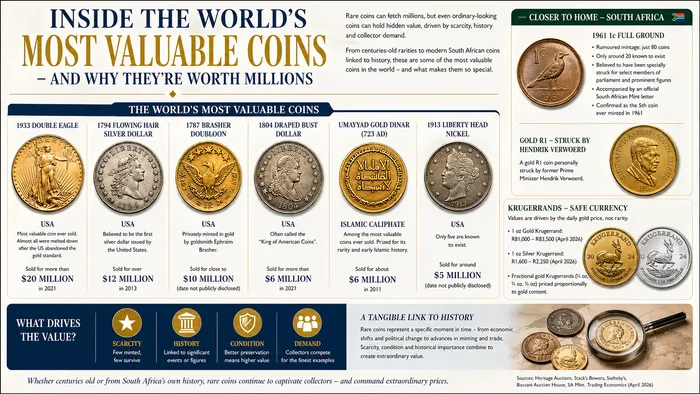
Inside the world's most valuable coins.
Image: ChatGPT
Internationally, there are many other examples of rare and valuable coins. At the top of the list is the 1933 Double Eagle, a United States gold coin that sold for more than $20 million at auction in 2021, making it the most valuable coin ever sold.
Although over 400,000 of these coins were originally minted, almost all were melted down after the US abandoned the gold standard during the Great Depression. Only a handful are known to exist today.
Another standout is the 1794 Flowing Hair Silver Dollar, widely believed to be the first silver dollar issued by the United States. One example sold for over $12 million in 2013, reflecting both its rarity and its historical significance.
Coins linked to early American history feature prominently among the most valuable.
The 1787 Brasher Doubloon, a gold coin privately minted by goldsmith Ephraim Brasher, has fetched close to $10 million at auction, while the 1804 Draped Bust Dollar – often referred to as the “King of American Coins” – sold for more than $6 million five years ago.
Rarity is not limited to the United States.
An Umayyad gold dinar dating back to 723 AD is among the most valuable coins ever sold, reaching about $6 million in 2011. The coin is prized not only for its scarcity, but also for its connection to early Islamic history.
In some cases, coins are valuable precisely because they were never meant to exist.
The 1913 Liberty Head Nickel is one such example. Only five are known to exist, and one has sold for around $5 million.
Across all of these coins, a common theme emerges.
Collectors place value on a combination of scarcity, condition and historical importance. Coins that were produced in limited numbers, withdrawn from circulation, or linked to significant events tend to command the highest prices.
Condition also plays a critical role, with even small differences in preservation having a significant impact on value.
Rare coins represent a tangible link to history, with each piece reflecting a specific moment in time – from economic shifts and political change to advances in minting and trade.
IOL BUSINESS