

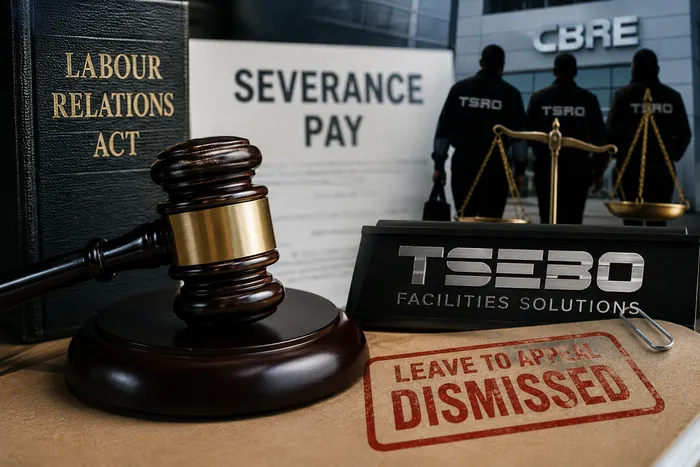
A Labour Court has found that retrenched workers are entitled to severance pay.
Image: ChatGPT
Tsebo Facilities Solutions has failed in its bid to overturn a Labour Court ruling ordering it to pay severance packages to former workers, after the court found its arguments could not overcome a flaw in the timeline of events.
Acting Judge C de Kock dismissed Tsebo Facilities Solutions’ application for leave to appeal, finding there was no realistic prospect another court would reach a different conclusion.
Tsebo Facilities Solutions is a unit of Tsebo Solutions Group, which was recognised as a Top Employer, receiving certification for 2024 and also securing a place among the top 20 companies to work for in South Africa.
The facilities unit provides integrated workplace management, including hard services (engineering, maintenance), soft services (cleaning, hygiene, security), and energy/water management.
Its request for appeal was to a bid to overturn an order directing Tsebo Facilities Solutions to pay severance pay to each of the three individual applicants after Tsebo Facilities Solutions lost a contract and 27 people were retrenched.
The Judge was interrogating whether Tsebo Facilities Solutions had “caused” or arranged alternative employment for workers who moved to CBRE Excellerate.
Tsebo Facilities Solutions argued that because it had played what it called an “instrumental role” in securing alternative employment, the workers were not entitled to severance pay under the Basic Conditions of Employment Act.
But the court found the chronology destroyed that argument.
According to the judgment, two of the employees had already received formal written job offers from CBRE on 28 February 2020, more than two months before Tsebo Facilities Solutions’ Alternative Employment Agreement was signed on 3 May 2020 and before retrenchment notices were issued.
A third employee had responded directly to a CBRE hiring notice and was interviewed before the agreement formally came into existence.
“The employment outcomes preceded the formal arrangement that Tsebo Facilities Solutions relies upon as constituting its instrumental role,” the court found.
Tsebo Facilities Solutions also argued that the Labour Court had improperly acted like an appeal court rather than conducting a review. But De Kock rejected that argument, finding the original commissioner’s conclusions were internally contradictory and irrational when measured against the evidence.
“Where a decision-maker’s own factual narrative is irreconcilable with the conclusion drawn from it, the conclusion is not rationally connected to the evidence,” the judge said.
The company further claimed the workers engaged in “secretive and opportunistic conduct” by accepting CBRE employment without disclosing it. The court dismissed that argument as irrelevant to the legal test.
“The employees’ subjective motivation in accepting independently obtained employment does not transmute that employment into employment arranged by the employer,” the ruling said.
The judgment also noted that 27 employees covered by the agreement were ultimately retrenched, undermining Tsebo Facilities Solutions’ argument that the arrangement guaranteed employment.
De Kock further warned against allowing labour disputes to endlessly cycle through the courts, citing earlier Labour Appeal Court authority cautioning that fact-based labour disputes should ordinarily end in the Labour Court rather than “reappear continuously in courts on appeal after appeal”.
While Tsebo Facilities Solutions argued that around 35 similar arbitration matters had been stayed pending the outcome of the case, the court found that did not amount to a compelling reason to grant leave to appeal.
IOL BUSINESS