


South Africans can, but don't, speak to their bank about lower interest rates.
Image: ChatGPT
South Africans collectively owe more than R2.3 trillion to banks and other lenders through home loans, vehicle finance, credit cards and other debt facilities.
Yet many consumers never ask for lower interest rates, even after years of making repayments on time. That may be costing them far more than they realise.
According to the South African Reserve Bank, household debt remains at about 62% of disposable income, while consumers are spending close to 9% of their disposable income servicing debt. Mortgage debt remains the single biggest component of household borrowing.
While many consumers assume interest rates are fixed once a loan agreement is signed, banks regularly reassess customer risk internally and borrowers with stronger financial profiles can sometimes negotiate lower rates, particularly on home loans.
The catch is that most people simply never ask. And it's important to do so now because many economists anticipate at least a 0.25 percentage point hike come mid-year from the current prime lending rate of 10.25%.
Across South African personal finance forums, consumers who successfully secured lower rates described a common pattern: banks became more flexible when customers presented competing offers from rivals or indicated they were prepared to move their business elsewhere.
One Reddit user on the PersonalFinanceZA forum said they request a “re-rate” from their bank every two years, resulting in repeated reductions to their home loan interest rate. Another described approaching a competing bank for a quote before returning to their existing bank, which then matched the lower rate to retain the customer.
The broader lesson is that banks price risk: not loyalty.
Consumers who are more likely to qualify for better rates typically have:
For bond holders, this can create significant negotiating leverage.
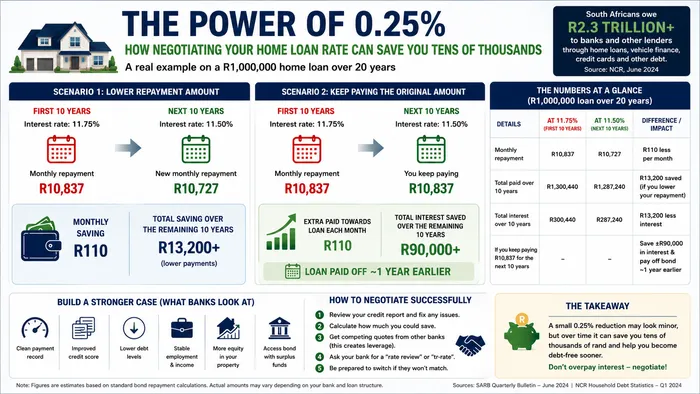
The power of negotiating a better interest rate.
Image: ChatGPT
Banks are also more likely to reconsider pricing where customers have built up surplus funds in access bonds, reduced their outstanding balances faster than required, or can demonstrate that the value of the underlying property has increased materially since the original loan was granted.
The savings from even a small rate reduction can become substantial over time.
On a R1 million home loan over 20 years, a borrower paying an interest rate of 11.75% would currently pay about R10,837 a month. If that borrower successfully negotiates a 0.25 percentage point reduction halfway through the bond term, lowering the rate to 11.5% after 10 years, monthly repayments could fall by about R110, saving more than R13,000 over the remaining decade.
The savings become even more significant if the borrower continues paying the original higher instalment amount, because the excess goes directly towards reducing capital and shortening the loan term.
The same principle increasingly applies to vehicle finance and revolving credit facilities.
Consumers with improved financial positions may qualify for refinancing at lower rates, while banks competing for market share may offer better pricing to attract customers from rivals.
In the case of credit cards and revolving debt, consumers may also gain leverage by threatening balance transfers or consolidating debt elsewhere.
Importantly, though, refinancing is not always automatically beneficial. New initiation fees, legal costs, valuation charges or longer repayment periods can offset the gains from a lower rate.
Still, with household finances under sustained pressure given higher fuel prices and pending inflationary increases, consumers are increasingly looking for ways to reduce monthly costs without dramatically changing their lifestyles.
For many borrowers, renegotiating debt may now be one of the simplest ways to create breathing room. And unlike cutting groceries, cancelling insurance or delaying medical care, asking the bank for a better rate costs nothing.
IOL BUSINESS