

In January 1976, petrol cost just 21.1 cents a litre. By May 2026, that had climbed to R26.52 a litre – an increase of roughly 12,470%.
Image: Statistics South Africa
South Africans filling up inland 93-octane petrol today are paying dramatically more than motorists did 50 years ago.
In January 1976, petrol cost just 21.1 cents a litre. By May 2026, that had climbed to R26.52 a litre – an increase of roughly 12,470%, according to data compiled by Statistics South Africa.
These figures form part of a new Statistics South Africa analysis tracking fuel prices and inflation over the past five decades. “For those wondering about the decimal places in these two amounts – yes, the petrol price was set at fractions of a cent in the old days!” the agency said.
The R1 per litre mark was reached in November 1985 and increased to R5 two decades later. The price then doubled in just three years, breaching the R10 level in 2008, said Statistics South Africa.
“Christmas cheer was dampened in December 2021 when motorists had to pay more than R20 per litre. The price eased from R26.31 in July 2022, only for April and May of 2026 to spoil the party. The new price set in May 2026 is the highest on record for inland 93-octane,” it said.
The report shows South Africa has experienced repeated fuel price shocks linked to international conflict, oil crises and currency weakness, including:
According to Statistics South Africa, the latest fuel increases in April and May 2026 rank among the sharpest increases in recent decades when inflation is considered.
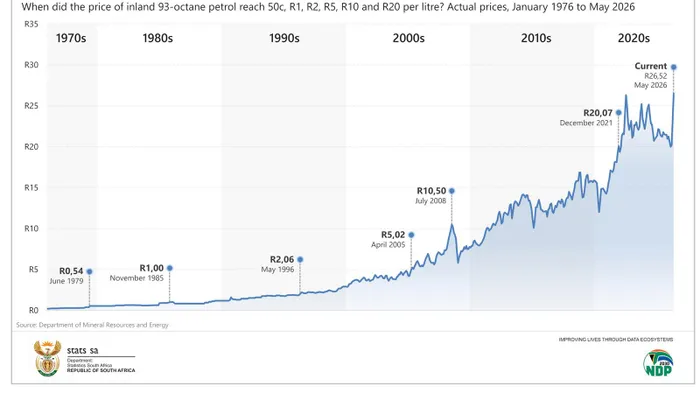
Statistics South Africa details how fuel prices have increased over the past 50 years.
Image: Statistics South Africa
Statistics South Africa noted that fuel price increases tend to spread rapidly through the economy because transport costs affect the price of most goods and services.
Historical reporting cited by Statistics South Africa warned during previous fuel crises that the impact would be “more like a tidal wave than merely ripple effects”. “Hardly a single item will escape the drenching,” another historical quote referenced in the report warned during an earlier fuel shock.
Statistics South Africa said petrol price increases have historically filtered through into:
The latest increases come as South Africa’s road freight sector warns that sharply higher diesel prices are placing operators under growing financial pressure, with concerns this could eventually feed through into retail prices and broader inflation.
The Road Freight Association has already warned that some transport operators may struggle to absorb the latest diesel increases, particularly after successive fuel hikes in recent months.
That matters because South Africa relies heavily on road freight to move food, fuel and consumer goods across the country. Transport costs alone can account for as much as 10% to 15% of the final retail price of food, depending on the product and the distance travelled.
Higher diesel prices are also raising costs across the agricultural chain, including planting, irrigation, harvesting and refrigeration.
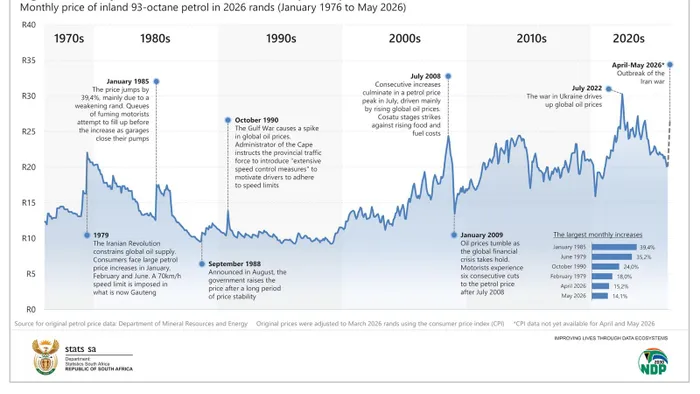
How global events have affected the petrol price.
Image: Statistics South Africa
However, Statistics South Africa says the hikes don’t tell the whole story. “There were also periods when the petrol price declined or remained stable. The reversal in the price after July 2008, for example, is striking,” it says.
Statistics South Africa data shows oil prices rapidly cooled as the global financial crisis took hold. The petrol price tumbled to a low of R5.82 per litre in January 2009 from a peak of R10.50 in July 2008. It would take another two years before the price reached R10 again.
More recently, the price fell from the July 2022 peak of R26.31 to a low of R19.99 per litre in February 2026.
This, it says, “shows that although petrol prices have generally risen, they have also experienced rapid increases and notable downturns”.
IOL BUSINESS