


The 2026 FIFA World Cup may ultimately become less about the ticket price itself and more about the combined cost of geography, exchange rates and the strength of the US dollar.
Image: Graphic: Nicola Mawson | IOL
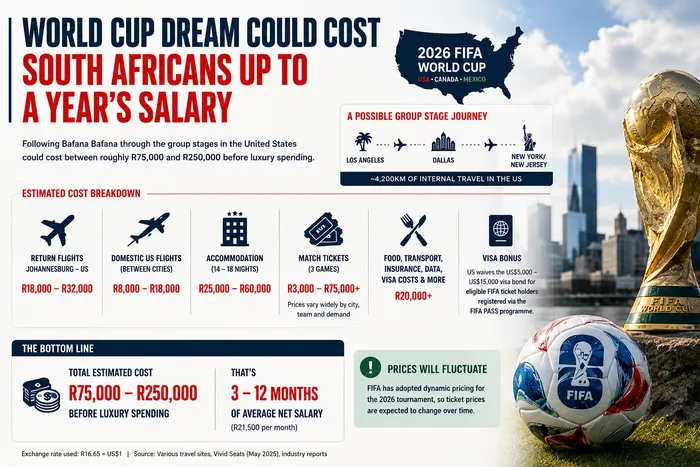
Following Bafana Bafana through the group stages of the 2026 FIFA World Cup in the United States could cost South Africans between roughly R75,000 and R250,000, turning football’s biggest event into a financial stretch that may consume up to a year of average net salary.
At a time when the rand is trading at roughly R16.65 to the dollar and average monthly net salaries sit at about R21,500, even relatively modest travel plans could quickly spiral into six-figure territory once flights, accommodation and internal US travel are included.
The costs become even more severe when measured against South Africa’s median income levels, which various estimates place between R6,000 and R17,000 per month because of the country’s deep income inequality.
The financial pressure comes as global investors have increasingly moved money into the US dollar amid heightened geopolitical tensions involving the US, Israel and Iran, strengthening the dollar against many emerging-market currencies, including the rand.
The geography of the 2026 World Cup is also unlike most previous tournaments.
While the tournament will also be hosted by Canada and Mexico, the United States will host the bulk of the matches across 11 cities, including Los Angeles, Dallas, Seattle, Atlanta, Miami and New York/New Jersey.
That creates a major cost problem for travelling supporters because following a team through the group stages alone could require thousands of kilometres of internal travel across the United States.
A realistic scenario for South African supporters could involve
That itinerary alone would require roughly 4,200km of travel inside the US, excluding flights from South Africa.
Unlike tournaments hosted in geographically compact countries such as Qatar, or those with extensive rail networks linking host cities such as Germany or France, supporters in the US are likely to rely heavily on domestic flights.
That means internal airfare, baggage charges, airport transfers and hotel changes become part of the hidden World Cup cost.
Estimated return flights from Johannesburg to the United States currently range between R18,000 and R32,000, depending on routing and booking windows.
Domestic US flights between host cities could add another R8,000 to R18,000.
Accommodation may become one of the biggest cost drivers.
A supporter staying between 14 and 18 nights across multiple US cities could realistically spend between R25,000 and R60,000 on hotels alone, particularly during peak tournament demand.
Food, local transport, mobile data, travel insurance and visa-related costs could add another R20,000 or more, although some South African travellers may benefit from a temporary US visa concession linked to the tournament.
The US government has waived proposed visa bond requirements of between $5,000 and $15,000 for eligible FIFA World Cup ticketholders registered through FIFA’s PASS opt-in programme, which is intended to help legitimate supporters secure expedited visa interview appointments.
The cost of watching the beautiful game.
Image: CharGPT
Match tickets themselves may not be the single biggest expense, although pricing is already pointing to a substantial financial burden for international supporters.
Ticket prices vary sharply depending on the city, stage and teams involved. Secondary marketplace listings currently show some group-stage tickets starting at roughly $60 to $160, while many resale prices are already running above US$800 and, in some cases, above $2,000.
At current exchange rates, three entry-level match tickets could cost as little as roughly R3,000 to R8,000 before fees and taxes, while more realistic mid-tier resale pricing could push three tickets beyond R40,000.
Premium hospitality pricing is even higher.
FIFA hospitality packages are already starting above $6,000 - or nearly R100,000 at current exchange rates - before broader travel costs are added.
Official and semi-official travel packages are also reflecting the scale of the expense.
One South African-linked “Follow South Africa” package currently advertised for the group stages is priced above R200,000 per person sharing, excluding some flights and additional spending costs.
Restaurant prices and America’s service tipping culture are also likely to significantly increase daily costs for South African travellers accustomed to spending in rand.
Even relatively ordinary daily spending of between $40 and $80 on meals, drinks and incidental expenses translates to roughly R660 to R1,330 a day at current exchange rates.
Over a two-week stay, that alone could add between R9,000 and R18,000 to the overall trip cost.
The scale of the tournament also means supporters hoping to follow South Africa beyond the group stages could face sharply higher costs if the team progresses.
The knockout rounds stretch into mid-July, potentially turning a two-week football trip into a month-long stay involving additional flights, accommodation and much more expensive match tickets.
For many South Africans, the 2026 FIFA World Cup may ultimately become less about the ticket price itself and more about the combined cost of geography, exchange rates and the strength of the US dollar.